








Ajay || Building Flozi retweeted

Ever seen a page use a keyword 23 times and get zero AI citations?
We audited one. "best CRM for small business" in the title, H1, meta, alt text, and body. Textbook SEO.
The page ChatGPT, Perplexity, and Google AI Overview all cited that phrase 3 times. But it covered pricing,
integrations, migration from spreadsheets, implementation time, and use cases by team size.
AI doesn't match your phrase to the query. It builds a map of the topic and checks if your page covers it.
Takeaway: stop asking "what keywords do we target?" Ask "what topic do we need to own, and how completely do we cover it?"
Ajay || Building Flozi retweeted
I gave Opus 5.5 and Sonnet 5.5 the same job: “Search Console growth has stalled for this site, help me debug it.” Same data access, same repo.
Both found the real story. Growth hadn’t stalled; the main site had lost ~70% of its clicks since its peak, and a subdomain’s traffic was hiding it in the totals. Both linked the drops to this year’s core updates and found the same losing pages.
The difference was in how they worked:
→ Opus went wide without being asked. It checked brand-search demand, found money keywords ranking ~#5 with zero clicks, cross-checked GA4, and looked through the repo history for site changes.
→ Sonnet went careful. It tracked a fixed set of pages to prove the drop was a real ranking loss, not a mix shift, and flagged that “lines up with a core update” is timing, not proof.
→ Opus occasionally stated a guess as a finding. Sonnet never did.
My takeaway: for open-ended “something’s wrong, find it” analysis, I’d start with Opus, because it decides what to investigate next on its own. But I’d still verify its causal claims, or have a second pass check them.
One run each, so treat this as an observation, not a benchmark.
Ajay || Building Flozi retweeted
I keep seeing SaaS teams approach AEO like SEO. Add schema. Rewrite metadata. Make pages “AI-friendly.”
I don't think that's the core problem. After digging into what actually helps SaaS products get named in ChatGPT, Perplexity, and AI Overviews, I think 3 signals matter most:
1) Retrievability: can AI find and extract a clear answer from your site?
2) Authority: does AI have enough confidence to associate that answer with your brand?
3) Third-party presence: are you mentioned in the sources AI already trusts?
The easiest way to diagnose this: Take 20 questions your buyers would actually ask AI.
“Best X for Y”
“X alternatives”
“X vs Y”
“Is X good for Z?”
Run them without mentioning your brand.
Then check:
→ Not appearing at all = retrieval problem
→ In the sources but not the answer = attribution problem
→ Mentioned but described vaguely = positioning problem
→ Competitors everywhere = third-party presence problem
That changes how you should think about AEO. You're not just optimizing a webpage.
You're trying to become a product that AI can find, understand, trust, and confidently recommend.
I wrote 12 practical SaaS AEO hacks based on this framework.
Link in the comments.

Ajay || Building Flozi retweeted
I was alwasy skeptic the way schema has been sold for AI search, so I read some research on this, and the top findings are:
1) AI-cited pages are nearly 3x more likely to have schema (correlation only).
2) Adding schema to 1,885 pages showed no meaningful AI citation boost (Ahrefs).
3) Results: AI Overviews –4.6%, AI Mode +2.4%, ChatGPT +2.2% (mostly noise).
4) AI systems ignore JSON-LD and mainly read visible HTML.
5) High schema coverage does not improve LLM visibility (Search Atlas).
6) Google confirms structured data is not a ranking factor or required for AI features.
7) Stronger signals: backlinks, authority, content depth, freshness, and E-E-A-T.
8) Schema still helps rich results, but not AI citations.
adding article link in comments
Now the website needs to be ready for both humans and agents but for agents it's also very important to be interact with because they will also are potential users.

I have seen many tools talking about whether a website is ready for AI, and all they do is check if content is available without JavaScript, but now agents are actively interacting, like submitting forms, navigating through pages, so agentic interaction readiness is more important than AI readiness.
Google launched WebMCP, which helps you test the exact thing. I tested Flozi today and wrote a simple guide on how to test any @webflow website from setup to testing.
(link in the comments)

Ajay || Building Flozi retweeted
The Technical and user-level differences between Traditional Search vs AI search
- Traditional Search: Type in a search box, get results, visit websites, focus on one-shot search.
- AI Search: Ask questions; AI visits websites and gets the answers, focused on conversation.
If you notice the last ones, what is changing is that products like Google AI Mode and ChatGPT are serving it.
So traditional search is dying then?
No, AI search requires websites to provide answers, and those websites are indexed by search engines like Google and Bing, so what has changed is how users now consume information: conversation rather than traditional search, and getting indexed on Google is still valuable.
Ajay || Building Flozi retweeted
For agencies, the base model of retention has changed primarily
- The cost to produce any asset (website, designs) has reduced
- Now systems dictate the output
If you want to retain a client, don't just offer them a website; include growth because it's the impact of your work on their business that matters more now.
Ajay || Building Flozi retweeted
I keep auditing the website, as I did for 69, and now compare it to previous audits; every website passed the crawlability check, but they are still lacking in
- AI Access: 88%
- Answer Readiness: 27%
- Schema: 24%
- Query Alignment: 20%
The problem isn't whether AI can access your site.
It's whether your content answers what buyers actually ask.

Ajay || Building Flozi retweeted
Touchpoints are the next funnels because they let you understand the user behaviour, and the difference is that they are outside your website, unlike funnels.
Touchpoints are new funnels because they define the buyer's decision in AI Search (AEO). Here is an example to understand them and how to find them for your website:
Let's say the buyer needs a Dubai website partner. One line to the AI: "Help me find some agencies."
1) Touchpoint 1: The ask itself
No budget, no priority stated. The AI filled the gap with assumptions.
2) Touchpoint 2: The shortlist
Six agencies scored, two chosen to go deeper on. A judgment call, made silently, that shaped everything after.
3) Touchpoint 3: The evidence
Team size, case studies, growth numbers, all pulled from the agencies' own websites. Nobody had called a single reference yet.
4) Touchpoint 4: The conflict of interest
One agency's "AI visibility" pitch relied on a tool they co-built themselves. Flagged in a footnote. Never resolved.
5) Touchpoint 5: The money
Two options, 5-10x apart in price. No budget was ever named to weigh against them.
6) Touchpoint 6: The ending
"Want me to dig deeper?" But the conversation ended with asking for reach-out details for both.
Note: There could be infinite conversations and touchpoints, and the goal isn't to find them all, just ideal ones.
Defining touch points offers a better way to be focused and make decisions for the website growth.
Touchpoints are new funnels because they define the buyer's decision in AI Search (AEO). Here is an example to understand them and how to find them for your website:
Let's say the buyer needs a Dubai website partner. One line to the AI: "Help me find some agencies."
1) Touchpoint 1: The ask itself
No budget, no priority stated. The AI filled the gap with assumptions.
2) Touchpoint 2: The shortlist
Six agencies scored, two chosen to go deeper on. A judgment call, made silently, that shaped everything after.
3) Touchpoint 3: The evidence
Team size, case studies, growth numbers, all pulled from the agencies' own websites. Nobody had called a single reference yet.
4) Touchpoint 4: The conflict of interest
One agency's "AI visibility" pitch relied on a tool they co-built themselves. Flagged in a footnote. Never resolved.
5) Touchpoint 5: The money
Two options, 5-10x apart in price. No budget was ever named to weigh against them.
6) Touchpoint 6: The ending
"Want me to dig deeper?" But the conversation ended with asking for reach-out details for both.
Note: There could be infinite conversations and touchpoints, and the goal isn't to find them all, just ideal ones.
Ajay || Building Flozi retweeted
Map the important conversations: Conversation is the shift in AEO, but unlike SEO, how to optimize content for them? Because there could be any number of them.
Don't try to cover all the conversations. Here is how to start:
- Start with the most basic questions, e.g., “My website is not coming to AI; what should I do?”
- Then take this to 5-7 questions and answers
- Now look back and find touchpoints
- The Problem you started with
- The comparison constraints you gave
- The way it’s treated the questions (will understand models)
- Who showed up and what was the source
-Anything else you discussed
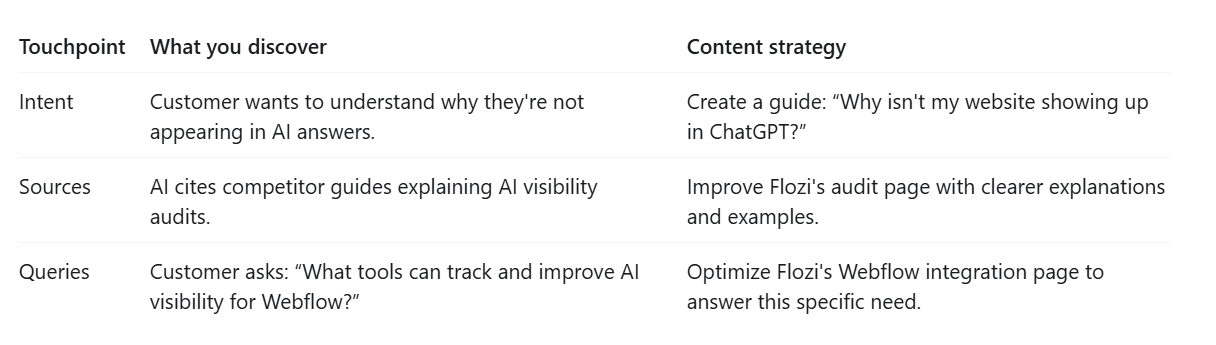
- Once you have the touchpoints, analyze them for intent, sources & query, and then build your strategy.
Do this with the AI model you think your customers are using. Models are very important because they are the ones that analyze the fetched data. Don’t use old models.
AEO workflow 101:
The workflow starts to look less like keyword optimization and more like conversation design.
1). Define the ICP: Identify the buyer, their problems, constraints, alternatives, and decision criteria.
2). Map the important conversations: Identify the few recurring conversation paths that matter most.
3). Define the touchpoints: For each conversation, identify the moments where being present could influence the decision.
4). Map evidence: Determine which pages, sources, discussions, reviews, and other references should support each touchpoint.
5). Replay: Run a bounded set of realistic conversations repeatedly.
6). Find the gaps: Look for touchpoints where competitors or third-party sources are being used instead.
7). Improve the evidence: Create or improve the pages and external signals needed to support those moments.
8). Measure coverage over time: Track whether the brand increasingly appears across the important parts of the conversation.

Ajay || Building Flozi retweeted
How to build ICP in AEO:
Many in AEO work still start with queries.
Find longer, more conversational queries, create pages around them, and track whether the brand appears.
But the query is only one expression of the underlying conversation. If you start with queries, you can easily end up doing keyword optimization with longer keywords.
Start with the ICP and map the decision context around it:
Buyer × Problem × Constraints × Alternatives × Decision Criteria
Understand the specific buyer and the situation they're in, then identify the conversations that naturally come from that context.
This gives you something much more useful than a list of keywords. It gives you a map of the conversations where your brand needs to be relevant.
AEO isn't just about tracking queries, of you really wanna get good at it, first understand it, get your hands dirty.
AEO workflow 101:
The workflow starts to look less like keyword optimization and more like conversation design.
1). Define the ICP: Identify the buyer, their problems, constraints, alternatives, and decision criteria.
2). Map the important conversations: Identify the few recurring conversation paths that matter most.
3). Define the touchpoints: For each conversation, identify the moments where being present could influence the decision.
4). Map evidence: Determine which pages, sources, discussions, reviews, and other references should support each touchpoint.
5). Replay: Run a bounded set of realistic conversations repeatedly.
6). Find the gaps: Look for touchpoints where competitors or third-party sources are being used instead.
7). Improve the evidence: Create or improve the pages and external signals needed to support those moments.
8). Measure coverage over time: Track whether the brand increasingly appears across the important parts of the conversation.
The shift is single Search and then site exploration to conversation and what I see people doing is still binary whether we are coming for a keyword or query or not.
SEO Vs AEO: When people talk about them, it's blue links vs. AI search, but the fundamental change very few talk about, and how you should think about AEO:
The fundamental shift:
What AI tools (ChatGPT, Google AI Mode, and others) have changed is enabling the ability to do conversions.
What needs to change in workflow?
Old workflow: GSC → queries → optimize pages
New Workflow: Conversations → intents → touchpoints → content → visibility

The leads from AI are the most nourished ones because they have already looked everything at AI about product.
So I would also add it's not just traffic but quality of it too.
AI Search as a distribution channel for saas?
It offers the cheapest and most reliable distribution of any out there, but starting it and having patience are the challenges.
If you are running a Saas and looking to start AI Search, then give a look at this:
linkedin.com/pulse/aeo-saas-…

Ajay || Building Flozi retweeted
If you're struggling with content growth, then try the Flozi editor
It helps:
(1): Identify queries the article should have
(2): Helps evaluate accuracy, originality, & authority
(3): Write in Canvas and publish to Webflow directly
It handles indexing and helps you optimize later based on performance.
linkedin.com/feed/update/urn…

Once you know which ones to prioritise is simple the hard part is finding those actions in pages.
This system works and better than mine it saves decision time.
I use claude to find data and review and then decide.
SEO/AEO isn't always about writing new content every week; leveraging what already exists on the website should be the first action.
(1): New content takes 4-6 weeks to collect data about how search engines are treating it.
(2): Existing content already has data which can be leveraged.
We did it for Neue World in a very systematic way, which is replicable for any website with GSC available.
linkedin.com/pulse/61-our-un…

Ajay || Building Flozi retweeted
What's the quickest way to rank in AEO?
- List queries for the website.
- Open ChatGPT, Claude, or your preferred AI tool
- Search them one by one and for each notice:
- If someone strong (domain/answering it fully) is coming, skip it.
- If AI has to construct the answer from multiple sources, then that's your chance; add the answer properly.
If it's this easy, then why do so many companies struggle? It's because of what they want to rank for. Usually, it's very competitive: what users are asking and ranking for requires beating the competition, and that's where all the AEO ranking game is.