

Freshwater ecosystem ecologist and biogeochemist. Assistant professor in the UNC Department of Geography. She/her. Black lives matter. [email protected]
- Tweets941
- Following338
- Followers774
- Likes2.2K



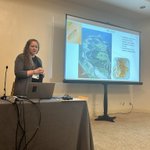


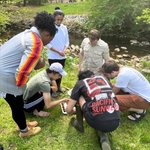


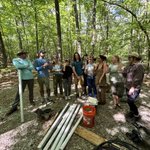


ALT 2024 Water Institute Dissertation Awards Recipients Dr. Looby and Dr. Shin.


ALT 9 panel plot showing how estimates of GPP (upper row), ER (middle row), and NEP (bottom row) differ between rates estimated from DIC (x axis) or DO (y axis) across three river sites. GPP and ER from DO is higher than that from DIC at most sites, with PQs ranging from 1.45-1.95 and RQs ranging from 0.8-1.5.

ALT Fig 1: "A conceptual diagram showing biogeochemical cycling of CO2 and DO (O2) in alkaline rivers. CO2 is one of the components in the total DIC pool, while HCO3- accounts for the majority under most conditions. Due to the DIC speciation, CO2 saturation gradient and air–water fluxes are less than those of DO. DIC is used to accurately compute carbon mass balances. In the simplest possible scenario, ecosystem-level photosynthetic and respiration quotients (PQE and RQE) stoichiometrically link changes in DIC and DO. Aqueous CO2 and its hydrated form H2CO3 are not differentiated, and are combined as CO2. Bubbles in the figure only represent the relative magnitude of gas flux and do not indicate the formation of bubbles. DIC, dissolved inorganic carbon; DO, dissolved oxygen."

ALT Three panels illustrating the relationship between NEP (x axis) and CO2 emissions (y axis) for three sites and DO versus DIC metabolism models. CO2 emissions are higher when NEP is lower for all three sites when using the DIC model; there is only a relationship between NEP and CO2 for the DO at one of three sites.

ALT Conceptual diagram showing our funded research plan, from ecosystem ecology to population and organismal ecology, focused on understanding the influence of climate change and deforestation on reach/microhabitat biogeochemistry, hellbender population density and age structure, and individual hellbender fitness and behavior (parental self-care vs. self-maintenance, cannibalism). Images show reach-scale river microhabitats that support fish, mussels, and hellbenders with dissolved oxygen sensors deployed at the stream bottom and within the water column; different ages of hellbenders in a population; different life stages of hellbenders; and predictive plots for how dissolved oxygen will vary over space and time due to respiration, declines in population density and increasing % of old adults with cannibalism, the trade-off between self-maintenance and parental care with changes in dissolved oxygen due to predicted increases in cannibalism with decreasing oxygen levels.


