
Tinkering with AI | SaaS & Digital Transformation Leader | AI, MACH, Composable CX | Fortune 1000 Advisor | Speaker | Netlify • Altudo • EPAM • VML
Atlanta, GA
Joined October 2014
- Tweets1.3K
- Following190
- Followers262
- Likes1.8K







Have you seen super successful executives, with tons of achievements, always dropping their experience in every aspect of every conversation, even finding ways to bring up experience unrelated to the agenda? Marketing yourself isn’t wrong but talk is cheap, show me the work.
At what point do we stop calling it AI Slop and start calling it Human Slop?
Low quality, half baked artifacts, lacking structure and depth, generated as a result of quick and shallow-prompting.
Deliberate and deep-prompting by domain experts truly unlocks the value from AI.
Is professional experience (human experience) the only real moat now?
What can’t be replicated in tech?
Do researchers and consultancies have a stronger moat with tried and tested proprietary frameworks and execution models?
What does it really mean when you say "I don't look at the code anymore"?
A - Checking diffs but not reading code?
B - Not checking diffs at all but reading agent output?
C - Not looking at agent output at all?
1/
Reality makes more sense through AI. Compute is now measured in megawatts because intelligence is fundamentally energy conversion. Humans transformed energy into civilization through biological intelligence. AI may simply be the next substrate for that same process.
Varun Nehra retweeted

in the last two weeks i've been on calls with teams from
scaled startups
growth-stage AI companies
fortune 100s
every one of them brought up the same problem unprompted
agent memory
so i wrote about the 5 stages of agent memory, and why memory is becoming the moat:
This quoted post is unavailable.
Application error. A client side exception has occurred... it happens but not good.
@OpenAI
to acquire Tomoro AI, an applied AI consulting and engineering firm, to strengthen its enterprise AI deployment capabilities.

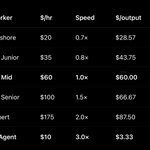
Revenue per employee. Profit per employee.

Jane Street made ~$40B in 2025 with 3,500 employees, a ~2x from the year before.
At ~65-70% profit margin, that's $8M profit / employee, the highest for a 1000+ ppl company. High-frequency trading continues to be the most efficient money making engine.
I want to share an old story about my Jane Street interview in 2014. Jane Street was known for hiring a lot of math, physics and CS olympiad winners from top universities and putting them through many rounds - including, for trading roles, a gauntlet of mental math. It was my 6th interview and my final round and I recall being asked "What is the next day after today in DD/MM/YYYY where all the digits are unique?" They'd toy with you and say "You can use a pencil and paper, if you want" but you knew that was an instant no. Painstakingly and as quickly as I could, I came to an answer. "How confident are you that this is correct on a 0-1 probability scale?" the interviewer said. "0.95", I blurted out, not fully knowing how to answer that. "Are you sure?" After thinking harder for a few more seconds, I realized I could've flipped the digits around to get a closer date. I gave the interviewer my answer. It was correct. "0.95 huh?" he chuckled. That's when I knew I failed.
Note: fwiw, other companies that come close in efficiency are
- Tether ($90M+ profit/emp)
- Hyperliquid ($80M+ profit/emp)
and on revenue:
- Valve ($50M/emp)
- OnlyFans ($37M/emp)
- Craigslist ($14M/emp)
- Anthropic ($12M/emp, run rate)
- OpenAI ($8M/emp, run rate)
For comparison, Nvidia is very efficient at scale and is $4.4M/emp.

Varun Nehra retweeted

Inviting users shouldn’t just add people…
It should set up your team correctly.
In Kriyastream:
•Invite users (platform vs team)
•Validate existing users
•Auto-create team structure
All in a simple 3-step onboarding flow.
Full walkthrough 👇
youtube.com/watch?v=1Nk5beD6…
Varun Nehra retweeted
How do you plan a project no one on your team has done before?
Most teams guess.
Better approach with AI:
→ Generate task chains
→ Estimate duration
→ Turn it into a reusable template
Don’t outsource planning to experts. DYI it!
youtu.be/0zRg_X2zDsA
The simplest way to measure AI ROI?
Not growth. Not churn.
Revenue per employee.
We've chased this software services metric for ever and it's finally getting a step-function boost.
Here is an ultimate example:
forbes.com/sites/josipamajic…


Varun Nehra retweeted
Every time you build a feature… you’re losing something valuable.
Not the code.
The process.
What if you could turn every implementation into a reusable project plan?
Stop rebuilding. Start compounding.
youtu.be/uLYl3g4Ri-M
Varun Nehra retweeted
A proposal is not a project plan.
But most teams treat it like one.
We used AI to break a proposal into a real, structured plan you can actually evaluate.
This changes how projects get approved 👇
youtu.be/ZkdKstNd_oY?si=izrQ…

Varun Nehra retweeted
Vibe PMing is real.
And it’s breaking teams.
AI lets you go from idea → prototype in hours.
But here’s the problem:
No one knows how it was built
It can’t be repeated
It doesn’t scale
Speed without structure = chaos.
Read what’s actually missing 👇
kriyastream.com/resources/bl…

Varun Nehra retweeted
We exist for 1 and 4. 2 and 3 are in jeopardy. AI can or will take over security, infra and flashy tech influencer jobs. Now if only @OpenAI hadn’t killed Sora 😐. Or maybe this explains why they killed Sora 😬? Human commentary is cheaper than tokens?


Varun Nehra retweeted
That’s exactly what we are focused on. Defining the input for the Agentic era. The future of work is in how you define it and not necessarily how you execute it.

Code is an output. Nature is healing.
For too long we treated code as input. We glorified it, hand-formatted it, prettified it, obsessed over it.
We built sophisticated GUIs to write it in: IDEs. We syntax-highlit, tree-sat, mini-mapped the code. Keyboard triggers, inline autocompletes, ghost text. “What color scheme is that?”
We stayed up debating the ideal length of APIs and function bodies. Is this API going to look nice enough for another human to read?
We’re now turning our attention to the true inputs. Requirements, specs, feedback, design inspiration. Crucially: production inputs. Our coding agents need to understand how your users are experiencing your application, what errors they’re running into, and turn *that* into code.
We will inevitably glorify code less, as well as coders. The best engineers I’ve worked with always saw code as a means to an end anyway. An output that’s bound to soon be transformed again.
Varun Nehra retweeted
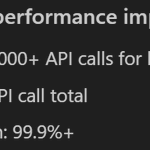
Another good performance improvement
For 100 rows:
Downstream API calls: on the order of 100 × (5–7) ≈ 500–700 requests from that single “load table” action
After refactor: 1 request
So you’re in the ballpark of ~500× fewer HTTP calls for that screen, not a small constant tweak.