

Building PlayerZero, Stanford AI🌲— https://xitter.cf/t.co/pVyfgcOryz
Stanford, CA, Atlanta GA
Joined September 2013
- Tweets315
- Following404
- Followers9.4K
- Likes485


Animesh Koratana retweeted

after switching our approach to building a "FirmOS", I'm increasingly confident that the future of agent collaboration within organizational settings is going to be a "company operating system" or CompanyOS, designed for agent and human collaboration
instead of a "company brain" that holds everything, the OS is for storing rules, processes, decisions made, which tools to use and how. it can mirror some data, but the source of truth is often best held in your existing tools (CRM, etc.). it's continuously updated and used by your agents
i think of this as a "flipped playbook" where instead of writing down the company rules first and following them (which is kind of like waterfall development), you're constantly updating the playbook as you decide or learn new things day-to-day running the business
Animesh Koratana retweeted

The better the harness, the better the business.
Berkeley published a study this week showing harnesses, the systems that control AI agents, set the price of an answer. The right harness cuts the cost of the same result by 71% without a loss of accuracy.
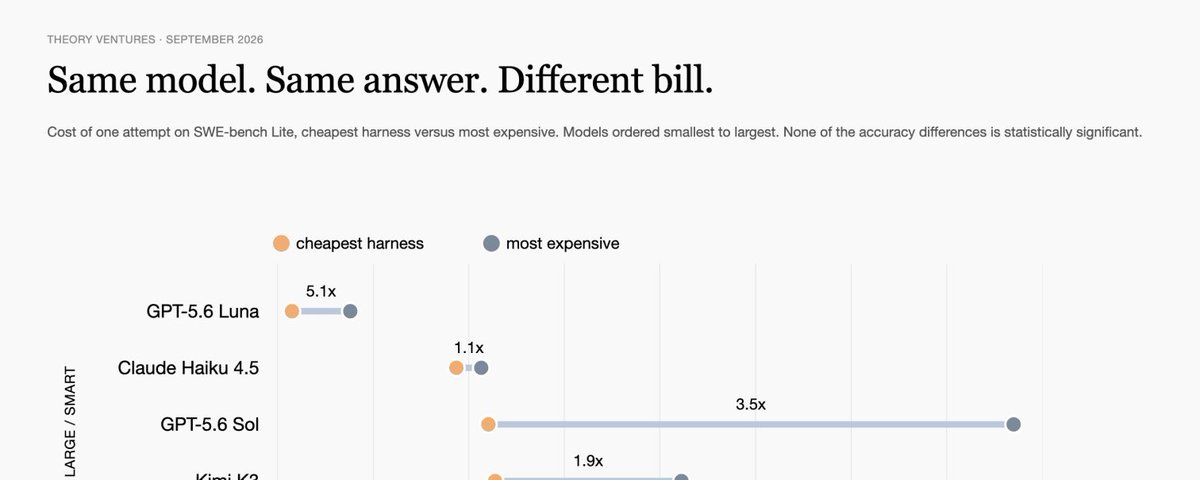
The most intelligent enterprise is not going to chase the “frontier models” blindly for all work. It will be the one that has learned how to need intelligence the least, turning yesterday’s expensive reasoning into tomorrow’s cheaper, more reliable execution.


Animesh Koratana retweeted

the thing that displaces github wont:
have a login with github button
have prs
wont have async ci / an actions like primitive
it will meet teams where they already work
produce an unbelievable amt of confidence in a unit of work
generally be so unlike github
its the end of an era but believe better things are yet to come
People often ask why we're called PlayerZero. A few reasons:
1. Coming up with names is genuinely hard.
2. We imagined a world where work gets done by many players (human and machine) cooperating. As a business, we want to be the orchestration and context behind that work.
But there's something much bigger than any one company happening here. A whole economy is forming: millions of agents, built by thousands of teams, doing real work. And an economy needs a substrate everyone can build on, adapt, and own. Conversely, an infrastructure that only a handful of companies can touch is thinking too small.
Open models are that substrate.
That's why @playerzero_ai signed the Open Weights and American AI Leadership letter alongside @nvidia , @Microsoft, @Meta, and dozens of others. The economy forming on top of open models is going to be bigger than anyone can imagine — and it should belong to everyone building it.
microsoft.com/en-us/corporat…

Animesh Koratana retweeted

-We built a sandbox for agents!
-Oh, cool, so they are blocked from accessing anything outside?
-Well, no, they need to access files, emails, APIs...
-So... you have a sandbox with a literal port open to the internet?
-Well, yeah otherwise the agents would be useless
-I see... But at least they can't write and run arbitrary code, right?
-What, no, of course they can do that, they are agents
-So... your sandbox lets agents write and run code that can literally run anything on internet?
-Yeah
-Let me ask you this: Are the employees in your company running these on their machines?
-Well, they are...
-But...?
-...but with guardrails
-Guardrails?
-Yeah
-Let me guess: The guardrail is a prompt?
-IT'S A VERY NICELY FORMATTED MARKDOWN FILE OK
Salesforce paid about $3.6 billion to get out of the filing business and into the business of doing the work. That tells you which one is worth anything now.
What it bought is @fin_ai (formerly Intercom), a company that answers customer support tickets.
I wrote a while back that Salesforce had turned into a filing cabinet in a world that had stopped needing filing cabinets, and that the only way out was to become the thing that does the work (xitter.cf/akoratana/status/20350…).
This deal is that argument paid out in cash. The unit of value moved from the data to the outcome.
Salesforce knows this, because they ran the experiment on themselves first. Benioff cut around 4,000 of his own support people last fall. He read this faster than almost anyone running a company his size. The question is whether you can buy the work one category at a time, or whether buying is already a step behind building.
Fin gets the work done in one domain: customer support. There are many more categories where the same transition is still coming. Every dollar Salesforce earns still comes from selling seats and this will change soon.
This will play out in many more domains, and we will see a lot more offers like this one.


We’re excited to share that we just signed an agreement for @salesforce to acquire @fin_ai for ~$3.6B. The transaction is expected to close in the fourth quarter of Salesforce’s fiscal year 2027.
Fin started as Intercom 15 years ago. We changed our name to cap our transformation just weeks ago. We were a darling of the SaaS era and invented so many of the patterns you see in software today. Nearly four years ago, in need of a reboot, we jumped on weeks-old modern LLMs to create and define the category we know as Customer Agents today.
Salesforce invented modern software and SaaS. And @benioff is like the final boss of tech founder CEOs. In seat for 27 years, he’s one of the last of his era. Still pushing, pivoting, placing big bets. It’s a privilege for @destraynor and I to get to partner with him and join forces with Salesforce upon close at this most fascinating time. And will be very fun to get their help bringing Fin to magnitudes more consumers.
To our customers: Over the past few years we’ve been shipping intensely. Including recently our groundbreaking model, Apex, and our paradigm-defining internal agent, Operator. With the resources of Salesforce this will only accelerate. And yet little will practically change. I’ll still be CEO, Des will still be running R&D, we’ll both still be committed to continuing to lead this category. Thank you very sincerely and deeply for your belief in us.
To all of our friends, our families, and our employees, past and present: While this is not the end, it is a major, pivotal, special, and emotional moment for us. From the bottom of our hearts, thank you. For everything.
To my cofounders, my exec team: Look what we built. Four young lads with a dream and nothing to lose. And a home grown exec team who pulled off the greatest and arguably only late stage software company pivot to AI, and invented one of the most important categories in AI. Thank you for sticking through all of this with me.
And now, time to get back to work. See you at our next product launch in a couple weeks. (:



This is becoming more true every day

I think that's true if you think of support as a queue. But it isn't... support is the edge where reality challenges operating theory. That’s why it feels messy: it touches product, policy, pricing, data, and people all at once. In that world, “answering tickets” isn’t the job. The job is to change the system so the next ticket never happens. That requires deep context (what actually broke), coordination (who/what to change), and authority (to make the change safely).
I think the market shakes out as:
* Systems of record (Zendesk/Intercom) remain the front door. Chat UIs commoditize.
* LLM answer layers become table-stakes; great for FAQs and knowledge deployment
* The durable value accrues in a Context & Change Layer that connects conversations to code, data, and policy; produces provable root cause; and pushes fixes with tunable autonomy and guardrails
Event loops, exploration loops, and sim loops flow into each other in ways that the world hasn’t internalized yet

The tldr.
There are different kinds of "loops" that help agents figure out what they should work on.
1. Event-driven: Systems process sensor data (customer feedback, bug reports, observability etc...) in ways that uncover work that agents need to perform in pursuit of well-defined objectives.
2. Explorers: Agents continuously investigate the search space of possible improvements in ways that reflect company goals, strategy, and taste.
3. Sims: Synthetic users navigate the product to unearth potential issues before customers see them.
👀

I want some kind of LLM workflow tool.
• Ability to manage a set of input files (Markdown or similar), plus other general-purpose context.
• With real-time collaboration. (And maybe some concept of snapshots or VCS integration.)
• And the ability to create/manage a inference workflows and a stored set of prompts.
• Access to general-purpose coding agents (and not just chat models).
• Some concept of compiled outputs/inference results (which ideally can be shared externally).
Many projects have this feeling: "there is all this stuff, which I want to process/compute over in this iterated way, with some build artifacts being important/worth saving." GNU Autotools x Notion or something. Is anyone building this?
What Tom ( @t_blom) is describing is actually a context graph. Every company will need a world model of how it operates.
We have been building something closely related at PlayerZero, an engineering world model for software, and two things become obvious fast.
1) You can't ask people to leave their work and start documenting what they know. It's not a good use of anyone's time, and it's why wikis, knowledge bases, and internal docs all become graveyards within months.
The context graph has to emerge from the exhaust of work already happening. Engineers shipping code, agents solving problems, support teams resolving tickets. The graph accumulates because useful work runs through it.
2) No single person can map how a company actually operates. Someone in engineering can describe their work, someone in support can describe theirs, but the connections across every function, every service boundary, every customer configuration, that's a task no human can do manually. The structure has to be discovered by observing real workflows across the entire organisation.
He is right about the system compounding over time. More work generates more decision traces, richer traces make agents more capable, more capable agents get deployed more broadly. We went from 54% simulation accuracy to 95+% in six months, purely from accumulated context. The compounding is the whole game.

Company Brain
@t_blom
Every company has critical know-how scattered across people's heads, old Slack threads, support tickets, and databases, and AI agents can't operate like that.
We think every company in the world is going to need a new primitive: a living map of how the company works that turns its own artifacts into an executable skills file for AI.
Animesh Koratana retweeted

📣 We just raised our $45M Series B from @TCVTech and @firstharmonic, with participation from @BainCapVC, @firstround, and @AlkeonCapital.
Sales is the most expensive function in most companies — and one of the hardest. Hundreds of accounts, different context, different stakeholders, different dynamics, and a different path to close. No one can do that perfectly. Critical things get missed.
So we gave every account its own AI agent — working 24/7, maintaining full context, progressing it through the funnel, and guiding reps and leaders on what to do next.
The greatest privilege has been building alongside companies like @Samsara @tryramp @ironclad_inc and @attentiveHQ — enterprises with thousands of sellers who are already living in the future.
There are only two unbounded upside problems out there: building and selling. Every company sells. and @useactively is building the system they'll all run on. We’re excited to pull every revenue team into the future we know is inevitable.
Animesh Koratana retweeted

As my partner @JayaGup10 put it, context graphs are having a moment.
We hosted an event with @playerzero_ai last month focused on what it actually takes to make this concept work in production. Where do decision traces get captured? How does that data persist across systems? How do you make it usable inside real workflows?
Thanks to @playerzero_ai and to everyone who joined, as well as the teams from @tonkean, @arizeai, @SkyflowAPI, and @turingcom for pushing the discussion forward.
If you’re a founder actively building in this space, drop us a note! We’d love to chat.


Building context graphs in the enterprise has made this feel very real.
The strategic asset is increasingly the right to participate in the flow of work:
the places where code changes, tickets move, approvals happen, and operational decisions get made.
Once a system is present there consistently, its position tends to deepen
