

Asking questions to understand – not to criticise – others. Student (MSc "Intelligence and Motion"). Long distance runner. Inexperienced coach.
Germany
Joined August 2016
- Tweets2.1K
- Following769
- Followers225
- Likes2.9K



"I often wonder: How much of our training do we do primarily to bolster self-confidence?" @exerscience
Me too. As well as: "How much of our training do we do primarily to make us feel like we're working hard?" Which may be related.

At this week's "Run Long, Run Healthy": possibly the best-ever review of training for elite distance runners. Plus: New views on daily hydration for runners. And faster music for easier running; footstrike & injuries; amazing inspirational runners. More. bit.ly/3umfkwi
2
The eternal search for THE BEST™ workout or intensity distribution (e.g. 80/20, zone 2 training, threshold training, Billat 30/30s, Rønnestad 30/15s) instead of getting better at figuring out what works at a certain point in time for an individual – and why!

What do I mean by "getting stuck in local minima"?
Our brains cling to things that worked for us in the past
However, all methods have their limits in how much performance we can extract from them
The things that made us "good" won't be the same things that make us "great"

1
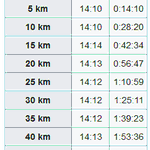
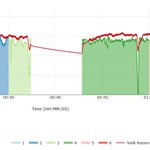
Next round of LT1/VT1/AeT testing via heart rate drift test. Didn't go quite as intended with an unplanned ~10 min stop after 36 min or so. Not sure how "valid" the result is, therefore. Avg pace for time moving is not 5:00/km but rather 4:12/km (see @RunalyzeDE
screenshot).


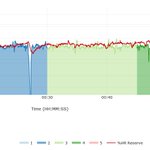
Incidentally did something very similar yesterday, testing how accurate determination of LT1/VT1/AeT via heart rate drift test (see uphillathlete.com/heart-rate…) is. This is what my 60 min run slightly below AeT (~165 bpm) looked like. Will have to do one more at ~170 bpm.


1
Interestingly enough, this is probably right around my current marathon pace – or even a bit faster. But potentially still below or just around LT1.
HR @ LT2/MLSS is somewhere around 185-190, in case anyone's wondering.
1
Incidentally did something very similar yesterday, testing how accurate determination of LT1/VT1/AeT via heart rate drift test (see uphillathlete.com/heart-rate…) is. This is what my 60 min run slightly below AeT (~165 bpm) looked like. Will have to do one more at ~170 bpm.


If 100 % energy comes from "aerobic glycolysis", is the energy supplied 100 % aerobic – as can be read almost everywhere?
Or rather ~9 (or 6) % anaerobic: 3 of ATP from glycogen (or 2 from glucose) of a total of ~33 ATP? Which would make a lot more sense to me.
Alain Güttinger retweeted

On 8th and 9th March 2022 we're holding a free Supporting Champions virtual performance summit?
supportingchampions.co.uk/su…

Is 10k race pace in zone 2 or zone 3 (in a 3 zone model) for runners, assuming it takes them somewhere between 26 and 40 minutes? How much does this depend on the method you use to determine LT2/VT2/MLSS/CS?
2
3
„The essentials are plenty of work, though not an excess of it, a good diet, plenty of sleep and rest, and no alcohol or tobacco. It is not necessary to be over-particular of what one eats providing it is good, nourishing food”
(Mike Murphy, 1914, on successful marathoning)
Interesting to look at the different reactions in the quote tweets of this article: teapawt.net/timeshighered/status/1…
What's your reaction and at what point do you draw your conclusion? Do you read the article on THE? Do you read the original paper (only the abstract or the whole paper)?
Alain Güttinger retweeted

Interesting paper, well worth a read.
When it’s time for the sex talk, words matter | American Journal of Physiology-Heart and Circulatory Physiology journals.physiology.org/doi/…

Alain Güttinger retweeted
Tried to show the difference between zones by HR (top) and pace (bottom) once in a presentation for a class in uni. Missing a lot nuance, only shows up to ~1500 m pace and not taking into account all the factors that influence HR like weather and ignoring cardiovascular drift.

Interesting discussion, although I personally look at the topic of "optimal training intensity distribution (TID)" from another point of view. Some thoughts:
This Post is from an account that no longer exists. Learn more
1
2
The answer will again depend on many factors, not least:
- How often is a certain stimulus needed to maintain a (physical) quality (i.e. what are the "residual effects of training")?
- How often to improve it?
- How often can an athlete train hard with adequate recovery? 5/n
1
1