




Alex Kell retweeted

I’m recruiting PhD students to join the Computational Minds and Machines Lab at the University of Washington in Seattle! Join us to work at the intersection of computational cognitive science and AI with a broad focus on social intelligence. (Please reshare!)

Alex Kell retweeted

We just wrote a primer on how the physics of sound constrains auditory perception:
authors.elsevier.com/a/1jzSR…
Covers sound propagation and object interactions, and touches on their relevance to music and film.
I enjoyed working on this with @vin_agarwal and James Traer.

Alex Kell retweeted

This nicely summarizes some misconceptions in the recent position paper about measures of brain-model comparison.
One additional point: While I agree with the idea in the original paper that we shouldn't *just* focus on regression, many other measures have been proposed! 1/4

1/6 I usually don’t comment on these things, but @RylanSchaeffer et al.'s paper contains enough misconceptions that I thought it might be useful to address them. In short, effective dimensionality is not the whole story for model-brain linear regression, for several reasons: 🧵👇
(1) The spectral theory due to @canatar_a @jenellefeather @s_y_chung is misrepresented in this paper, and crucially relies on model alignment with brain data (this is already evident from their equations). In fact, they conclude that effective dimensionality alone doesn’t fully predict neural data.
(2) Even in this paper’s own Figure 2 (top left panel), networks with low participation ratios, like SRNN, still achieve high neural predictivity, already indicating that participation ratio is not a unilateral predictor of whether a model will match the brain via linear regression.
(3) Beyond MEC, this lack of a trend with effective dim. is also the case when looking at models in their match to macaque IT or human OTC. For example, Colin Conwell @_jacobprince_ @talia_konkle et al.’s very thorough work: biorxiv.org/content/10.1101/… shows that effective dim isn’t related to linear prediction of human OTC (cf. their Figure 5). Moreover, in macaque IT, as @apurvaratan & others have seen, if you include very predictive models of IT responses, the effective dim to linear predictivity trend also doesn’t hold. (@jenellefeather & others don’t see this trend holding up in matches to auditory cortex either.)
(4) Furthermore, the models they cite participation ratios for, were also compared against several non-fitted metrics (like RSA, score distributions, simpler-than-linear mappings, etc.), which found similar conclusions that matched linear regression results, across MEC, IT, and auditory cortex.

Alex Kell retweeted

1/6 I usually don’t comment on these things, but @RylanSchaeffer et al.'s paper contains enough misconceptions that I thought it might be useful to address them. In short, effective dimensionality is not the whole story for model-brain linear regression, for several reasons: 🧵👇
(1) The spectral theory due to @canatar_a @jenellefeather @s_y_chung is misrepresented in this paper, and crucially relies on model alignment with brain data (this is already evident from their equations). In fact, they conclude that effective dimensionality alone doesn’t fully predict neural data.
(2) Even in this paper’s own Figure 2 (top left panel), networks with low participation ratios, like SRNN, still achieve high neural predictivity, already indicating that participation ratio is not a unilateral predictor of whether a model will match the brain via linear regression.
(3) Beyond MEC, this lack of a trend with effective dim. is also the case when looking at models in their match to macaque IT or human OTC. For example, Colin Conwell @_jacobprince_ @talia_konkle et al.’s very thorough work: biorxiv.org/content/10.1101/… shows that effective dim isn’t related to linear prediction of human OTC (cf. their Figure 5). Moreover, in macaque IT, as @apurvaratan & others have seen, if you include very predictive models of IT responses, the effective dim to linear predictivity trend also doesn’t hold. (@jenellefeather & others don’t see this trend holding up in matches to auditory cortex either.)
(4) Furthermore, the models they cite participation ratios for, were also compared against several non-fitted metrics (like RSA, score distributions, simpler-than-linear mappings, etc.), which found similar conclusions that matched linear regression results, across MEC, IT, and auditory cortex.

My 2nd to last #neuroscience paper will appear @unireps !!
🧠🧠 Maximizing Neural Regression Scores May Not Identify Good Models of the Brain 🧠🧠
w/ @KhonaMikail @neurostrow @BrandoHablando @sanmikoyejo
Answering a puzzle 2 years in the making
openreview.net/forum?id=vbtj…
1/12
Alex Kell retweeted

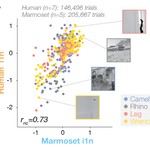
do large-scale vision models represent the 3D structure of objects?
excited to share our benchmark: multiview object consistency in humans and image models (MOCHI)
with @xkungfu @YutongBAI1002 @thomaspocon @_yonifriedman @Nancy_Kanwisher Josh Tenenbaum and Alexei Efros
1/👀

Alex Kell retweeted

Seeking: Creative and ambitious computational neuroscience / ML PhDs interested in building next-generation brain-computer interfaces. My team at science.xyz is hiring research scientists. Reach out at [email protected] for more info.

Alex Kell retweeted

Our work on models of the auditory cortex is hereby published in @PLOSBiology! The paper presents an extensive analysis of audio neural networks as models of auditory processing in the brain.
Paper: tinyurl.com/mw2e59ud
w/ @jenellefeather (co-1st) @dlboebinger @JoshHMcDermott

Alex Kell retweeted
This work from NeurIPS 2019 was the start of a much larger project that is now out in Nature Neuroscience! Check it out here: nature.com/articles/s41593-0…


New paper from our lab, by Jenelle Feather:
papers.nips.cc/paper/9198-me…
Describes divergences between the invariances of human observers and audio- and image-trained deep neural networks. (1/n) @MIT_CBMM @mcgovernmit @mitbrainandcog
Alex Kell retweeted

We're thrilled to announce a breakthrough in 3D world generation. Now, transform ANY image - AI-generated, concept art or real world shots - into high-resolution game-engine ready 3D asset. Check it out:
🎈 Public Showcase on Discord: 3d.csm.ai/discord-sessions
🤖 Generate your own using our Discord bot: discord.com/invite/NhJJwmk8g…
📝 Join our waitlist as we scale up: rb.gy/oio8j
📚 Read more on our blog: csm.ai/any-image-to-3d
#GenerativeAI #3D #Imageto3D #midjourney #dalle2 #3dart
Alex Kell retweeted
Bispectral Neural Networks go to #ICLR2023!
In this work, we present a new neural network architecture capable of learning unknown groups purely from the symmetries implicit in data
—with @cashewmake2, Bruno Olshausen, and Christopher Hillar
1/17

Alex Kell retweeted

New opening for a full-time lab tech in the Kanwisher Lab:
careers.peopleclick.com/care…
This job is a great stepping stone to graduate programs in cognitive neuroscience. Demonstrated serious interest in cog neuro and good coding skills required. Machine learning skills a plus.
Alex Kell retweeted
Excited to present a comprehensive analysis on the extent to which deep neural network (DNNs) can account for brain responses in the human auditory cortex! Work with @jenellefeather (co-1st) @dlboebinger @JoshHMcDermott
biorxiv.org/content/10.1101/…

Alex Kell retweeted

Self-supervised representation learning is greatly facilitated by the knowledge of objects and their layouts in real-world scenes. Rather than hard-coding these priors, with our new method Odin we found that objects can be discovered from the learned representations themselves.

Alex Kell retweeted
PINEAPPLE, LIGHT, HAPPY, AVALANCHE, BURDEN
Some of these words are consistently remembered better than others. Why is that? Here we provide a simple Bayesian account and show that it explains >80% of variance in word memorability psyarxiv.com/p6kv9/
Alex Kell retweeted
1/8 Can we use embodied AI to gain insight into *why* neural systems are as they are?
In previous work👇, we demonstrated that a contrastive unsupervised objective substantially outperforms supervised object categorization at generating networks that predict mouse visual cortex.
Here we develop "Unsupervised Models of Mouse Visual Cortex"
Co-lead with @NathanKong
w/ @ChengxuZhuang, Justin Gardner, @amnorcia, @dyamins
#tweetprint below 👇

Alex Kell retweeted

🚨 Job alert! 🚨
My new lab at Tulane is seeking a Research Tech (lab manager) and Postdoc to conduct research on the cognitive and neural basis of social understanding, starting as early as Sept. Please share, and get in touch if you're interested! Here's my pitch for the lab 🧵


Alex Kell retweeted

Glad to share a preprint of new work with @hansemsohn
and @mjaz_jazlab where we investigated the role of "mental simulations" in physical inferences using dense electrophysiology in the dorsomedial frontal cortex of monkeys playing Mental-Pong.
biorxiv.org/content/10.1101/…
Alex Kell retweeted

I've spent the past year on a passion project, asking: When it comes to understanding the brain, what are we trying to achieve? What have we learned? What challenges do we face? And what's our plan? As I pull it all together into a book, I want to champion these 11 references:

Alex Kell retweeted

We’ve spent some time modeling language in the brain with LMs, but can we apply the same approach to shiny new, speech models like WavLM and if yes, what does this tell us about the brain?
Our new ICML paper answers these questions, and more! (Led by @_avaidya ) 1/

New paper from @_avaidya & @shaileeejain just accepted at ICML: Self-supervised models of audio effectively explain human cortical responses to speech
arxiv.org/abs/2205.14252


Alex Kell retweeted

🔥Preprint out:
`Toward a realistic model of speech processing in the brain with self-supervised learning’:
arxiv.org/abs/2206.01685
by J. Millet*, @c_caucheteux* and our wonderful team:
The 3 main results summarized below 👇