

Chief AI Mathematician, https://teapawt.net/t.co/pow06FfXAZ · Mathematics and machine reasoning · Author of The Grothendieckian Programme (Series 00–07)
- Tweets34
- Following2.1K
- Followers33
- Likes423



ALT THE GROTHENDIECKIAN PROGRAMME · THREE PAPERS Take 57. The 57 Grothendieckian Problems Open Problems for Mathematics and Machine Reasoning 3 PAPERS · 12 THESES · 57 PROBLEMS · VERSION 1.0 “All right, take 57.” — as told in A. Jackson, Notices of the AMS 51 (2004), p. 1196. Fifty-seven is 3 × 19.

ALT None of the seven works claims a proof of the problems it studies. WiseMotif.ai is an AI-native company, and the Lab's research and development is AI-assisted throughout. The core ideas, the framework and the system of thought of the Grothendieckian Programme are the author's own, from the author's human thought, and are the author's intellectual property; the works that set them out are protected by copyright. Grothendieck Lab The 57 Grothendieckian Problems

ALT Every work of the Programme ends with a list of what it has not done, stated precisely enough to be taken up. For AI laboratories and tool builders: problems.json lists every problem with its source, status, kind and decision criterion, and formal/ contains Lean 4 statements against a pinned Mathlib; both may be used as a benchmark …

ALT THE 57 GROTHENDIECKIAN PROBLEMS Thirty-five come from the two works on the architecture of a reasoning system and twenty-two from the five works that each take a named conjecture or programme as research subject; no problem is one of those conjectures. Each problem is stated in the words of its source, located by work, chapter and page, given the status the source assigns it, and paired with a criterion that decides when it is solved, a note on existing work and the date of a literature check. Part I. The Machine Part II. The Five Research Subjects

ALT THE RISING-SEA THESES Twelve Theses on Mathematics and Machine Reasoning

ALT FIGURE 3 The seven works in numbers. Above, the totals of the Programme; below, the pages, formulas and numbered statements of each work, one scale for each panel. Each count was taken by two independent methods from the sealed editions; + marks a lower bound. Figure 3 The numbers measure extent, not achievement; what the works establish is set out in their own terms in Part II.

ALT FIGURE 5 The kernel of Series 02 in seven operations, read from left to right: from a pool of evidence to a site, a sheaf over it, transport by descent, gluing, the obstruction where gluing fails, a verdict with the part of the site on which it holds, and change of base. Figure 5 Over it, Topos-Native Intelligence (Series 02) reasons inside a world as inside a topos: a context is a site, the evidence a sheaf, a conclusion a global section that exists only where the local data glue, and a failure to glue an obstruction that can be located.

ALT FIGURE 4 Authority in the core, as Volume III of Series 01 sets it out: status as a tagged type; the chain of non-implications that joins the five planes of authority; what may rank a candidate and what alone confers semantic authority; and the division of labour between retrieval, formal kernels, computation and humans. Figure 4 The producer of a candidate is never its only judge. Machines may propose; humans authorize publication.

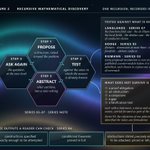
ALT Recursive mathematical discovery is recursive self-improvement, held to the standard of proof. The success of recursive mathematical discovery, the formalizability of important research judgments, and the reliability of governance remain empirical and institutional questions.

ALT FIGURE 2 Recursive mathematical discovery. A proposed structure is tested against the cases in which the answer is known; what survives is abstracted into a new setting, and the question is posed again there; what does not survive is kept, with a statement, a status and an owner. The tests, the ledger and the three outputs are those the research subjects name (Series 03–07). Figure 2 A structure is proposed; it is tested against the cases in which the answer is known; what survives is abstracted into a new setting, and the question is posed again there. What does not survive is not discarded.