
Seattle, Berkeley, prev research @DecagonAI
Joined May 2023
- Tweets97
- Following108
- Followers153
- Likes14.7K


Alon Ragoler retweeted

Multiple-speaker identification sounds simple and solved (e.g. diarization), but it’s actually completely mismatched to real-time use cases. if you take action based on a speaker flag, false positives are critical: to stay below 1% over a 10-turn conversation you need a per-turn FP rate under 0.1%, and current methods are nowhere close. so we built a suite of methods that outperform existing approaches several-fold.
Built with @alon_rag


Alon Ragoler retweeted

Show a robot a cart it's never seen. It doesn't need to know it's a "cart," just that it's pushable, rolls & holds stuff.
Happy to announce my first-author paper on functional latent spaces got into #CoRL2026: "What Objects Enable, Not What They Are"
arxiv.org/abs/2606.05533
🧵

Alon Ragoler retweeted

One of the trickiest problems you run into with voice AI in the real world is that people often call in messy environments.
There might be other voices in the background, or the person might be talking to other people at the same time.
Super cool work from Decagon Labs on how we've tackled this problem!
Alon Ragoler retweeted

Conversational voice agents need to know when a different person is speaking, but not every background voice should count.
We combined speaker embeddings with a post-trained audio-language model to determine when a speaker change matters.
Alon Ragoler retweeted
Fast text serving ≠ fast speech.
Here's how we got our time to first audio under 30ms with nearly 10x more audio throughput.
Alon Ragoler retweeted
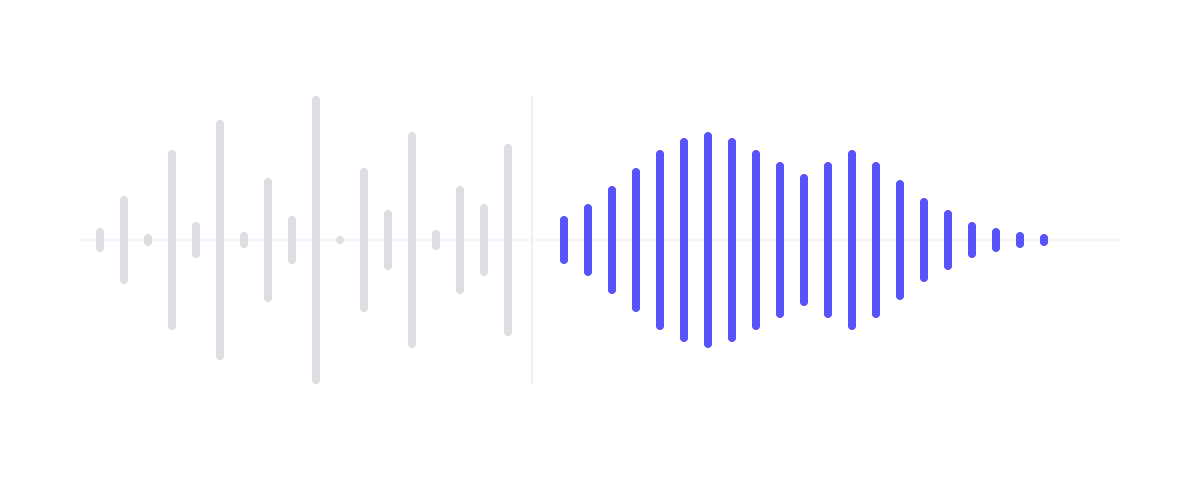
Modern TTS models can sound great — and still fail badly on pacing, pauses, and prosody.
We adapted DPO + GRPO to flow-matching models to tackle the tail end of TTS behavior:
Alon Ragoler retweeted

Hardware yearns for block sparse attention, yet it seems largely absent from open weight LLMs. DeepSeek developed NSA, and people speculated DeepSeek v4 would integrate it, yet it was never utilized.
We have a hypothesis as to why.
We found that replacing dense attention with NSA significantly degraded its ability on synthetic retrieval tasks, even when finetuned on them. On our 32k context benchmark, it scored 0.300 compared to dense attention’s 0.904.
We found the reason, and how to fix most of it. Introducing COBS🌽(Cumulant Order Block Sparse Attention), with @AdiGhai18 @sanjitneelam @ZVasania @tensorpro:
• Raises NSA’s 0.300 → 0.820, closing ~86% of the gap to dense
• 15.15x less KV-cache read traffic than dense (just 1.21x the NSA baseline)
• Lower position-wise NLL than dense in our comparison
The key insight: block selection is the keystone to block sparse attention, and existing methods are mathematically stuck in storing a first-order approximation of a cumulant generating function. COBS caches a compressed second cumulant and escapes this ceiling.
Details in the paper.


Alon Ragoler retweeted

Hosting a fireside chat with @AshwinSreenivas on building Decagon from 0->1. We'll talk about the early days, what worked, what didn't, and lessons from scaling the company. DM me for an invite!


