




Week 45 of our weekly update is out.
The big news: the teacher dashboard went live this week, three weeks ahead of plan.
Teachers can now give a whole group the same patients and see each week what the class missed. A medical school in Istanbul also received four patients, one of them built for its own students.
This issue includes catch-up chapter 2 of 4, about our customers: how a pilot works, and where our 15 institutions in 10 countries stand.
Read it here: alyt.ai/investors/updates/we…

2
138
Today, we're launching our new investor page, and with it the ALYT weekly update. From now on, we publish an update there every Monday morning: what moved at ALYT last week, and what comes next.
alyt.ai/investors
Many of you asked for a regular, clear view of our progress. The weekly update gives you that in one place, in the same format every week, so you can follow us week by week and check what we do against our plan.
Investors and founder circle members also receive confidential notes with each issue.
The first issue, week 44, is live now:
alyt.ai/investors/updates/we…
A lot happened before this first issue, starting with Educational 2.0 on 1 July. To bring everyone up to date, every update in November also carries one chapter of a short catch-up series.
Chapter 1, on how we rebuilt ALYT from the ground up in four months, is out now. The next chapters cover our customers (9 November), evidence and team (16 November), and our plan for 2027 (23 November). We chose a series over one long report so the weekly update could start right away, and so you can catch up one theme at a time.
After 23 November, the update continues on its own. All chapters and past issues stay in the archive:
alyt.ai/investors/updates
1
157
Back in September, we announced Bedside. Today it is almost finished, and we are integrating it into the platform as we speak.
Not as a feature on its own, but directly inside the cases teachers create themselves, which keeps a promise we made early on: that a teacher can build a full case from scratch at the touch of a button, bedside and all.
The first preview comes next week.
4
220
Alongside the new student experience, an entirely new teacher dashboard is coming to ALYT Educational 2.0 next week.
It is built to give faculty the whole picture of their class at a glance: where students are in their assignments, which patients they have seen, and above all, where the group is reasoning well or going wrong.
Everything a teacher needs sits on one screen, and it is designed to feel intuitive rather than like another system to learn.

2
149
Most assessment in medical school only checks the endpoint: did the student reach the right diagnosis?
That says almost nothing about how they got there, so a careful reasoner and a lucky guesser walk away with the same mark.
We built ALYT to measure the path instead. Every action a student takes on a virtual patient is recorded against the clock, and before they can order a single test they have to commit a differential with a probability on each diagnosis.
Because the engine knows the truth of the case, it can tell a focused workup from a scattergun, confidence that was earned from confidence that was misplaced, and the thinking trap behind an error.
Two students can reach the same diagnosis and still get very different feedback, and that difference is what matters to universities.
Our latest round of performance work has made ALYT between 7 and 20 times faster across the platform.
The logbook dropped from 5 seconds to under 0.8, the profile endpoint from 1.5 seconds to 118 ms, and the bedside view from 2.1 seconds to 240 ms, while the token check on every request now completes in under a millisecond.
The result is a quicker and more effortless experience for every student using ALYT.
2
4
297
A look at how case authoring works in ALYT.
You provide a source, a guideline, an article, a PDF, or a few lines on a patient, set the level, and optionally pin the diagnosis and specialty.
ALYT then generates a living patient: the narrative, the examination findings, and a result for every test a student can order, with the patient’s state evolving as the student acts or fails to.
An AI critic reviews it, you refine it in natural language and play it through, and it reaches students only after independent clinician sign-off.
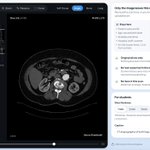
Real CT and MRI scans are now live inside ALYT cases, and this is the first look at them in action.
In practice, a teacher drops a real CT pulmonary angiogram into a pulmonary embolism case and sees it exactly as a student will.
Students never get the scan handed to them. They have to decide to order the CT, and only when the result comes back in the case’s own timeline does it appear, in a proper PACS-style viewer where they can scroll through every slice, switch window presets, measure in millimetres, and open other views.
2
6
295
A first look at the teacher view of our new CT and video viewer for ALYT Educational 2.0.
Teachers add a real CT scan in four steps.
ALYT reads the files on the teacher's own computer, shows which series students can use, and explains in plain words why the others are left out. Only the images and their measurements are uploaded. The patient details in the files never leave that computer.
Surgical videos follow the same idea: prepared in the browser, and shown to students when they choose that procedure for their patient.
Stay tuned for the student view.

🩻 A completely new CT and MRI viewer is on its way to ALYT Educational 2.0.
The goal is to make imaging feel much closer to real clinical practice, with a set of innovative features that bring students as close as possible to reading real scans, so the whole experience feels realistic and genuinely more engaging rather than like a textbook exercise.
This is just an early look. We will reveal both the full teacher view and student view later this week.

New in ALYT educational: thinking traps 🧠
After every case, ALYT checks the student's reasoning for four classic errors: anchoring, premature closure, omission, and commission.
When a trap caught them, they see exactly where, in their own case.
Each trap comes with what we saw in their decisions and one strategy for next time. For anchoring: "When a new finding arrives, ask what it does to your leading diagnosis. Name one finding that does not fit, and let it move you."
Teachers see per student whether each trap fades over the weeks.
One of the biggest features we have built so far is coming to ALYT, and we are calling it Bedside. 🛏
Students will see the actual patient lying in their bed in 3D, then tap any part of the body to examine it.
The camera flies into that region, and a real close-up photo of that same patient fades in, so the exam happens on the person in front of them rather than a diagram.
One click returns them to the bedside, and the case picks up with everything they found.
The full Bedsive v1 reveal is coming soon. Stay tuned!

This is what a teacher sees inside ALYT: every case at their institution in one place, drafts included.
✅ Each case shows its status openly, whether it has been independently validated by a physician or is still waiting on that sign-off, and everything is sorted by specialty.
Right now this library holds 44 cases spanning cardiology, neurology, psychiatry, and more, with 21 of them already physician-validated.
It gives educators an honest view of exactly how far each case has come.

How we build a single case at ALYT, step by step.
🔹 Everything starts from a written clinical source of around 60 to 70 KB. It lays out the patient, how they change throughout the day, what each test shows, and what happens if the student acts too late or gets it wrong. If we cannot score the main lesson, we do not start.
🔹 The model turns that source into a much larger, branching version of the case in roughly six minutes, and a validator throws out anything that is unreachable or unclear.
🔹 We add the finer detail next: the near misses, the literature behind it, how reliable each test is, and the questions that check understanding. Another model reads it all against the original and flags whatever is off.
🔹 Then we play the case through ourselves. If the scoring does not reflect the medicine, it goes back.
🔹 The patient has a portrait for every stage so you can watch them recover or decline, and every scan is a real, openly licensed radiograph, never generated.
✅ Last, an independent doctor reviews and approves it, and the person who made the case cannot be the one who signs it off.
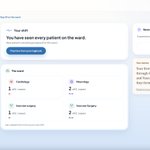
A look at how students actually move through ALYT.
Rather than picking exercises, they work shifts on a ward where patients are grouped by specialty, from Cardiology to Neurology to Vascular Surgery.
🔁 Once every patient has been seen, new ones are prepared, and the student chooses which department to focus on next.
It turns studying into something that behaves much more like real clinical work.

Some of the strongest features from our B2B work are making their way into ALYT Educational 2.0, led by a new 3D skills program.
🥽 The aim is more immersive patients and more realistic clinical scenarios, so students can practice in an environment that behaves more like the ward itself.
We will share the first sneak peeks next week.

📊 This autumn we begin the first real study of ALYT.
At our partner universities, a full cohort will use ALYT 2.0 during a regular teaching block, practicing on published and physician-reviewed cases while the platform automatically logs how much each student trains and on what.
The primary analysis is pre-registered: after the December and January exams, we test whether students who practiced more on ALYT scored higher on the exam questions covering that material, corrected for their earlier grades.
It is the second hard data point on whether using ALYT actually moves outcomes.

🎯 The duty roster no longer picks at random.
At the start of each shift, ALYT now looks at what a student is genuinely weak at, drawn from their recent performance and their confirmed error patterns, and boosts the cases that match.
When a patient is chosen for a reason, the mentor explains it on a short handover strip inside the hero, in a human voice, so the student always understands why this patient and not another.
Now live in educational 2.0!

👩⚕️ Educational 2.0 trades the traditional case library for a real logbook of virtual patients.
A library is something you browse and move on from, while a logbook is something you accumulate, the same way a junior doctor builds a record of the patients they have seen.
Every case a student completes stays with them, reasoning and outcome intact, and the picture of their progress grows sharper with each one.
