Amarsh Chaturvedi (@amarshc) header
Amarsh Chaturvedi (@amarshc) profile picture

2x Founder | IIT Kanpur Alum

Panaji
Joined July 2009
Photo by Amarsh Chaturvedi (@amarshc)Photo by Amarsh Chaturvedi (@amarshc)Photo by Amarsh Chaturvedi (@amarshc)Photo by Amarsh Chaturvedi (@amarshc)Photo by Amarsh Chaturvedi (@amarshc)Photo by Amarsh Chaturvedi (@amarshc)Photo by Amarsh Chaturvedi (@amarshc)Photo by Amarsh Chaturvedi (@amarshc)Photo by Amarsh Chaturvedi (@amarshc)Photo by Amarsh Chaturvedi (@amarshc)
The case for sovereignty in #EnterpriseAI @produktivai #Kynexa
Replying to @gartner
@Gartner predicted the human-to-seller ratio to be 1 to 10 by 2028. @McKinsey @McKinsey 's research said that 2-5 humans will manage up to 100 agents in banking. When I did my maths for large enterprises, one thing that I realised was that such a massive dependence on agentic processes will also increase your dependence on agentic frameworks provided by cloud providers like AWS, GCP, Azure, IBM or Databricks. Such a large digital working force would be difficult and costly to migrate without disrupting enterprise business. I want you to take a moment and think if you are spearheading an AI-native journey in your company. You are giving away your enterprise's future prosperity to these giants. I have put in some thoughts in my latest article on Substack. Let me know your comments. #EnterpriseAI #AIGovernance #AgenticAI ashwanir.substack.com/p/when…
1
12
Looks like @github is down. Core ops severely affected. #outage #GitHub
1
152
Several important pointers from @nikesharora here. Echoing the additional pair of eyes for CIO/CISOs and the need for data governance and enterprise controls in place for #agents running amock. Exactly the problem we’re solving @produktivai
It's been an eventful week. Multiple vulnerabilites in Internet facing software, coding repositories, examples of agent behavior that seem concerning and a flurry of security specialists with solutions that can partially solve your problem. There in lies the challenge. Given the state of IT and security infrastructure, no one solution works. Let's break it down: 1/3 1. Vulnerabilites are being found and will continue to be found as models get more capable, the fragmented nature of the effort denies us the opportunity for a comprehensive find and replace option. 2. Even if all vulnerabilities could be found instantly and patches available - we will be reliant on the ability of enterprises to deploy all these changes at speed. It is not clear what the collateral impact of all these patches will/could be to our infrastructure of deployed en masse. We will need a hybrid patch approach. 3. Virtual patching(VP) is needed in conjunction with direct patching but for a comprehensive (VP) solve you have to be lucky enough to have "modern frontier defenders" (Cyber companies that have vaulted infrastructure that can create patches at speed and push content rapidly to protect their customers) you need them for your network traffic, your traffic to applications on the cloud, your WAF, your end point. 4. There will continue to be patches that will need to be deployed directly but virtual patching will take the heavy load off. 2/3 Medium term solve: Unfortunately token economics and current cyber architectures will not allow for defender swarms to contend with an offensive attack launched using agents. (Some x pundits who aren't steeped in cyber should take heed). Yes, theoretically we should aspire to have these agentic swarms defend us when we are under attack, unfortunately an attack is a sniper moment, chained vulnerabilities, cloaked attack followed by swift exfiltration. It's a speed program not a brute force problem. To solve for this, enterprises need to get their SOC architecture right, logs, feeds, cyber products orchestrated via a modern SOAR for swift response. Only then can we deploy agents to detect and remediate. In addition, enterprises need to modernize and dare I say platformize their perimeter stack to ensure consistency. Unfortunately, enterprises still seem to not see the urgency across the board, decisions are stuck, CIO/CISO's have a lot on their plate. While some honestly have bit seen the scale of such a problem before and it's hard convincing the organization that one needs to open the floodgates on modernizing the IT and security infrastructure. So we will continue to see environments being brought down to patch today it's for PHP, tomorrow it will be for the next one. 3/3 AI deployments are the"wild wild west" - LLM capabilities are expanding faster than we can build products to secure them. Sure an agent will jump across guardrails in a research lab, which is a lesson for all of us to deploy agents securely. But there is a lag between the discovery, the availability of that in a public model and the time needed for the cyber industry to build governance or an antidote. And no, dear frontier lab friends, the world cannot just trust you to build the solve. The infrastructure industry in tech builds and the cyber industry secured and provides assurance to the boards and organizations around security and safety. AI security is the new attack surface. CEOs (present company included) want AI adoption, getting the pace of adoption wrong could be the last decision we make, at the same time "deploying it wrong" could have the same consequence. There are billions of dollars being spent on coding, is your coding harness secure? Start there. If agents can jump guardrails, they can hide stuff in code. Validate business outcomes needed, test your user case and ensure agentic deployments are well guard railed. Deploy a second set of eyes to watch your deployments for drift, compliance and verifiability.
1
17
Amarsh Chaturvedi retweeted
Many companies are investing heavily in AI but seeing little measurable productivity improvement. This is because their tools optimize work within individual functions rather than across them. Research shows that employees spend 37% of their time on coordination work, and 77% want to spend less time on it. AI can reduce these costs by connecting systems and functions, enabling better cross-functional decisions, and freeing employees to focus on more substantive work. Here’s how leaders can capture that value. s.hbr.org/3W0bIAr
10
6
1
32
9,085
And that’s where the role of effective enterprise controls on #data and #AI comes into play. Unlocking AI across functions would need more groundwork first. @produktivai
11
When #AI does not differentiate between your data sources, should your governance practices do that? Explore structured and unstructured data workflows with #Kynexa by @produktivai
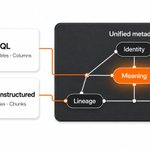
Produktiv - #SQL #semantic modelling #Kynexa combines language models and human input to describe SQL tables, roles and columns. Explore SQL connectivity, metadata, lineage and stewardship. Governed SQL retrieval is in development. produktiv.ai #EnterpriseAI #RAG #AI
1
1
13
And maybe that’s why AI controls are so important in an enterprise
Turns out AI can cause more problems than it solves. 36% of AI execs at companies with $1B+ in annual rev reported an AI incident that led to data loss, financial damage, brand damage or operational disruptions. Companies are now limiting employee AI usage.theguardian.com/technology/2…
1
7
Amarsh Chaturvedi retweeted
Not sure who needs to hear this but.... An LLM doesn't "understand" anything. It is a statistical model that spews out tokens based on probabilities calculated through massive matrix operations and context, not an understanding of the subject matter.
1,171
1,089
270
9,329
1,062,966
Amarsh Chaturvedi retweeted
Data integrity companies have spent years helping enterprises understand whether data is accurate, consistent, classified and traceable. AI introduces another operating boundary to the same model. Let’s consider a scenario - a model rarely receives an entire governed source. A retrieval service selects fragments, assembles context and passes a smaller information set into the reasoning process. The integrity question therefore continues into the AI workflow. Enterprises need to know which information was selected, what access rules applied and what evidence can support the action. I see a natural partnership opportunity emerging between solutions of different players in the data and AI space. Established data platforms bring trusted metadata, quality and lineage. An Enterprise AI Control Plane can carry those governance assets into the context used by AI. That extends the value of the existing data investment. It also gives AI teams a stronger foundation than rebuilding governance inside every application.
1
1
1
20
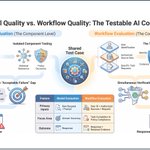
A model evaluation asks whether a model performs well on a defined set of #prompts. An #enterprise workflow evaluation asks a larger question - did the complete application behave correctly for a particular user and task? #EnterpriseAI #Quality
1
2
14
Amarsh Chaturvedi retweeted
If you are responsible for taking your AI into production, here are a few things you need to do. First, start preparing a deployment review. The list is big, and a few items are explained below with an example. If you need the review document checklist before taking the demo to production, then DM me. 1. Preparing a deployment review for an enterprise document-based AI assistant? Build a small evidence pack around the proposed setup. Here is a practical starting structure. 2. An information-flow diagram: identify the services involved and what is sent between them. Use synthetic examples. Mark the receiving model service clearly. 3. A location record: document storage and processing arrangements service by service, with supporting references. Leave unconfirmed details visibly open for review. 4. A responsibility sheet: identify who performs operational tasks, who approves changes and which agreement sets the commitment. Avoid assuming a task is included because a service is described as managed. 5. A demo-to-deployment comparison: show the differences in sources, identities, configuration and service arrangements. State which differences still need assessment. 6. A diagnostic-handling plan: define what support evidence may contain, who receives it and how it must be handled. These are review recommendations, not proof of compliance or guarantees about a product.
1
1
35
Amarsh Chaturvedi retweeted
#EnterpriseAI platforms should scope the control at the stages in processing. Check how #Kynexa does it for governing #AI, data, context, agents and tools. produktiv.ai/platform
3
3
14
Amarsh Chaturvedi retweeted
Best #EnterpriseAI tests mimic a little part of the employee's job. These tests don't need production data. Meaningful scenarios can be created with synthetic data. The goal is to see if the workflow lets a person work with #AI confidently. #AIGovernance
2
3
15
Amarsh Chaturvedi retweeted
#Kynexa supports unified metadata for SQL and unstructured data, which helps in controlling the flow of information to AI agents and RAG through semantic policies. Check out more on produktiv.ai #EnterpriseAI #AIGovernance
2
3
51
#Explainability #traceability and #monitoring of AI activities remains at core of #EnterpriseAI rollouts. Check out how we @produktivai help you do that
Retain the evidence for an AI test: user role, source scope, request, policy outcome, response, and expected behaviour. It makes a defect possible to reproduce and investigate. #EnterpriseAI #AIGovernance
2
31
Are slow pace calls linked to this? #AIAgents #LLM
While AI adoption might appear widespread from the outside, much of the money powering it is concentrated in the hands of a few heavy buyers, tightly connected suppliers and investors and infrastructure commitments that have to pay for themselves before the hardware cycle moves on. Now the question is whether the economics behind each use case will survive a shift in pricing, funding or supplier relationships. Read my latest article: ashwanir.substack.com/p/why-… #EnterpriseAI #AIGovernance #AI #ArtificialIntelligence #AGI @produktivai @Substack
1
27
Forgot to consider your semantic contracts and definitions before implementing AI in financial services? Look out for fun! #EnterpriseAI #semantics #AIAgents #Agentic #BFSI
1
2
37