

Co-founder, CEO at @RunLaminar. Formerly @harvard. Powering America's critical supply chains.
San Francisco / Boston
Joined July 2013
- Tweets41
- Following96
- Followers65
- Likes6







Just wrapped my keynote at the Fellows Forum — grateful to Alex Ren and Lucas Sheiner for the invitation to speak about Physical AI for process manufacturing!
Process industries have been running on hardcoded, static automation for decades — fixed timers, manual sampling, decisions made by assumption rather than real-time intelligence. Changing hard code to dynamic code, driven by real-time molecular chemistry inline, is the shift Laminar was built to make.
The hardware innovation that makes all of it possible is our model-defined sensor, built from first principles to capture high-fidelity data inline and generalizable across any material in any industry that runs through a pipe. No other solution closes that loop across the full Process-Aware Autonomy stack the way Laminar does.
The manufacturers already running Laminar are seeing what productive, efficient, highest quality, sustainable, and self-driving processes actually look like in practice. The opportunity ahead is extraordinary, and our partners are only beginning to scratch the surface of what becomes possible.
As I said on stage: @RunLaminar is the only physical AI company for the world of pipes, reactors, and stainless steel equipment. And if you're running a pipe, you need to be running Laminar.


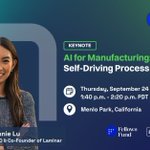
Presenting a keynote this Thursday on how @RunLaminar is reinventing the factory from the floor up — what it actually takes to build the self-driving factory inside the world of pipes, stainless steel equipment, and production lines that have been running the same way for decades.
Process-Aware Autonomy is just day one. Hope to catch you there!

5
101

Perks of the job at @RunLaminar : getting products from customers directly from factory visits🥫
We love our customer Ken's Foods (they have the BEST sauces), and are proud to support and enable best-in-class manufacturing and transformation in their operations for iconic products. Thanks for the great partnership!
Brody and Jacob after just coming back onsite with Ken's Foods 🤝

2
55
Had a wonderful time sitting down with Matt Crane and Will Lehmann on the Code & Cobblestones podcast to talk about what we're building at Laminar and why process manufacturing is one of the most consequential opportunities in Physical AI right now.
We got into Process-Aware Autonomy, what it actually means to build Physical AI for the factory floor, and why the industries that produce everything the modern world runs on are finally getting the technology they deserve.
If you want to go deeper on any of it, give the episode a listen!
youtube.com/watch?v=VsCJdVX5…

2
42
Had a fascinating conversation with a customer yesterday during a business analysis session that reframed how I think about the value of time on a production line.
The instinct when you recover hours on a bottling line is to calculate the additional revenue from more run time — and at $700 to $1,000 per hour in run time cost, the number gets large quickly. But what the conversation surfaced is that time itself is often worth more to a bottler than the revenue it could generate.
Recovered hours mean more planning time for the team, additional preventive maintenance cycles that prevent far more expensive unplanned downtime, less overtime for operators already stretched thin, and the flexibility to deploy labor where the plant actually needs it most.
Efficiency in manufacturing isn't always about making more. Sometimes the most valuable outcome @RunLaminar delivers is giving a plant the breathing room to run better, not just faster.
That flexibility compounds in ways that don't always show up in a revenue calculation but show up everywhere on the floor.
38
One belief I hold deeply as a founder is that the burden of tech adoption should never sit with the customer.
Pilots close easily at @RunLaminar because we ask almost nothing of the customer to get started. A facility doesn't need a whole infrastructure overhaul or a five-year transformation roadmap before benefiting from real-time visibility into what's actually happening inside their pipes. The technology meets the plant exactly as it exists, on day one saving both resources and time simutaneously.
The technical sophistication of Process-Aware Autonomy tends to get most of the attention when people describe @RunLaminar, and rightfully so, since the engineering underneath it is genuinely hard. But how easy the technology is to deploy using deserves equal attention. Any manufacturer, regardless of size or region, regardless of where they sit on the digital maturity curve, can get started with @RunLaminar today.
33
Everyone investing in physical world and traditional industries:
Pattern matching is for non believers. There are no rulebooks, playbooks, formulas.
48
This. Is what we do at Laminar. Everyone who is saying "Atoms not bits" means space. This is actually atoms.
Physical AI for the world of pipes, reactors, and equipment.

Automate everything except plumbing, and every plumber gets paid like LeBron. Short of super AGI, the humans doing physical work become the bottleneck. @travisk is right. But there's a layer beneath the plumber. Atoms runs driverless haul trucks in a Texas quarry. More than two million tons of limestone in eight months. Those trucks are moving atoms that already exist. So is the plumber. I build chemical plants. Software automated language and math because both are symbolic. A reaction has an equation too. That equation doesn't change when you scale it up, but everything else does. People tuned the pressure, the oxygen, and the flow by hand over decades. My plants run engineered enzymes into a metal catalyst. A model can write that synthesis. For now, you can only learn how the enzyme shears under the pump by... pumping it. That's part of why one wafer still takes 100+ chemicals and the US can't make 60% of them in the volumes the fabs need. If the plumber is the last mile of the physical world, the molecule is the last inch. The final thing to automate are the reactions that make the pipe in the plumber's hand possible.
1
125
When most people hear AI right now, they picture a chat window that answers a question, drafts an email, or summarizes a document. That's generative AI, and it has rightfully dominated the conversation for the past few years.
Physical AI is a different category entirely, and almost nobody outside manufacturing understands what it actually means yet. Changing how the physical world runs – the plants, the pipes, the production lines that make everything we consume, Physical AI is not a fad.
I want to say that clearly because I think there's still a contingent of people waiting for the bubble to pop. What I see instead is one of the most unprecedented paradigm shifts in the last century, and it's not going back.
There's a lot of uncertainty right now, but all uncertainty is opportunity. At @RunLaminar, we're building the next level of Physical AI – Process-Aware Autonomy – pioneering self-driving factories and we couldn't be more energized about what comes next!
45
Loved sitting down with Joe Sullivan and The Manufacturing Executive Podcast questioning the assumptions that have gone unchallenged for decades and rethinking what's actually possible on the factory floor.
Apple: podcasts.apple.com/us/podcas…
Spotify: open.spotify.com/episode/6Ts…
1
74
Most manufacturers today sit on more process data than they've ever had, collected through grab sampling, historian systems, and dashboards. The problem is that by the time a deviation surfaces in a report, it's too late. @RunLaminar closes the loop!
46
Just published an extensive interview with @adammendler's Leadership Today, and I spoke on what I've learned building @RunLaminar. Check out the full interview!
adammendler.com/blog/annie-l…

2
50
I'm currently at the @wef 's Annual Meeting of the New Champions in Dalian, China, and shared my perspective on the Factories that Learn panel.
If you want to hear from some of the sharpest minds thinking about the future of manufacturing, listen here!
weforum.org/meetings/annual-…

2
36
Super excited to share that my latest article just published on the @wef! I dive deep into why process manufacturing represents the last great frontier for physical AI, and why the manufacturers moving first will define this decade.
weforum.org/stories/2026/06/…

We can all agree we are beyond excited for this summer like the World Cup and America's 250th anniversary, but it's also beverage bottlers and fillers most demanding production seasons ever! Bottlers who win this summer will be the ones running the self-driving factory 😉
1
36
My brother David spoke at TEDxHarvard and said it better than I ever could:
@RunLaminar is just the beginning.
Process-aware AI in industrial manufacturing is here — not as a concept, but as technology running in 100+ facilities across every continent except Antarctica!

30
I am beyond thrilled to share the news that the @wef named @RunLaminar a 2026 Technology Pioneer! Big challenges mean big opportunities. #TechPioneers26 #DeepTech #Innovation #InnovateScaleImpact

Deeply honored to be on the #100WomenInAI list alongside an extraordinary group of women who are building the future of this industry from the ground up.
Grateful to XFactor Ventures, Flybridge , and Silicon Valley Bank for the recognition, and congratulations to everyone!

3
106