

A Helper of your Joy (2 Corinthians 1:24) Rightly Dividing the Word of Truth (2 Timothy 2:15) Faith Alone in all Dispensations (Romans 4) King James Bible, only
Joined December 2015
- Tweets24.1K
- Following636
- Followers1.3K
- Likes52.3K




Pinned Tweet
Understanding the mystery given to Paul is so important to God that the adversary has worked overtime to ensure many who CLAIM to know what it is defend it on incorrect grounds.
ALL men have ALWAYS been given eternal life based on faith and faith alone. AND the revelation given to Paul is indeed separate and deserves to be understood and appreciated distinctly from the doctrine given to the nation of Israel. Paul’s letters contain the specific doctrine pertinent to this dispensation of grace in which we live.
youtube.com/playlist?list=PL…

Why does God through Paul tell us we are dead to the law in Romans 7 after he tells us we are dead to sin in Romans 6?
Because the natural thinking of the flesh goes like this : “ok I am not under the dominion of sin… so that means I can now follow the law perfectly!”
That is why Romans 7 is dedicated to explaining exactly what happens when we, beings with sin still in our members (, try to “live for God” by utilizing the law— we produce “fruit unto death”.
And Paul already introduced this concept earlier:
Rom 3:20 Therefore by the deeds of the law there shall no flesh be justified in his sight: for by the law is the knowledge of sin
Rom 5:20 Moreover the law entered, that the offence might abound. But where sin abounded, grace did much more abound:
Then as Romans 7 goes on to elaborate,
Touching that law does one thing and one thing only, whether we are in Adam or in Christ, it puts “sin into motion” (7:5)
Learning to live without the law or any law operating in our thinking is learning to live “under grace”.
Because whether it’s the Mosaic law or any law we invoke to guide our behavior (Rom 2:14,15) that law only serves to manifest our need for redemption in the first place.
In my flesh, I can totally be a respecter of persons. And it happens very automatically, almost feels like auto pilot.
I need to remember, each and every time I hear anything, to take that to the Lord. To mind who I’ve been made to be in Christ, and in that mindset take what was said to my Father and examine it against his Word.
Thats how minding the things of the spirit is a safeguard against the flesh’s tendency to show favoritism, which the Corinthians really put on display and are given to us for our learning
A respecter of persons shows favoritism. He’s willing to hear truth only if it comes from the “right” person.
How do know if that’s you? When you’re ready to dismiss something, imagine your favorite pastor saying it.
“But he wouldn’t say that.”
Well imagine he did. Suppose he had newly seen something and was sharing it with the assembly. Would you call him to correct him, or pause and weigh what he said against scripture?
So beautiful!

Accepting Reality While Acknowledging God’s Truth
Romans 8:35–39 | 2 Corinthians 4:16–18 KJB
Something beautiful I’ve been learning through Romans 8:35–39 is that Paul isn’t teaching us to deny our reality. He’s teaching us to acknowledge it without allowing it to override God’s truth.
In verses 35–36, Paul acknowledges the reality of tribulation, distress, persecution, suffering, and even death. He doesn’t dismiss these experiences or pretend they don’t exist.
Our circumstances are real, and God’s truth is real. Both can exist simultaneously.
We can experience distress and still have peace with God (Romans 5:1). We can experience suffering and still possess hope (Romans 5:2–5). We can experience tribulation and still be more than conquerors through Christ (Romans 8:37).
This connects beautifully with 2 Corinthians 4:16–18. Paul acknowledges that the outward man is perishing while the inward man is being renewed day by day. Our present afflictions are temporal, but God’s promises are eternal.
And this is something I’ve been practicing personally when speaking to God. I’m learning to acknowledge my feelings, my distress, and everything happening around me without denying what God has already accomplished for me in Christ.
My conversations with God have become an opportunity to acknowledge both my present reality and His eternal truth.
I can come before Him and say:
Father, this is what I’m experiencing. This is what I’m feeling. This is what’s happening around me and within me. I acknowledge all of it. But I also acknowledge what You have said about who I am in Christ, what You have accomplished, and what You have promised. My circumstances are real, but they are not greater than Your truth.
This is what makes Romans 8:37 so powerful:
“Nay, in all these things we are more than conquerors through him that loved us.”
Notice Paul says IN all these things, not AFTER them.
I don’t have to wait until my circumstances change to acknowledge God’s truth. I can experience hurt, fear, and distress while choosing to yield my mind to what God says.
Romans 8:18 reminds me that the sufferings of this present time are not worthy to be compared with the glory that shall be revealed in us.
Accepting reality isn’t surrendering to my circumstances. It’s acknowledging what I’m experiencing while choosing to yield to God’s truth.
And perhaps this is part of the beauty of the inward man being renewed day by day. My circumstances may not change immediately, but my thinking can continue to be renewed through the doctrine.
I am not denying my reality. I am learning to see my reality through the truth of who I am in Christ.
Study the Scriptures daily. Acts 17:11 • 2 Timothy 2:15
Our hearts should rejoice in the fact that in Israel’s program, God’s justice and righteousness only permit that man should have salvation from the debt & penalty of sin by faith alone, that no sin after that moment could alter Christ functioning as their propitiation, their kinsman redeemer.
Why? Because our own eternal security is not just a dispensational technicality that you just so happened to be born into.
He desires our eternal security to rest in who He is, the great I AM. That’s why Romans 4 (faith alone in all dispensations) is given to us right after the gospel in Romans 3:21-26 — he wants us to know these things! The order of the information matters.
He desires us to know Him, his character, what makes our Lord, THE LORD. His righteousness and justice are attributes are not subject to change based on dispensation. That news ought to be glorious and thrilling to us.
If you only had eternal security because of being born in this dispensation, you could point to yourself and boast (which would be boasting against the branches). Boasting is excluded. By what law? Works? Nay but by the law of faith. (Rom 3:27)
What’s the law of faith? It’s the law by which God gives man His life on the basis of faith, and faith alone.
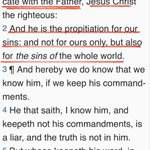
Let’s also look at the context of 1 John 1 to see how to understand 1 John 1:9.
v 2: Eternal life was manifested to them.
Why is John writing this letter?
v 3: that they may also, in addition to the eternal life they already have, have fellowship with them.
Why do they want that, John?
v 4: that their joy may be full. So John is wanting to increase the joy they already have in the Lord. This is not a message on how to “stay saved”, it’s a message on having living fellowship in this fallen realm.

To understand the context of 1 John 1:9, and what kind of forgiveness is being spoken about here, the text gives you exactly how you should be thinking about it.
Look at the very next chapter, 1 John 2
v1 John is writing these things — what things, John?
—>The things I just told you about in the last chapter.
And he’s writing them for a purpose. What’s that purpose?
—> So that they don’t sin.
And yet if the do sin, they are not to think that means they have “lost their salvation”, why?
—> because they also have an advocate, Jesus Christ
v 2 and what are they to remember about Jesus Christ? That he actually covers that sin, and all sins, when he functioned as their propitiation, their Kinsman Redeemer.
These verses really pin down the context and provide the assurance in our hearts the God means for us to have.
These text itself does not permit us to see 1 John 1:9 as conditional salvation unto eternal life.

The only way you would conclude 1 John 1:9 was about eternal life would be if you had not really looked into what God is actually saying to them through John.
This is danger of having the wisdom of man guide our bible study instead of the Holy Ghost. It is very, VERY easy to get something in your ear “they could lose their salvation”, and read that into the text.
But God provided a remedy for that— the context! The context gives us a sword to fight with the wiles of the adversary that can creep into our thinking.
I want to say this as clearly as I can, and I don’t mean it as an insult or an attack.
As far as I can see, if you believe Israel could lose the salvation that delivers them from the debt and penalty of sin by their works, then your edification has stalled at Romans 4. You’re trying to build on a foundation other than the one the Apostle Paul laid. That building is not stable bc it is not built on truth.
If I were you, I would go back. I would prioritize my own time alone with the Father and his word. I would go back to Romans 1-5 and I would spend many months— even a year—single-pointedly focused on what my Father wants me to know to make sure my foundation is the same one He has in mind.
I say this because I’ve been there and that was exactly what I needed to get grounded. I’m trying to speak plainly in a way that might have gotten my attention then.
Of course you have to be persuaded in your own mind. You are free to consider this or set this aside, but I’m saying what I wish had been said to me years ago.
I say this as someone who used to run around with only “1 Corinthians 15:1–4” and “you’re not Israel” on my tongue. Those truths matter, but when they were the extent of my foundation, I was not established.
Being established involves more than knowing we are eternally secure and distinct from Israel. It means being educated and rooted in the first things of the faith.
Paul tells us that the book of Romans was written with our establishment in view:
“For I long to see you, that I may impart unto you some spiritual gift, to the end ye may be established;” — Romans 1:11
And at the close of the epistle, he says God is now able to “stablish you according to my gospel, and the preaching of Jesus Christ, according to the revelation of the mystery” (Romans 16:25).
People take 1 John 1:9, rip it out of context, and say that Israel’s eternal security depended on their confessing their sins. Thats’s wrong.
What differs in Israel’s program is their walk with the Lord. The confessing vs denying of sins is not tied to their eternal security— it is tied to their fellowship with the Lord.
Why it’s imperative we rightly divide and understand 1 John 1:9 is not written for the Body of Christ is in their dispensation they can “fall in and out of fellowship”. We on the other hand have the atonement, are “at one” with the Father and do not come in and out of fellowship. Romans 5:1,2
But this is not an issue of their eternal security. And what happens is people cherry pick verses to support their agenda, ignoring the context God put that verse in.
My question is, why do you need Israel to not have eternal security? The text clearly dictates what is being spoken about, so what makes you need to cling to this egregious error?

And frankly, there is a transdispensational application here. If you walk around pretending you have no sin, you’re walking in darkness about what God desires to do in you: transform you into the image of His Son. Romans 6:1–8 shows that we are to reckon ourselves dead indeed unto sin, and walk in newness of life.
Obtaining a perfect sanctification is not a process: you received it the moment you were baptized into Christ by faith. 1 Cor 6:11.
Walking consistent with that gift that you may be sanctified IS a process. 2 Tim 2:21
Just because you received a perfect bicycle doesn’t mean you know how to ride it.
2 Tim 2 :21 If a man therefore purge himself from these, he shall be a vessel unto honour, sanctified, and meet for the master's use, and prepared unto every good work
1 Cor 6:11 And such were some of you: but ye are washed, but ye are sanctified, but ye are justified in the name of the Lord Jesus, and by the Spirit of our God.
Whatever church you are associated with, whatever pinnacle you think you have reached, you are going to have to deal with the nitty-gritty things in your mortal body that are in total opposition to you being conformed to the image of God’s son.
That is the mystery. The mystery is the hidden wisdom uniquely available in Paul’s epistles that are meant to change us from glory to glory.
There is no way around it. It is an opportunity. The fact it’s uncomfortable is not a signal that’s not it. Sometimes we mistake comfort for the peace of God.
2 Corinthians 3:18 (KJV)
But we all, with open face beholding as in a glass the glory of the Lord, are changed into the same image from glory to glory, [even] as by the Spirit of the Lord.