

Building the future in Software, Web3, Electricals, Real Estate, Agro & General Contracts. Makers of @supachainhq, @joinsupashop & @supadaofi | Apus Industries
- Tweets112
- Following13
- Followers14
- Likes151




ALT Apus Industries graphic on an off-white background. Headline: Design the error state. Subline: Say what happened. Offer one next step. A line illustration shows a phone screen with a warning triangle, two message lines and a cyan retry button, with a curved arrow looping from the button back to the top of the screen. Qualifier: general software-scoping guidance, not a client case study.

ALT Apus Industries graphic on an off-white background. Headline: Done is a checklist. Subline: Each criterion is a yes or no that someone can test. A framed diagram: write criteria leads to build feature, then check each one, then accepted on a heavy cyan arrow; check each one also leads to fix the gap, which loops back to build feature. Qualifier: general software-scoping guidance, not a client case study.

ALT Apus Industries graphic on an off-white background. Headline: Keep v1 small. Subline: Its one job: show whether the core idea works for real users. A line illustration shows one small solid block with a cyan top on a ground line, beside a tall leaning pile of dashed blocks. Qualifier: general software-scoping guidance, not a client case study.

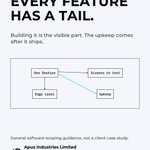
ALT Apus Industries graphic on an off-white background. Headline: Every feature has a tail. Subline: Building it is the visible part. The upkeep comes after it ships. A framed diagram: one feature points to screens to test, edge cases and, on a heavy cyan arrow, upkeep. Qualifier: general software-scoping guidance, not a client case study.

ALT Apus Industries graphic on an off-white background. Headline: Let usage pick v2. Subline: Ship the one path, watch real use, then decide what comes next. A line illustration shows a small block on the left with a trail of dots leading to one of three blocks, which is filled cyan; the other two are dashed. Qualifier: general software-scoping guidance, not a client case study.

ALT Apus Industries graphic on an off-white background. Headline: One contract, two sides. Subline: Write the contract. Build the app against a mock. Build the API to match. Test both against it. A line illustration shows one cyan-filled contract sheet between an app (a phone) on the left and an API (a server rack) on the right, with field lines running from each side into the sheet. Qualifier: general software-scoping guidance, not a client case study.

ALT Apus Industries graphic on an off-white background. Headline: Test the restore. Subline: A backup you have never restored is a guess. An isometric line illustration shows an archive box with an arrow into a database, beside a stopwatch with a cyan wedge marking elapsed time. Qualifier: general software-scoping guidance, not a client case study.

ALT Apus Industries graphic on an off-white background. Headline: Ship the build you tested. Subline: Promote it to production. Don't rebuild it. An isometric line illustration shows the same striped parcel on two pads joined by a cyan arrow, and below it a dashed detour through a gear leading to a parcel with different stripes, crossed out. Qualifier: general software-scoping guidance, not a client case study.

ALT Apus Industries graphic on an off-white background. Headline: Roles before screens. Subline: Permissions shape every screen. A framed diagram with four steps: list the user types, map actions per role, mark approvals, decide what is logged. Qualifier: general software-scoping guidance, not a client case study.

ALT Apus Industries graphic on an off-white background. Headline: Migrate with a plan. Five numbered cards: find where the data lives; clean and merge duplicates; map old fields to new ones; rehearse the import; check every record arrived. Qualifier: general software-scoping guidance, not a client case study.

ALT Apus Industries typographic graphic. Headline: Agree what done looks like. Subline: Write it down before the build starts. Qualifier: general software-scoping guidance, not a client case study.


ALT Bright desk photograph of a silver laptop on the right. On screen, four admin-need cards: look up an account; change content without a developer; see what failed; manage access. Headline: Plan the admin side too. Qualifier: General software-scoping guidance, not a client case study. Apus Industries X signature.


ALT Dark stone photograph of a phone lying on the right. On screen: Check minimum received, with a bar marking the worst price a slippage tolerance still accepts. Headline: Slippage tolerance is a limit you set. Experimental qualifier. SupaDAO X signature.


ALT Dark marble desk with a laptop on the right. Left-side typography: Final is a decision. On-screen type: Final is a decision, not a timestamp. Qualifier: Conceptual. Industry research question, not a product claim. SupaCore X signature @supacore_xyz.

ALT Light oak desk photograph of a tablet. On screen: a solid In V1 block (the core task a user finishes on day one) and a dashed Not yet block (needed at scale, or still done by hand). Headline: Scope v1 by what you leave out. Qualifier: General software-scoping guidance, not a client case study. Apus Industries X signature.

ALT Apus Industries Limited. Spec the failure, not just the success. What the user sees, what's saved, who gets told. General software-scoping guidance — not a client case study.

ALT Apus Industries Limited. Mobile or web? Usage pattern decides it, not preference. General software-scoping guidance — not a client case study.