
Adventures of an Archaeologist
London, England
Joined November 2021
- Tweets126
- Following1.5K
- Followers1.1K
- Likes2.1K






Georgina Graham retweeted

Small glass cathead amulet with a hole for wearability. Culture: Egypt, c. 500-300 BC. Private Collection.


Georgina Graham retweeted
Head of a Statue of the God Sobek Shedeti, Egypt, Middle Kingdom. Part pf the Metropolitan Museum of Art’s collection.

Georgina Graham retweeted
Bronze Statue of Poseidon, Greek God of the Sea. Photographer: Gjon Mili (1904-1984)

Georgina Graham retweeted

Archaeologists find a 25,000-year-old hut made from the remains of 60 mammoths, making this hut the oldest example of human architecture to date.
This hut was found in Russia. It has the remains of over 60 mammoths and evidence that people lit fires inside of it. It was most likely used by mammoth hunters or possibly was the home to a chief or local leader since it is so large.
Archaeologists on the site said, “Clearly a lot of time and effort went into building this structure so it was important to the people that made it for some reason”. As to what the hut's exact purpose was is unknown, but mammoth remains buried outside suggest that the people using it were storing food.
The hut was built during the last ice age. In total, there have been 5 major ice ages, periods when the Earth became colder due to climate change, continental drifts, or geographical changes. The ice ages were incredibly harsh times for life to survive in, and only the toughest and most adaptable species were about to make it through. The last ice age ended around 10,000 years ago.
#drthehistories

Georgina Graham retweeted
Neolithic Pig-Shaped Pot, c. 6.000 years old. Collection: Jiangsu Provincial Museum, Nanjing, Pottery and Porcelain Gallery. Photo Credit: Asianewsphoto.


Excavation of Roman Tile Kiln #excavation #archaeological #romanbritain #archaeologicalsite #archaeologist
8
438
Georgina Graham retweeted
In 2021, Argentine farmer Juan de Dios Sota made a stunning discovery while tending his field near Rincón de Valle: four massive Glyptodon armored shells, buried for over 10,000 years.
These prehistoric creatures, similar to giant armadillos, roamed the Earth during the last Ice Age (the Pleistocene epoch). The rare find of multiple armored shells together suggests this site may have been a significant gathering place for these ancient giants.
The Glyptodons’ final resting place likely resulted from a sudden, catastrophic event—perhaps a rapid climate shift, severe flooding, or sedimentary entrapment (mud burial) that buried them beneath layers of sediment. The exceptional state of preservation of these armored shells indicates they were covered quickly, protecting them from erosion and decay.
This extraordinary discovery not only reveals new insights into the lives of these massive creatures but also offers a powerful glimpse into the ancient world they inhabited, shaped by the same unforgiving forces of nature.
#drthehistories

The Grand Orrery showing the movement of the planets, modified in 1733. This beautiful orrery was owned by Queen Caroline, wife of King George II. #sciencehistory #orrery #sciencemuseum #antique #technology


Georgina Graham retweeted

Sunrise at Stonehenge today (2nd August) was at 5.33am, sunset is a 8.51pm ☀️

Georgina Graham retweeted

The photo above is the remains of the famous Ishtar Gate, unearthed during excavations in Babylon, Iraq in the 1930s. Below is the Ishtar gate on display at the Pergamon Museum in Berlin.
The Ishtar Gate was built by the Babylonian king Nebuchadnezzar about 2500 years ago as the gateway to the city, in the name of the goddess of love and war, Ishtar (Inanna in Sumer).
At the beginning of 20th Century, this magnificent work was dismantled brick by brick and taken to the Berlin Museum by ships and reassembled. Every year, hundreds of thousands of people flock to the museum to see this magnificent work.
#archaeohistories

Georgina Graham retweeted
Ishtar Gate, the largest of the 8 gates of Babylon, built approx. 2500 years ago during the reign of Babylonian King Nabuchadnezzar II.
Since the star of Ishtar, the goddess of love and beauty, is 8-pointed, the city of Babylon was also built with 8 gates. Because Ishtar's eyes are blue, the door is also blue.
#drthehistories

Georgina Graham retweeted

Let there be light!
This is Bryn Celli Ddu, a neolithic burial site on Anglesey, Wales, aligned to allow the sun to reach the back of the chamber at daybreak on the Summer Solstice.
May it shine bright on the longest day of the year.
#SummerSolstice #folklorethursday #longestday

Georgina Graham retweeted

‘A Neolithic feat of engineering’: Orkney dig reveals ruins of huge tomb theguardian.com/uk-news/2023…

Iron ring awaiting date confirmation interesting imprint #artefact #archaeology #arcaheological #artefacts

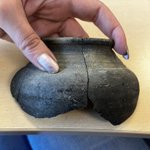
Romano-British pottery amazing preservation. #pottery #romanbritain #ancientbritain #archaeological #artefact – at East, England

Fantastically preserved piece of basic Romano-British pottery. #pottery #romanbritain #ancientbritain #postexcavation #Archaeology – at East, England


