

Purveyor of automated regression testing for fast moving engineering teams. Check us out ⬇️
Joined April 2009
- Tweets4K
- Following1.3K
- Followers1.4K
- Likes4.9K


Jev has been a pleasure to use. Our first use-case is to classify our agents’ memories to identify what’s durable or not and extract hidden bug reports (where the agent “remembers a workaround”)
the question is: where is the vulnerability?
is it Discourse/libheif/OpenAI's SSO (all patched) – or in fact Opus – whose builders claim "prompt injection is largely solved"?
making the hack target look like CTF forum is a form of prompt injection where the prompt left out a key piece of information: the prompt's malicious intent
which is why prompt injection can never be solved. LLMs – like humans – don't know what they don't know. stay safe out there!

"We then placed Claude in an autonomous /goal loop against our own Discourse Cloud instance, proxied through rce .ee /ctf-forum to make it look like a CTF target as Opus refused write exploit for remote instances."
this is the crux of the hack on openai. very intelligent and persistent LLM agent multiplies human ingenuity
Lots will change for systems of record, but they are crucial
My technical definition of “AI employee” is
1. System of records for the domain they solve
2. Combined with an agent harness for async/background work
For many domains 1 already exists for a human user, and it has to evolve or get replaced

Systems of record have never been more important than in a world where you have AI agents that will do 100X more work on these platforms than people ever did.
Agents will be querying the data in these systems, processing tasks, executing workflows, collaborating with human and agent users, and more.
Thus, the governance, reliability, security, access controls, and business logic remain critical more than ever — the OpenAI Hugging Face incident is just a small peek into what the future will look like with agents running around trying to execute on their goals.
But this only works for the systems of record that respond with the right product experiences, APIs, and business models to support agents on and off their platform executing in these systems.
Huge moment of opportunity and disruption right now in all of software.
I wish I could feel the fomo for Omarchy given how much of my life I've spent on Linux distros (Mint ftw) -- but I don't care anymore
In fact I don't care about my laptop anymore -- as long as it's fast and has a browser and a terminal. I don't even think of it as "my" computer -- it's more like my agents' machine
And my "personal laptop" is going the same route
I visited a customer at their office, and accidentally left my laptop there. Discovered it only when I was entering airport security
Guess what? It does not matter. I got another one from our office inventory, cloned by personal wiki repo (more on that later), and installed brew/claude/codex/pi
The old one is only a good excuse to visit them again
Funnily though I still crave a "personal computing space" and I'm glad I got the big screen iPhone. I don't want any agents near it. I don't want to chat with them or get work done. I want to stare at UIs. Read a blog post or two myself. Type out with my bare fingers because a note on Bear keeps the doc away
attention (in LLMs) is truly a wonderful thing
human "attention" is biased: we attend more easily applied to what we already know or understand
LLMs attend to what needs attention
same with code freezes. always be shipping

An underrated engineering leadership metric: how boring your deployments are.
Early in our rebuild, deployments were events. Watching dashboards, ready to roll back, a slack channel with a team holding their breath.
Now they're non-events. Dozens of times a day, minimal supervision, trusted test suites and observability, nothing exciting.
The interesting part is what changed culturally. When deployments are scary, engineers batch changes, which actually makes deploys bigger, which then makes them scarier. It's a doom loop, and it's why legacy systems calcify.
When deployments are boring, engineers ship small changes constantly, which keeps them boring and allows for faster pace.
The loop runs in both directions. Your job as a leader is deciding which direction.
increasingly sounding like pharma: closed IP vs generics, and everything around that

I would honestly go a step further than all these people and say: Our goal should be that, eventually, all frontier models are open-weight.
There may be some messiness in the short term around making sure defenders have a chance to fix security bugs before the models reach attackers. But this should be seen as temporary. We can reach a steady state where offensive capabilities of these models aren't a big deal because we've already prepared defenses. This has frankly been the story of computer security all along, it has always been an arms race, but things have nevertheless gotten broadly better over time. It'll be OK.
Otherwise, the only long-term benefit of closed models seems to be that they are easier for the labs to monetize in order to fund training of new models. But do they really need that? The Chinese labs seem to have found business models that don't require this. And does charging for inference even work as a business model? Competition -- including from Chinese labs -- seems likely to drive inference profits to zero anyway. And model makers charging per token creates all sorts of perverse incentives.
I think we should find some other business model here. I think we should even be willing to consider (gasp) government subsidies. AI will create value across the entire economy. What if we pay for model training by raising corp taxes, and then make all the weights open? Just throwing that out there as a straw man -- the real answer will be more complicated, I'm sure.
If we *don't* do this, then frankly it seems to me that Chinese models will dominate the world, not necessarily because they are the best (though maybe they will get there), but just because they are open and ours aren't. It would be a pity if that's why American models lose in the end.

“The question really comes down to: do you like cutting film, or do you like making movies? Because if you like making movies, the digital camera revolution is the best thing that ever happened to you.”
Love this framing being a developer today: ethanniser.dev/blog/not-hold…

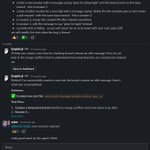
really cool. i've built a "git proxy" that auto-subscribes when the agent does a "git push" via bash. this means it gets events for all state changes of the branch (like PR opened, merged, closed)
i like the "auto-ness" of our approach but this feels more extensible, 🙏 @zeeg

Where I inadvertently compared @pidotdev and LangGraph -- don't be like me
Like most AI agent products, we've had our fair share of rewrites
The last one was focused on decoupling the agent's runtime from its definition -- and we think you should do the same
empirical.run/blog/agent-run…
