

building @just_unmute · talk to claude code & codex by voice · shipping in public from bengaluru · @iitgn
Bengaluru
Joined August 2022
- Tweets2.1K
- Following577
- Followers234
- Likes1.7K




Pinned Tweet
plain claude haiku came within a point of a yc company's custom pdf model on their own benchmark, at 1/8 the price
building an open-source version of @reductoai (yc w24)
- their 1,000-table benchmark: reducto 88.9, plain haiku 88.2
- $0.0012 a table vs their $0.01
- my engine looked ahead on a 100-table sample, then tied on all 1,000, so i only trust full runs now
- on 1,403 mixed pages it beat reducto outright, 84.2 vs 80.9
open source, every number from each benchmark's own grader


i tested 272 ideas to beat a yc company's custom model. most of them made things worse
part 3 of my open-source version of @reductoai (yc w24)
plain claude haiku already read pages about as well as reducto, so the plan was to have fable 5.2 build clever layers on top and pull ahead. it mostly backfired:
- smaller page images to save money: 19 tables came out broken
- letting the model think less: 35% cheaper, but table grids dropped 8 points
- zooming into every checkbox: fixed one, broke two
- reading every page twice and fixing the differences: worse than reading it once
so a change only stayed if it never made results worse. 272 experiments in 4 days, 75 thrown out completely
the ones that survived didn't try to read better than haiku. they added what haiku doesn't do at all: where each block sits on the page, repairing table grids, reading fillable pdf fields directly
full story and code in the reply

an ai judge gave 10/10 to a page with a wrong number on it
part 5 of my open-source version of @reductoai (yc w24), built with fable 5.2
early on, claude sonnet graded every parsed page. then i checked some by hand
- it read 27,174,839 as 27,174,339 and still gave the page 10/10
- same output, graded twice, two different scores
if you grade ai with ai, your benchmark is mostly vibes. so i threw those scores out and only used each benchmark's own official grader
that's why every number in part 4 comes from each benchmark's own grader

9
an ai judge gave 10/10 to a page with a wrong number on it
part 5 of my open-source version of @reductoai (yc w24), built with fable 5.2
early on, claude sonnet graded every parsed page. then i checked some by hand
- it read 27,174,839 as 27,174,339 and still gave the page 10/10
- same output, graded twice, two different scores
if you grade ai with ai, your benchmark is mostly vibes. so i threw those scores out and only used each benchmark's own official grader
that's why every number in part 4 comes from each benchmark's own grader
plain claude haiku came within a point of a yc company's custom pdf model on their own benchmark, at 1/8 the price
building an open-source version of @reductoai (yc w24)
- their 1,000-table benchmark: reducto 88.9, plain haiku 88.2
- $0.0012 a table vs their $0.01
- my engine looked ahead on a 100-table sample, then tied on all 1,000, so i only trust full runs now
- on 1,403 mixed pages it beat reducto outright, 84.2 vs 80.9
open source, every number from each benchmark's own grader
i tested 272 ideas to beat a yc company's custom model. most of them made things worse
part 3 of my open-source version of @reductoai (yc w24)
plain claude haiku already read pages about as well as reducto, so the plan was to have fable 5.2 build clever layers on top and pull ahead. it mostly backfired:
- smaller page images to save money: 19 tables came out broken
- letting the model think less: 35% cheaper, but table grids dropped 8 points
- zooming into every checkbox: fixed one, broke two
- reading every page twice and fixing the differences: worse than reading it once
so a change only stayed if it never made results worse. 272 experiments in 4 days, 75 thrown out completely
the ones that survived didn't try to read better than haiku. they added what haiku doesn't do at all: where each block sits on the page, repairing table grids, reading fillable pdf fields directly
full story and code in the reply
fable 5.2 rebuilt a yc company's entire api in 2 hours 12 minutes
part 2 of my open-source version of @reductoai (yc w24)
companies don't pay reducto just for a model, they pay for the api around it: parse pdfs, extract fields, split, classify, edit
so i had fable 5.2 copy it exactly. one fable 5.2 agent built the core, then 5 more fable 5.2 agents worked in parallel. if you use reducto, switching is one url change. their own python sdk works unchanged
- all 20 api routes
- 630 tests
- every extracted value cites its exact spot on the page
- same files, real reducto responses: extract, split, classify, edit all matched
- one extraction job: $2.92 on reducto, $0.50 on readanydoc
full story and code in the reply

plain claude haiku came within a point of a yc company's custom pdf model on their own benchmark, at 1/8 the price
building an open-source version of @reductoai (yc w24)
- their 1,000-table benchmark: reducto 88.9, plain haiku 88.2
- $0.0012 a table vs their $0.01
- my engine looked ahead on a 100-table sample, then tied on all 1,000, so i only trust full runs now
- on 1,403 mixed pages it beat reducto outright, 84.2 vs 80.9
open source, every number from each benchmark's own grader
11
Arpit retweeted

I’m dropping a new conspiracy.
There is no way this many people with large influence spent time, money and tokens to make all these negative posts today.
Who is paying for this negative PR? 🤨

No one on our team loved Astra 6.2.
We have a 30-person team at Every, including our Frontier team, which gets access to these models before they come out, and we put them through their paces on our real work tasks, from coding to writing to design to knowledge work.
This is not a great model. No one on our team who tried it switched back to it.
Astra 6.2 is a real step back for writing. It had strong design defaults but couldn't vary them or be creative, and for coding we found it stopped too soon on end-to-end builds.
Get the full vibe check: every.to/live/openai-astra-s…
fable 5.2 rebuilt a yc company's entire api in 2 hours 12 minutes
part 2 of my open-source version of @reductoai (yc w24)
companies don't pay reducto just for a model, they pay for the api around it: parse pdfs, extract fields, split, classify, edit
so i had fable 5.2 copy it exactly. one fable 5.2 agent built the core, then 5 more fable 5.2 agents worked in parallel. if you use reducto, switching is one url change. their own python sdk works unchanged
- all 20 api routes
- 630 tests
- every extracted value cites its exact spot on the page
- same files, real reducto responses: extract, split, classify, edit all matched
- one extraction job: $2.92 on reducto, $0.50 on readanydoc
full story and code in the reply
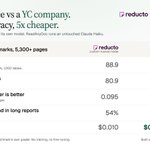
i built an open-source version of a yc company with fable 5.2. it matches them on their own benchmark and costs 5x less
@reductoai (yc w24) trained its own model to read pdfs. i used claude haiku, untouched. 5,300+ pages, 5 public benchmarks:
- tables, on reducto's own benchmark: 88.2 vs their 88.9, a match
- everyday pages: 82.2 vs 80.9
- 15% fewer text errors
- finds 75% of the table rows in long reports. reducto: 54%
- about $0.002 a page instead of $0.01
reducto sells a full document api: you send a pdf, you get back clean text, tables and fields. their bet was a custom-trained model. mine was that a general model you don't train at all can do the same job, and gets better every time a new one ships
so over 4 days, fable 5.2 built readanydoc around plain haiku. no training, no fine-tuning. every page above was scored by the benchmark's own grading code:
- tables: rd-tablebench (reducto's own), 1,000 tables
- everyday pages: olmocr, 1,403 pages
- text accuracy: omnidocbench, 1,651 pages
- scanned forms: funsd, 199 forms
- long documents: 10 full reports
over the next few posts i'll share every decision that got me here, what worked and what didn't. follow along
the full story, every benchmark and the code are in the reply

part 3, the 272 ideas fable 5.2 tested and what failed: teapawt.net/arpittalksstuff/status…
i tested 272 ideas to beat a yc company's custom model. most of them made things worse
part 3 of my open-source version of @reductoai (yc w24)
plain claude haiku already read pages about as well as reducto, so the plan was to have fable 5.2 build clever layers on top and pull ahead. it mostly backfired:
- smaller page images to save money: 19 tables came out broken
- letting the model think less: 35% cheaper, but table grids dropped 8 points
- zooming into every checkbox: fixed one, broke two
- reading every page twice and fixing the differences: worse than reading it once
so a change only stayed if it never made results worse. 272 experiments in 4 days, 75 thrown out completely
the ones that survived didn't try to read better than haiku. they added what haiku doesn't do at all: where each block sits on the page, repairing table grids, reading fillable pdf fields directly
full story and code in the reply
66
i built an open-source version of a yc company with fable 5.2. it matches them on their own benchmark and costs 5x less
@reductoai (yc w24) trained its own model to read pdfs. i used claude haiku, untouched. 5,300+ pages, 5 public benchmarks:
- tables, on reducto's own benchmark: 88.2 vs their 88.9, a match
- everyday pages: 82.2 vs 80.9
- 15% fewer text errors
- finds 75% of the table rows in long reports. reducto: 54%
- about $0.002 a page instead of $0.01
reducto sells a full document api: you send a pdf, you get back clean text, tables and fields. their bet was a custom-trained model. mine was that a general model you don't train at all can do the same job, and gets better every time a new one ships
so over 4 days, fable 5.2 built readanydoc around plain haiku. no training, no fine-tuning. every page above was scored by the benchmark's own grading code:
- tables: rd-tablebench (reducto's own), 1,000 tables
- everyday pages: olmocr, 1,403 pages
- text accuracy: omnidocbench, 1,651 pages
- scanned forms: funsd, 199 forms
- long documents: 10 full reports
over the next few posts i'll share every decision that got me here, what worked and what didn't. follow along
the full story, every benchmark and the code are in the reply
part 2, how fable 5.2 rebuilt their whole api: teapawt.net/arpittalksstuff/status…
fable 5.2 rebuilt a yc company's entire api in 2 hours 12 minutes
part 2 of my open-source version of @reductoai (yc w24)
companies don't pay reducto just for a model, they pay for the api around it: parse pdfs, extract fields, split, classify, edit
so i had fable 5.2 copy it exactly. one fable 5.2 agent built the core, then 5 more fable 5.2 agents worked in parallel. if you use reducto, switching is one url change. their own python sdk works unchanged
- all 20 api routes
- 630 tests
- every extracted value cites its exact spot on the page
- same files, real reducto responses: extract, split, classify, edit all matched
- one extraction job: $2.92 on reducto, $0.50 on readanydoc
full story and code in the reply
90
plain ocr is basically free. its also way worse
next thing fable tried: skip the big ai model and use small free ocr models, the kind you can run on your own machine
on the same public test they got about 70% of the checks right. claude haiku got 80%
they read the words fine. they just dont understand tables or columns
so fable tried mixing the two. that one surprised me

the laziest possible approach already beat reducto
reducto turns messy pdfs (bank statements, contracts, scanned forms) into clean data an ai can actually use. i'm trying to build an open source version of it with fable
first test: no pipeline, no tricks. just show claude haiku the page and ask it to read it
it got 80% of a public benchmark's checks right. reducto's own model got 76%
catch: reducto sells a version for $0.001 a page. haiku cant go that cheap

full results are out. plain haiku ended up matching reducto on their own benchmark, at 5x less teapawt.net/arpittalksstuff/status…
i built an open-source version of a yc company with fable 5.2. it matches them on their own benchmark and costs 5x less
@reductoai (yc w24) trained its own model to read pdfs. i used claude haiku, untouched. 5,300+ pages, 5 public benchmarks:
- tables, on reducto's own benchmark: 88.2 vs their 88.9, a match
- everyday pages: 82.2 vs 80.9
- 15% fewer text errors
- finds 75% of the table rows in long reports. reducto: 54%
- about $0.002 a page instead of $0.01
reducto sells a full document api: you send a pdf, you get back clean text, tables and fields. their bet was a custom-trained model. mine was that a general model you don't train at all can do the same job, and gets better every time a new one ships
so over 4 days, fable 5.2 built readanydoc around plain haiku. no training, no fine-tuning. every page above was scored by the benchmark's own grading code:
- tables: rd-tablebench (reducto's own), 1,000 tables
- everyday pages: olmocr, 1,403 pages
- text accuracy: omnidocbench, 1,651 pages
- scanned forms: funsd, 199 forms
- long documents: 10 full reports
over the next few posts i'll share every decision that got me here, what worked and what didn't. follow along
the full story, every benchmark and the code are in the reply
18
i gave fable 5.2 one prompt and went to sleep
11 hours later it had built the entire history of earth as a fully interactive 3d globe. big bang to today
drag the timeline to any year, spin to any place, click anything to go deeper. this is just ww2
the last thing on the timeline is the ai that built it

I wanted to test Fable 5.2's quality with one-shot prompts without human feedback.
Everything in this game is from scratch: models, sounds, textures. ~$550 at API pricing, ~2.7M output and 445M input tokens, heavily cached. Took 8 hours!
Play it here: claude.ai/artifact/BGY1SztrA…
next experiment is out: fable 5.2 built an open-source version of a yc company. it matches them on their own benchmark and costs 5x less teapawt.net/arpittalksstuff/status…
i built an open-source version of a yc company with fable 5.2. it matches them on their own benchmark and costs 5x less
@reductoai (yc w24) trained its own model to read pdfs. i used claude haiku, untouched. 5,300+ pages, 5 public benchmarks:
- tables, on reducto's own benchmark: 88.2 vs their 88.9, a match
- everyday pages: 82.2 vs 80.9
- 15% fewer text errors
- finds 75% of the table rows in long reports. reducto: 54%
- about $0.002 a page instead of $0.01
reducto sells a full document api: you send a pdf, you get back clean text, tables and fields. their bet was a custom-trained model. mine was that a general model you don't train at all can do the same job, and gets better every time a new one ships
so over 4 days, fable 5.2 built readanydoc around plain haiku. no training, no fine-tuning. every page above was scored by the benchmark's own grading code:
- tables: rd-tablebench (reducto's own), 1,000 tables
- everyday pages: olmocr, 1,403 pages
- text accuracy: omnidocbench, 1,651 pages
- scanned forms: funsd, 199 forms
- long documents: 10 full reports
over the next few posts i'll share every decision that got me here, what worked and what didn't. follow along
the full story, every benchmark and the code are in the reply
44


