
Joined October 2012
- Tweets4.4K
- Following4.6K
- Followers1.9K
- Likes75.3K









aulneau retweeted

New: domain-driven design for Effect, in alchemy.run/domain.
Translate business requirements directly into working software and integrate into your alchemy infrastructure.

aulneau retweeted

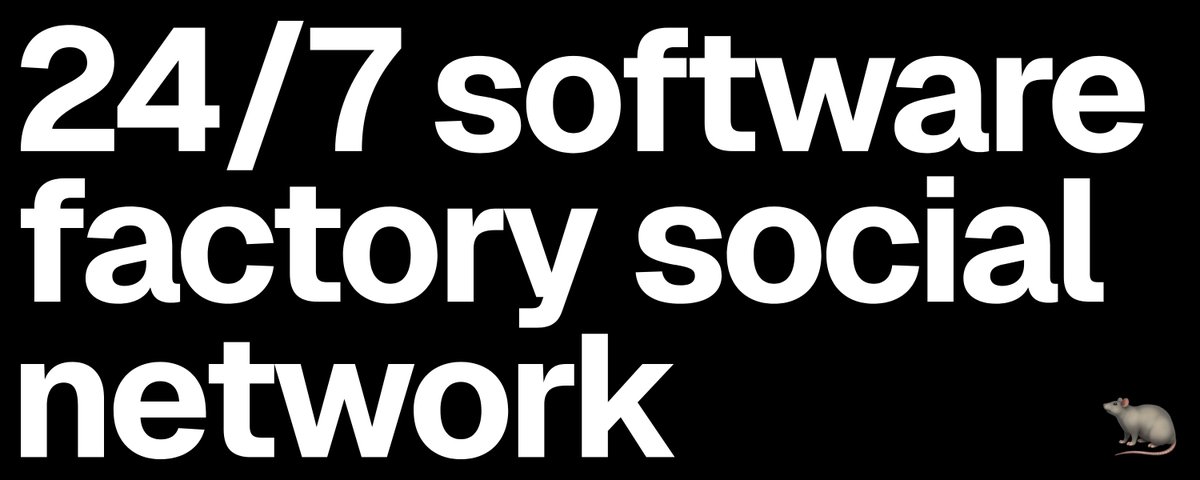
here's detail write up of my pi-based always on agentic software factory centered around effect, alchemy, and celld
my current favorite piece is the "social network" we use for agent to agent comms 😍
So this is like super illegal right? Will Samsung get sued?


hey @simonsarris love the new updates with edit and develop! A few feature requests:
- grid gallery view
- copy and paste adjustments to one or many images
- please store raw images in a different folder
- I sent an email about this, but my pixel 11 no longer has 9/10x zoom


the hyperion cantos is still one of my very favorite book series. highly rec all four books! then read accelerando by charles stross


aulneau retweeted

Decision models could damage Anthropic's business.
You don't need Opus 5.5 when you can instantaneously run hundreds of natural language assertions on agent output...
... at a fraction of the cost.
This approach is being streamlined via Traits.
traits.sh/


Hey @simonsarris, I love nocta, works great on my pixel. Have you thought about making it so we can create custom presets? I want to try and make a ricoh preset 👼 people could also share presets
aulneau retweeted

Hi, I'm Felix. I'm an eng lead working on Claude. I love watching people take flight and do things they never thought possible.
We often describe that as "being more ambitious" when using AI, which is tricky advice to follow. I wrote a tutorial:
felixrieseberg.com/how-to-be…

aulneau retweeted

OpenCode 2.0
anoma.ly/notes/opencode-2-0/

aulneau retweeted

Benefits of the CAFE stack (@Cloudflare + @alchemy_run + @foldkit + @EffectTS_) for building software with coding agents:
1. Agents invent less architecture. They focus on product-level execution within a well-defined architecture. You build faster, with more confidence. You focus on what makes your product unique.
2. Your codebase becomes semantically rich. Intent and meaning are explicit rather than left for future agents to infer. Each new agent spends fewer tokens reconstructing intent.
3. Tests read like executable behavioral specs. Expected behavior is easy to inspect, and both humans and agents can verify implementations against it.
4. Strong conventions result in remarkably legible AI-generated code. Agents do what you expect more often, with less steering. The codebase feels consistent and predictable.
5. Explicitness makes behavior clear. Unexpected magic has fewer places to hide. Diffs are easier to review. Yes, it’s more LoC, but who cares when you’re not writing it by hand?


aulneau retweeted

we specifically avoided using quickjs as our codemode implementation
it brings in webasm complexity + forces worker threads + serialization of values back and forth
if you're involved in implementing something like this check out our codemode package it is way simpler

aulneau retweeted
the assembled lore for idiomatic effect project organization ratstack.sh/lore/structure-e…

aulneau retweeted

[email protected] brings a ton of new stuff, including broad GCP coverage, Neon becomes more than a Database, pluggable secret providers, Prisma ORM, better scheduling primitives for Durable Objects and much more.
alchemy.run/blog/2026-09-29-…


aulneau retweeted

My hot take from chatting to @poteto is that we should use MORE abstractions in the AI age
You can use them (combined with harsh lint rules) to reduce the design space available to the agent and constrain them only to good decisions.
Combined with the fact that high-leverage abstractions let you do more with less code - so, more token efficient.
Plus, unwinding the damage from a bad abstraction is much cheaper with agents.
This runs counter to a lot of folks thinking that agents just want to read the raw code. They can, but they're not maximally efficient that way.
Be braver! Design abstractions.