

The Gatekeeper for Token Communities on Robinhood Chain. 0x9a56738c5c413abc99b78758a63c89ac098f7e7d
Joined September 2026
- Tweets40
- Following4
- Followers69
- Likes10









Pinned Tweet
$A401 is live on Robinhood Chain via @ponsdotfamily .
The token powers the access layer built for programmable onchain authorization and continuous community gating.
CA: 0x9a56738c5c413abc99b78758a63c89ac098f7e7d

Auth401 is evolving past simple token gating.
At the core, it’s an authorization engine that turns live onchain state into community permissions.
A typical access flow looks like this:
wallet signature → policy evaluation → authorization decision → continuous re-check
The policy layer can evaluate things like token balance, holding duration, NFT ownership, wallet age, contract activity, allowlists, blocklists, and cross-chain conditions.
That means access is no longer just:
“Do you hold X token?”
It can become:
“Does this wallet still satisfy the exact policy this community requires?”
And because Auth401 keeps re-evaluating eligibility, permissions can change as onchain state changes.
200 → Authorized
401 → Unauthorized
403 → Access Revoked
No custody.
No approvals.
No manual checking.
Just programmable authorization backed by blockchain state.
Auth401 is building the permission layer for token communities.
Most token communities still run access like it’s 2021.
Check a wallet once.
Add the user to Telegram.
Hope they still qualify a month later.
Auth401 changes that.
Auth401 turns live blockchain state into programmable community permissions.
→ Verify wallet ownership
→ Check token balances, NFTs & LP positions
→ Enforce holding periods and wallet-age rules
→ Combine allowlists, blocklists & custom policies
→ Grant access automatically
→ Continuously re-check eligibility
→ Revoke access when the policy is no longer satisfied
No custody.
No manual screenshots.
No static token-gating bot.
Your community defines the rules.
Auth401 handles the gate.
Already built across multiple chains, with Telegram as the first access layer.
200 — ACCESS GRANTED
401 — UNAUTHORIZED
403 — ACCESS REVOKED
Onchain access control should be infrastructure, not admin work.
auth401.xyz
Access granted shouldn’t mean “we checked once.”
With Auth401, every request is evaluated against live onchain conditions before the gate opens.
Wallet verified.
Policy checked.
Requirements passed.
200 — AUTHORIZED
And if those conditions stop being true later, access can be re-evaluated too.
That’s the difference between a basic token gate and a real authorization layer.
Auth401 verifies the wallet, enforces the policy, and guards the community.
$A401
Access granted shouldn’t mean “we checked once.”
With Auth401, every request is evaluated against live onchain conditions before the gate opens.
Wallet verified.
Policy checked.
Requirements passed.
200 — AUTHORIZED
And if those conditions stop being true later, access can be re-evaluated too.
That’s the difference between a basic token gate and a real authorization layer.
Auth401 verifies the wallet, enforces the policy, and guards the community.
$A401

The gate is only useful if it knows why someone should be allowed through.
That’s what Auth401 is building.
Onchain native.
Access comes from live blockchain state.
Non-custodial.
Users prove ownership with signatures. No funds move. No custody.
Continuous.
Eligibility can be rechecked after entry, not just once at the door.
Programmable.
Communities define their own rules instead of relying on one dumb balance check.
Token communities shouldn’t run on manual approvals and guesswork.
They should run on policy.
Auth401 guards the gate.
$A401
A lot has changed with Auth401 in a very short time.
We started with a simple idea:
A Telegram gatekeeper for token communities.
Now it’s turning into a real onchain authorization layer.
What we’ve shipped so far:
• Wallet verification through signed messages
• Programmable access policies
• Token balance gating
• NFT ownership checks
• Holding-duration rules
• Wallet-age conditions
• Allowlist / blocklist logic
• Automatic access approval
• Continuous eligibility checks
• Automatic access revocation
• Multichain support
• Cross-chain policy logic
• Tiered access for Holders / VIPs / Whales / OGs
• Solana wallet support through Phantom / Solflare
• EVM wallet support through MetaMask / WalletConnect
• Arc Mainnet support now live
The whole idea is simple:
Access should not be permanent. It should be earned from live onchain state and continuously verified.
200 — Authorized
401 — Unauthorized
403 — Access Revoked
One gatekeeper.
Multiple chains.
Programmable rules.
Continuous enforcement.
And we’re still early.
$A401 is becoming the access layer for token communities.
Auth401 was never architected to just be a Telegram bot. In fact, if the Telegram integration didn't exist, the core product would still be: Programmable authorization infrastructure.
The Telegram bot is simply the first practical distribution client. It demonstrates the engine’s capability. Under the hood, Auth401 is built as an extensible standard that moves access control entirely off of localized application databases and onto the public ledger.
While we launch with the focus and constraints of V1 perfecting the gatekeeper experience the infrastructure is built to scale. What starts with group gating can evolve into on-chain reputation modeling, or what we call Proof of Conviction.
This shifts access logic away from binary balance checks and toward nuanced, multi-chain parameters. The goal is to move past 'guessing' and toward deterministic policy evaluation. Once that primitive is hardened, Auth401 can move beyond chat interfaces.
If we are building a world that is strictly on-chain, our authentication layers must be too.
Access should be a policy. Not a guess.
Most token gating relies on binary, one off balance checks that fail to capture real conviction. Auth401 turns on chain state into programmable community permissions.
By evaluating multi variable logic token balances, holding duration, LP positions, wallet age, and historical contract interactions the policy engine grants access based on verifiable on chain proof.
Define the rules. Verify the state. Enforce access deterministically.

The Auth401 setup and integration demo is now live.
A lot of you asked how the entire setup actually looks in practice, so we put together a complete walkthrough. See how administrators add and configure the bot inside a Telegram group, define custom cross chain rules, and activate continuous policy enforcement.
The video also covers the end user experience, detailing gasless, native signature verification across supported wallets.
Arc support is now LIVE on Auth401.
We started with @Arc on testnet.
Now that Arc Mainnet is here, A401 has moved with it.
Token communities on Arc can now use Auth401 for:
Wallet verification.
Programmable access policies.
Token-gated Telegram communities.
Continuous eligibility checks.
Automatic access revocation when requirements are no longer met.
Same gatekeeper.
Now on @Arc Mainnet.
Verify → Policy → 200 Authorized
More chains. More communities. One access layer.
$A401 × Arc

A401 Update
Until now, our @arc integration was built around Arc Testnet.
With @arc Mainnet now live, our immediate priority is clear:
Make Auth401 fully Arc-friendly first.
That means shifting our focus from testnet support to production-ready Arc Mainnet authorization — so token communities launching on Arc can use A401 for:
wallet verification, token-gated access, programmable policies, continuous checks, and automatic revocation when requirements are no longer met.
Arc is moving to mainnet.
A401 is moving with it.
First focus: Arc Mainnet readiness.
Then we keep expanding the multichain gatekeeper.
Auth401: Operational Infrastructure & Deployment Progress
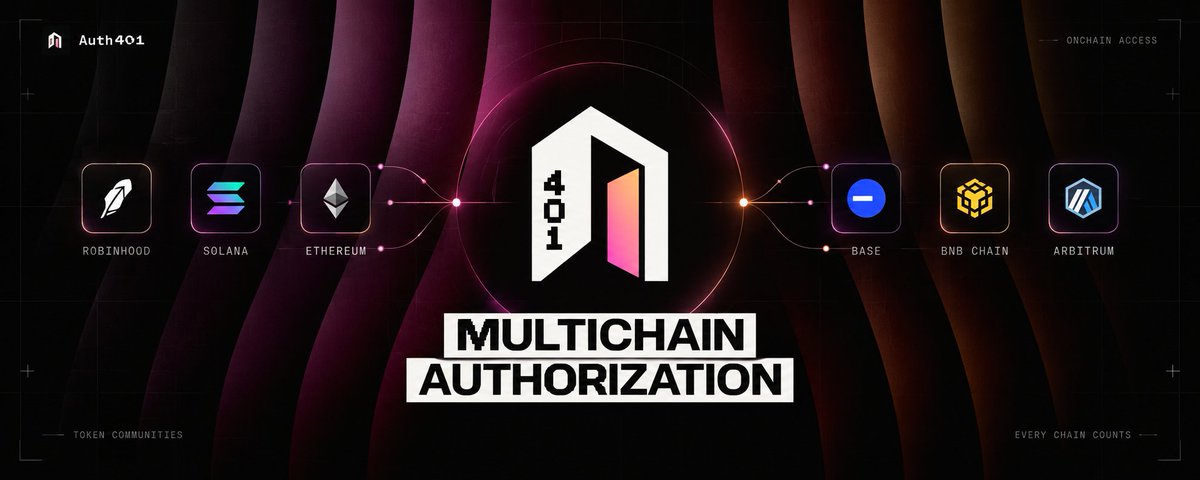
Auth401 began as an on chain gatekeeper for Robinhood Chain communities, built to eliminate the security vulnerabilities of static, one-time token verification. Today, the protocol functions as a live multi-chain authorization engine across Robinhood Chain, Solana, Ethereum, Base, BNB Chain, and the Arc Testnet.
The core infrastructure executes gasless, zero custody cryptographic signature challenges natively inside Phantom and Solflare for Solana, and via MetaMask and WalletConnect for EVM networks. Users complete verification directly within their wallet environment without external browser redirects or unnecessary transaction fees. Telegram serves as the primary distribution client, where the onboarding bot automates community entry, ongoing checks, and role assignments without manual administrative overhead.
Rather than relying on primitive point in time snapshots, Auth401 enforces continuous authorization. The system periodically audits active wallet balances against configured community rules, deploying automated grace periods and programmatic revocations (HTTP status 403) whenever a wallet no longer complies.
With the release of Policies v2, the protocol introduces composable cross chain policy architecture and dynamic tiering. Communities can now evaluate multi chain balances and protocol interactions simultaneously under a single rule set. A single wallet signature parses eligibility across general holders, liquidity providers, and early supporters, updating community permissions automatically as on-chain states change.
Most token-gating bots answer one question once:
“Does this wallet hold the token?”
Auth401 is building something deeper.
Programmable, continuous authorization for token communities.
A member verifies their wallet.
Auth401 evaluates the community’s onchain policy.
If the rules pass:
200 — AUTHORIZED
But access doesn’t become permanent.
Auth401 keeps checking.
If the wallet stops qualifying, it can enter a grace period. If the policy still fails:
403 — ACCESS REVOKED
No custody.
No token approvals.
No gas just to verify.
Decisions happen server-side against live onchain state.
And Auth401 is no longer tied to one ecosystem.
Robinhood Chain
Solana
Ethereum
Base
BNB Chain
Arc Testnet
One gatekeeper.
Multiple chains.
Programmable policies.
Continuous enforcement.
Your community. Your rules. Auth401 handles the gate.
Auth401 Policies v2 is Live: Multi-Chain Authorization & Dynamic Tiering
Single network access checks no longer reflect modern token ecosystems. Policies v2 upgrades the Auth401 engine to support composite, cross chain rules and automated role segmentation.
Composite Cross Chain Logic: Evaluate state across Robinhood Chain, Solana, Ethereum, Base, and EVM networks simultaneously. Combine holdings, LP stakes, and network criteria into a single evaluation.
Dynamic Access Tiers: Assign holders, OGs, and whales to distinct channels from one policy configuration.
Single Verification Flow: Users authenticate once using native wallet signatures. Permissions adjust automatically as on-chain balances evolve.
Multi chain was the foundation.
Policies v2 delivers programmable access control.
Next Up for Auth401: Cross-Chain Policies.
Multichain support was just the beginning. With Auth401 Policies v2, we’re taking access control to the next level.
Communities will be able to define access policies using conditions across multiple blockchain networks.
For example:
Hold a token on Robinhood.
Own an NFT on Solana.
Meet a balance threshold on Ethereum.
Meet the required conditions and gain access.
With tiered access, communities can automatically distinguish between Holders, VIPs, Whales, and OGs all through a single, unified verification system.
One verification.
Multiple chains.
Dynamic access levels.
One intelligent gatekeeper.
Auth401 Policies v2 is coming.
The future of access control is cross-chain.
Appreciate community members testing the architecture and documenting how seamless on-chain gating can be.
Please stay alert: do not join unverified Telegram group chats or click any external TG links floating around.
Treat all unofficial links as unverified and prioritize your operational security.

I know no one was gonna do it, so Baki did it.
Made a gated community GC for $A401 holders.
Just me seeing what Auth401 is actually building and thinking: why are we still running crypto communities like it’s 2021?
Random TG links everywhere.
Bots farming groups.
People entering with zero skin in the game.
Admins manually checking wallets.
Screenshots as “proof”.
People selling and still sitting inside gated chats forever.
Meanwhile $A401 is literally building infrastructure to fix this exact problem.
So I thought fuck it.
Let’s actually use the concept.
The idea is simple:
Hold / meet the required onchain conditions → get access.
No endless manual verification.
No random people farming the GC.
No pretending you’re part of the community when your wallet says otherwise.
Your wallet becomes your access credential.
And imo this is where Auth401 gets interesting.
Token gating itself isn’t new.
But programmable access that can continuously verify whether someone still meets the rules is a completely different game.
Today it can be a private $A401 GC.
Tomorrow it can be alpha groups, DAOs, trading communities, NFT communities, private research groups, contributor chats, premium channels and basically any community where access should depend on verifiable onchain conditions.
I’m not waiting for someone else to build the culture around it.
If we’re early, act early.
So yeah
Baki made the $A401 gated GC.
Built by the community.
For the community.
Now let’s see who actually belongs behind the gate. 🔐
$A401
0x9a56738c5c413abc99b78758a63c89ac098f7e7d


