

Associate Professor @UCLAAnderson. Market design, digital platforms, AI. @UCBerkeley PhD.
Los Angeles, CA
Joined May 2026
- Tweets667
- Following528
- Followers1.2K
- Likes1.8K




Pinned Tweet
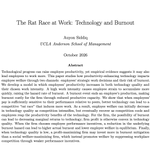
New research: Does AI accelerate the “rat race” at work?
This paper considers that question in light of empirical evidence that suggests AI is intensifying work, and tries to unpack some of the relevant economic forces within a simple theoretical model.
1/

One way to think about this: How much does a boost in economic growth rates pull the future forward?
Suppose that starting in 1970, growth rates received a lasting boost of 2pp/year. Then the year 2000 arrives in 1988 instead, in terms of annual output. That's a big deal!

I would love it if some economists wrote a clear general-audience-accessible piece on how to think about 2pp (or growth) in units and abstractions, or even one just specifically aimed at AI researchers and computer scientists. I don't just mean something like "here is the long-run trend in GDP and the trend in child mortality and they correlate" or something one would see at a progress conference. That is good but not enough.
What I mean is something that will help to deeply calibrate a sophisticated (quantitative yet non-economist) reasoner on why 2pp matters.
In my experience as one of the extremely few computer scientists working on the economics of frontier AI, most computer scientists (who generally have no economic training) do not think 2pp over the next decade can coincide with much progress in society/improved welfare. Not to be unkind to my fellow computer scientists, but I honestly think the first-order reason is 2 is a small number, fairly close to 0.
So if one believes that AI will improve society dramatically, then that suggests they need to reject "2pp" and, often, to throw out trust in economists with it altogether (baby with the bathwater). But I think a lot could be fixed if economists can help reconcile "2pp" and with "materially better".
(And maybe this already exists and I am unaware.)
Auyon Siddiq retweeted

New Substack post with @soumitrashukla9. Work has never been just about the income earned sans effort costs, as typical in economic models. Key aspects of people’s identity, their meaning, and sense of agency are all wrapped up with what they do for a living.
There has been a lot of conversation lately about how technological change, particularly AI, may disrupt this relationship, from Ezra Klein's column on his own mathematician father’s grapplings with losing meaning in mathematics, to Francis Fukuyama's post on AI, agency, and recognition. In this piece we take a historical perspective on how technological transformation has disrupted identity and meaning by affecting jobs, and how workers and society responded to these changes.
Much of the debate around AI and jobs has centered on wages and material consequences, but losing one's work is also intertwined with how people view their place in society. Most people know about the Luddites—skilled weavers and knitters—who protested the devaluation of their mastery. What’s less known is that the Luddites were actually experts in using the machines as well, and that their protests prompted prominent economists like David Ricardo to rethink the role of automation in society, and later inspired the Arts and Crafts movement. A century later, when recorded sound displaced 20,000 cinema musicians, their campaign against "canned music" and two-year recording ban pressured labels into funding live performance.
Soumitra and I have been working on versions of this essay for months. He led the piece, and we’re both really excited to get it out there.
Link to the post here: aleximas.substack.com/p/tech…


The most revealing part of this conversation between Jon Stewart and Jacob Coxon wasn't Coxon's warning about A.I. doom, but his description of A.I. utopia, and Stewart's incredulous response. I wrote about it — and Francis Fukuyama's "Last Man," and A.I. easily solving the problems that bedeviled my father's field of mathematics for decades — here: nytimes.com/2026/10/18/opini…

Auyon Siddiq retweeted

Very happy to share a new paper, “Technology Bottlenecks: Measuring Where AI Could Raise the Value of Work It Cannot Yet Do.”
AI exposure measures ask about the work AI is capable of doing. We ask instead where the marginal value of work AI cannot yet do may rise as AI speeds up the rest of the job.
To do so, we employ 288 million U.S. job postings mapped line by line to their closest O*NET tasks and GPT-4 feasibility ratings from Eloundou et al. (2024) to construct a measure, “bottleneck pressure,” for each task in each occupation that posts it.
Using a simple task-based framework, we derive this pressure at the task level, showing that for an AI-infeasible task it is the exposure of the occupation that posts it, so the same task can face very different bottleneck pressure in different jobs.
Reporting bottleneck pressure alongside AI exposure shows both the scope for AI to perform work and where improving the work it cannot do may pay off more as capabilities expand.

Business schools definitely face many challenges. But this article calling to shut them down mostly attacks a caricature of what business schools are -- in its own words, one that focuses excessively on the question of “How do we maximize shareholder value?”
In reality, the modern business school is pretty different than the picture painted here:
1) For starters, the article omits any mention of the excellent research being done in business schools. At the author's own institution of Cambridge, this includes research on patient safety in hospitals and entrepreneurship in developing economies. The faculty of most business schools include economists, psychologists, and engineers, all of whom bring different perspectives from their research into the classroom. All of this is sidestepped in the article.
2) One of the main criticisms is that the "case method" focuses too much on single decision-makers over institutions. There is truth to this. But business schools also use a variety of teaching methods. For example, when I teach MBA statistics we emphasize being critical consumers of data and developing broader data literacy skills, without using traditional cases. This makes the student the protagonist of the case rather than a hypothetical manager.
3) Lastly, the article understates the agency that students have, which shapes curricula in the long run. Competition drives business schools to be responsive to student demands, and this usually includes lessons beyond profit-maximization (try to give a 90 minute lecture to MBA students on improving shareholder value and you'll be booed out of the classroom). And if MBA graduates want to work for Goldman Sachs after graduation, that's their own decision -- let's not infantilize our students.
For sure, there are sector-wide concerns about the future of MBA programs and business schools, but transforming students from altruists into mindless profit-maximizers is not one of them.
nytimes.com/2026/10/18/opini…

Auyon Siddiq retweeted

Be like Robert Hall:
Write papers that are overwhelmingly correct and deeply insightful, but which also make the smartest people around you think you're on drugs.
Four predictions from the model:
1) Employee welfare can fall as technology improves if employee evaluation depends sufficiently strongly on their relative performance. Each employee works harder in anticipation of more productive peers, even though collectively they would all prefer to work less.
2) The firm’s marginal returns to technology can be decreasing when employees face burnout risk and the gains from technology are large; without burnout, marginal returns are increasing.
3) When the firm can adjust performance incentives, a decrease in burnout risk (e.g., improved work conditions) can increase burnout in equilibrium. The firm makes the most of its more stable workforce by ratcheting up competition through stronger performance incentives.
4) Lastly, when productivity gains from technology are modest, a profit-maximizing firm can spend more on burnout mitigation (e.g., wellness programs) than one that also internalizes employee welfare; the latter instead protects welfare by suppressing workplace competition through weaker incentives.

Main takeaways:
(I) Whether employees collectively benefit from improved productivity depends on the structure of workplace incentives,
(II) improvements in work conditions that coincide with technological progress can be “optimized away” by the firm, making burnout worse, and
(III) a welfare-conscious organization may find it more efficient to protect employees by cooling competition, rather than only investing in wellness.
Full paper: auyonsiddiq.com/pdfs/ratrace…
Nobel committee deserves their own peace prize for trying to keep both sides happy


BREAKING NEWS
The Royal Swedish Academy of Sciences has decided to award the 2026 Sveriges Riksbank Prize in Economic Sciences in Memory of Alfred Nobel to Robert E. Hall and Michael Woodford “for microeconomic foundations of macroeconomic stabilisation.”
#NobelPrize

On technological change and identity: @BStulberg has a nice metaphor of thinking about identity as rooms in a house.
If your house has only one room and it floods, it is devastating. But if your house has multiple rooms, you can try to find some peace in another.

🧵1/10 Given the recent reactions of mathematicians over rapid advances in AI, I think it is important to remember that technological change has historically been a very personal event for people.
Over the history of technological progress, looms have fallen silent, switchboards have gone dark, and factory lines have shrunk bringing with them a human crisis of identity and what it means to be a master of one's craft.


To give a better sense of the kind of work you can do in operations management, here are 10 papers by senior Ph.D. students -- 5 theoretical and 5 empirical -- in no particular order:
THEORY
1. Preventing Catastrophic Wildfires: Annual Grid Inspection and Maintenance Plan (Abolfazl Taghavi et al.)
Uses stochastic optimization to study how utilities should inspect grid infrastructure to reduce wildfire risk. papers.ssrn.com/sol3/papers.…
2. Mitigating Shortages of Generic Drugs: The Role of Reliability Certification (Robert Swinney, Xiaoyu Wu, Can Zhang)
Uses a game-theoretic model to study whether certification of drug manufacturers can help prevent drug shortages. papers.ssrn.com/sol3/papers.…
3. Pooling Goods of Different Quality: Platform Design under Inventory Commingling (Hanqi Wen et al.)
Uses a game-theoretic model to study the impact of online marketplaces mixing inventory from sellers of different quality. papers.ssrn.com/sol3/papers.…
4. Dynamic Persuasion Strategies for Mitigating the Spread of Fake Content (Wenjuan Li, Dongwook Shin)
Uses a persuasion model to examine when social media platforms should share fact-checking information with users. dwshin.people.ust.hk/researc…
5. Multi-agent Adaptive Mechanism Design (Renfei Tan et al.)
Combines mechanism design and optimization to study how to elicit truthful information from users when their beliefs are initially unknown. arxiv.org/abs/2512.21794
EMPIRICS
6. The Cost of Intelligence: Impacts of AI Data Centers on US Electricity Prices (Vishrut Rana et al.)
Uses a synthetic control approach to study how AI data centers are impacting electricity prices. papers.ssrn.com/sol3/papers.…
7. Reducing Prescription Errors Through Information Intervention: A Field Experiment in Healthcare Operations (Xiaodan Shao et al.)
Conducts a randomized field experiment with physicians to study whether notifications can reduce medication errors. arxiv.org/abs/2609.09673
8. Improving Access to Essential Medicines via Decision-Aware Machine Learning (Angel Tsai-Hsuan Chung et al.)
Combines machine learning and causal inference to study how to better allocate essential medicines in Sierra Leone. arxiv.org/html/2607.20542v1
9. Video-Based AI Misconduct Monitoring: Unintended Consequences on Operational Outcomes (Zhanzhi Zheng et al.)
Uses staggered difference-in-differences to study the effect of computer vision cameras used to monitor employee misconduct. papers.ssrn.com/sol3/papers.…
10. The Route Not Taken: Adjustment Headroom after the Panama Canal Expansion (Zhi Li, Xabier Barriola, Jing Wu)
Uses shipping and firm-level data to study how Panama Canal expansion changed companies' sourcing and supply-chain decisions. papers.ssrn.com/sol3/papers.…

An even better idea is to apply to PhD programs in operations management in a good business school.
You can do econ-adjacent research (theory or empirics), but face a much less competitive academic job market because nobody knows we exist
Happy to field questions!

Does cruelty toward AI make cruelty toward humans more or less likely? If it's the former, then this may be a good policy, regardless of whether AI has feelings.

Exclusive: Anthropic is updating its usage policy for the first time in over a year. The new rules prohibit sustained "abusive or cruel behavior" towards Claude & add new restrictions about propaganda campaigns, surveillance & weapon development. theverge.com/ai-artificial-i…

The potential of AI to do these kinds of epic metastudies is underappreciated. It's unlocking an entirely new class of research questions.

