
PhD candidate at Ben-Gurion University for Cognitive and Brain Sciences at the Brains and Machine lab.
Joined May 2024
- Tweets24
- Following157
- Followers64
- Likes66



Itamar Avitan retweeted

Some more AI-assisted teaching. This week, I gave our @bengurionu Cognitive and Brain Sciences sophomores a primer in multivariable calculus to help them develop an intuitive understanding of gradient descent, building on a smart lecture plan originally developed by @OrenShriki.
I used Codex to develop an interactive, fully client-side @plotlygraphs demo that visualizes how fixing all but one variable collapses a multivariable function into a function of a single variable—and how partial derivatives are simply ordinary derivatives of these one-variable functions.
Because the demo runs entirely in the browser, students can open it themselves and interactively explore the surfaces, slices, and derivatives.
The demo is available online and for download here:
brainsandmachines.org/demos/…
Itamar Avitan retweeted

Cognitive computational neuroscience
nature.com/articles/s41593-0…
1/ Move beyond brain mapping.
Mapping which brain regions activate during a task is not enough to explain cognition. We need computational models that reproduce behavior and explain how neural activity generates perception, learning, decision-making, and action. The goal is to understand the mechanism, not just the location.
2/ Build models that perform cognitive tasks.
Allen Newell argued that understanding cognition requires constructing systems that actually perform the functions we want to explain. A theory of decision-making, for example, should predict choices under different conditions—not merely describe them verbally. Simulations help test whether proposed mechanisms work together to produce intelligent behavior.
3/ Integrate three disciplines.
Cognitive science explains the computations underlying thought; computational neuroscience investigates how neural circuits implement those computations; AI develops algorithms that perform complex tasks. Each provides different constraints. Combining them could produce models that are simultaneously behaviorally effective, computationally explicit, and biologically grounded.
4/ Neural networks are a bridge between brains and AI.
Deep neural networks learn hierarchical representations that can resemble those observed in biological sensory systems. Research has shown that networks trained for object recognition can predict aspects of visual cortical representations. However, predictive similarity does not prove that the brain uses the same algorithms. Models must also be tested against neural and behavioral evidence.
5/ Biological neurons offer more than artificial units.
Most conventional artificial neural networks use simplified units that combine inputs and apply nonlinear transformations. Biological neurons exhibit action potentials, dendritic computations, recurrent signaling, oscillations, and complex temporal dynamics. Incorporating these features into task-performing models may reveal computational principles that simpler AI architectures overlook.
6/ Neural decoding is not a complete explanation.
Decoding asks what information can be extracted from neural activity. Encoding models predict neural responses; representational similarity analysis compares patterns of activity; connectivity models examine interactions. These methods constrain theories, but they do not necessarily explain how the brain transforms information to solve a task. Mechanistic models must connect representations to computation and behavior.
7/ Bayesian inference offers a theory of perception and reasoning.
The brain must interpret noisy sensory information using prior knowledge about the world. Bayesian models formalize this process by combining prior beliefs with incoming evidence. Generative models go further by representing how hidden causes produce observations. They offer a framework for studying uncertainty, causal reasoning, concept formation, and the ability to learn from limited experience.
8/ Learning and control require multiple strategies.
Reinforcement learning provides a framework for understanding how actions and feedback shape future behavior. Model-free approaches learn values or policies from experience; model-based approaches use an internal model to evaluate possible outcomes; episodic approaches reuse specific past experiences. Understanding how biological brains combine these strategies could inform more adaptive AI systems.
9/ Combine bottom-up and top-down approaches.
Bottom-up neuroscience begins with neurons, circuits, and measured activity. Top-down approaches begin with a cognitive function and ask what computations are required to perform it. Neither is sufficient alone. Strong theories should explain how biological mechanisms support meaningful behavior—and use behavioral requirements to identify which neural mechanisms matter.
10/ The future is an integrated NeuroAI.
A major challenge is to connect three levels: computational goals, representations and algorithms, and neurobiological implementation. This requires collaboration across neuroscience, cognitive science, mathematics, and AI, along with shared datasets, models, tasks, and evaluation methods. The ultimate ambition is to build systems that perform intelligent tasks while explaining how brains learn, represent knowledge, and adapt.
The big idea:
The next leap in AI and neuroscience may come from treating the brain not simply as a source of data, but as a system whose computational principles can be tested through models that connect neural mechanisms to intelligent behavior.

Itamar Avitan retweeted

1/5
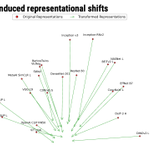
New preprint: what does lateral recurrence add to visual representations?
Recurrence reuses the same weights over time: more computation, no new parameters.
Does that extra computation refine representations? If so, which ones?
doi.org/10.64898/2026.10.02.…

Itamar Avitan retweeted

Leading AI models appeared to predict brain activity equally well…
…until we asked them to synthesize images that precisely control neural firing, like these 👇
Across 25 neural sites, closed-loop experiments revealed striking hidden differences in model-brain alignment.
🧵
Itamar Avitan retweeted

What is the nature of universal representations in AI models, and what determines whether they emerge?
Our paper accepted at #neurips2026 led by @florianmahner & @andropar addressed these questions comparing 162 vision models, with intriguing results.
arxiv.org/abs/2605.13675
👇


Itamar Avitan retweeted
How can we design experiments that make models disagree? One section of our new @NatRevNeurosci Review with @KriegeskorteLab and @SchuettHeiko examines studies that used stimulus sets designed to elicit distinct predictions from competing models. Full text link at the end. 1/14
Itamar Avitan retweeted

I deeply resent that AI has forced me to eliminate em dashes from my writing for fear of signaling slop
Itamar Avitan retweeted

UNIfication enables PFDA by activating protocol fees. PFDA internalizes MEV through auctioned fee discounts.
Complementary approaches push this further by doing MEV inference and resolution in-transaction - making backruns and JIT routing atomic, deterministic, and no longer block-level MEV.
Presenting our #NeurIPS2025 work on model–behavior alignment today.
Could we even recognize the “right” model of behavior under flexible evaluation?
Come chat about DNNs & human visual perception!
Hall C-E #2010
Friday (today!) 4:30 – 7:30 PM
neurips.cc/virtual/2025/loc/…
Itamar Avitan retweeted
@avitanit will be presenting at #NeurIPS2025 today!
If you're interested in how neural network representations may capture (or appear to capture...) human perceptual judgments, come say hi and chat!
Fri, Dec 5, 2025 • 4:30 PM – 7:30 PM PST
Exhibit Hall C-E #2010

Itamar Avitan retweeted

I gradually realized just how lucky I was to have an advisor with such first reaction
Let us protect our community together
You’re unable to view this Post because this account owner limits who can view their Posts. Learn more
Excited to share my first paper: Model–Behavior Alignment under Flexible Evaluation: When the Best-Fitting Model Isn’t the Right One (NeurIPS 2025). link below.
Our work reveals a sharp trade-off between predictive accuracy and model identifiability. Flexible mappings maximize predictivity, but blur the distinction between competing computational hypotheses.
Kudos to our NeurIPS 2025 reviewers for thoughtful, human-generated reviews. I’ll be presenting poster #2010 in San Diego on Fri, 5 Dec from 4:30–7:30 p.m. PT. Come say hi!
arXiv : arxiv.org/abs/2510.23321
Code and data: github.com/brainsandmachines…
