

Researcher of Arts Engagement #AudiencingArt #ArtsEngagement #AudienceDevelopment #AudienceResearch #Art #VRArt #PhysiologyOfArtExperience #ECoC @RHULPsychol
Europe
Joined October 2010
- Tweets4.2K
- Following961
- Followers471
- Likes11.9K





Dr Agnieszka Wlazel retweeted

Could Trump actually turn America into a fascist state?
Yes. Here's how, in five steps.
Dr Agnieszka Wlazel retweeted

Oh my god. You have to watch Chelsea Handler absolutely destroy JD Vance. This is BRUTAL!
Dr Agnieszka Wlazel retweeted

💡 Great primer on the basics of Russian propaganda. These exact psychological methods are also increasingly being used by wannabe-dictators and Putin's assets in the West.
Dr Agnieszka Wlazel retweeted

Yesterday morning I got asked the real serious question of this election -
Is the UK full?
Dr Agnieszka Wlazel retweeted

The 12 most creative ads you'll ever see:
✋🏿1. Sam - looking for a designer

My paper has just been accepted for the International Conference on Cultural Policy Research 2024 in Warsaw!✅"Transdisciplinary study of arts engagement questioning the utility of cultural participation data gathered for cultural policy purposes" #ICCPR2024 #ICCPRinWarsaw
5
83
Dr Agnieszka Wlazel retweeted

Starvation in Gaza is a war crime. bbc.com/news/world-middle-ea…
Dr Agnieszka Wlazel retweeted

ICYMI: Figures for attendance at arts events have been stable since 2005, despite many audience development initiatives, says Agnieszka Wlazel @LeedsAHRI @awlazel artsprofessional.co.uk/magaz…
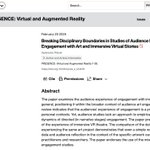
Not just as an #AudienceEngagement researcher, but also as a frequent #VRart audience member, I hope some of VR creators will read my article in MIT's Presence: Virtual and Augmented Reality @mitpress. The article will be published soon!

5
54
We need to be reminded about it from time to time - there are no writing “rules” in academic writting patthomson.net/2024/01/15/th… via @patthomson

1
31
Dr Agnieszka Wlazel retweeted

NEW: an ideological divide is emerging between young men and women in many countries around the world.
I think this one of the most important social trends unfolding today, and provides the answer to several puzzles.

Why the figures for arts attendance in England have been stable for some 20 years despite indefinite variables in action? We should rethink methods for data collection. But we should also rethink audience development practices.

ICYMI: Figures for attendance at arts events have been stable since 2005, despite many audience development initiatives, says Agnieszka Wlazel @LeedsAHRI @awlazel artsprofessional.co.uk/magaz…
4
50
Dr Agnieszka Wlazel retweeted

Remember our study last week on ORF? Here are the details: we found that a short museum visit reduced anxiety and stress. People listening to music while viewing Klimt's mural found the painting more pleasant and the music helped them to focus on the art. doi.org/10.1037/aca0000641

ALT Photographer: © Zsolt Marton. Secession

ALT Figure 2. from Fekete et al. (2023). Those people who listened to music while viewing Klimt's mural found the painting more pleasant and the music helped them to focus on the experience.
Dr Agnieszka Wlazel retweeted
As I'm fond of saying, real and unpredictable elections are a blessing in this world, but it often takes those from places without them to appreciate them. Do not take them for granted! Treasure your democracy and always vote while you can. 🇵🇱


Dr Agnieszka Wlazel retweeted

In 4 minutes, Kurt Vonnegut explained stories better than anyone I’ve ever heard.
“The shape of the curve is what matters. Not their origins.”
He plots stories on 2 axes:
X: Time
Y: Good fortune / ill fortune
He goes on to say,
“Somebody gets into trouble, then gets out of it again. People love that story. They never get tired of it.”
Point 1:
Stories have defined patterns.
In Joseph Campbell’s Hero of a Thousand Faces, he makes the case for the Hero’s Journey.
Since then, it’s become the most famous storytelling structure in the world.
Vonnegut argued stories could be divided into 8 shapes.
Each story, he said, fit one of the 8.
Point 2:
Vonnegut says,
“Be a sadist. No matter how sweet and innocent your leading characters, make awful things happen to them — so the reader may see what they're made of.”
To see who your characters really are, you have to make them suffer.
Only then does your audience have someone worth cheering for.
Point 3:
End on a high note.
Vonnegut says, “It’s not accidental that the line ends up higher than where it began. This is encouraging to readers.”
The way a story makes people feel when they finish is how they remember it.
It’s called recency bias.
Lift people up and they will love you.
***
“There are people. There are stories. The people think they shape the stories, but the reverse is often closer to the truth.”
I wrote this with @RobbieCrab. Follow him for lessons on storytelling + fundraising.
And I talk about creative storytelling. Follow @nathanbaugh27 for more like that.
Dr Agnieszka Wlazel retweeted

Social selling factory in Indonesia 🤯
This is UGC industrial mass production. This is a freaking factory.
Selling things online is changing so fast. Everything is changing so fast.
This is unreal
Dr Agnieszka Wlazel retweeted

AI just reconstructed a Pink Floyd song from brain activity.
And it sounds shockingly clear.
Think about the potential of this tech for people struggling with communication.
We're living in the future.
Dr Agnieszka Wlazel retweeted
Students at Stanford University developed glasses that transcribe speech in real-time for deaf people. Amazing. The product is called TranscribeGlass.
Dr Agnieszka Wlazel retweeted

If UKRI wants to support a diverse research environment, it should include independent researchers
#IndependentResearchers wp.me/p4m9em-ciy