

marketing manager @KaitoAI @kaitostudio_ | prev @lunarstrategy brand comms, storytelling and intent-based marketing
My Website
Joined August 2015
- Tweets7.1K
- Following1.8K
- Followers6.9K
- Likes18.2K





Pinned Tweet
I joined @KaitoAI as Marketing Manager.
for the past two months, i've been helping shape how Kaito’s story gets told. this role brings together so much of what I love.
but more importantly, it feels like play to me, because i truly believe that the intersection of crypto, AI, and data will shape the next chapter of the attention economy.
very grateful to @Punk9277 @Tianqi_Wang5 @blingoh, and the rest of the team for this incredible opportunity to create my best work while working on the industry-defining product.
Nick retweeted

We’re expanding how we measure creator contributions on Kaito Studio.
Starting with the next Katalyst campaigns, three additional signals will help determine rewards alongside mindshare, sign-ups and other campaign criteria:
- The official X verified home timeline impressions
- Verified X followers
- Aura
Together, these give projects a fuller picture of creators’ reach and audience quality.
Set up and verify ↓
Nick retweeted
you can teach someone how to write, edit, design, or use ai. but can you teach them to have good taste?
a while ago, a client asked me to help him develop exactly that.
> big creative concepts
> visual references for launch videos
> story-driven brand assets
he's a friend too, so saying no felt worse than usual.
but what he's essentially asking for is taste. and i genuinely don't know how to sell that.
you can't transfer it in a few calls. it takes countless reps. everything you've consumed, paid attention to, and experienced over the years.
films, podcasts, books, series, content. all of it builds a library of references you can pull from later. plus the personal experiences that make you notice things other people walk straight past.
"taste is what you notice that others don't" - i absolutely adore this.
so if i were to develop it from scratch, i'd focus on two things:
1. consume a lot.
both inside your niche and outside of it. but also make time to process what you consume.
that's how you let the learnings settle in and learn to connect seemingly unrelated ideas into something of your own.
2. practice paying attention.
be present. question things. look for meaning beyond what's immediately obvious.
sure, sometimes you'll read into things that aren't there. but you're training yourself to notice what others overlook.
and finally, actually apply that taste to your content, stories, products, whatever you're building.
because that's how you develop a style of your own, which is just taste applied to your work.
Nick retweeted
output mode vs. craft mode (or the trap of being consistent)
i posted on youtube every week for an entire year.
52 videos in 52 weeks.
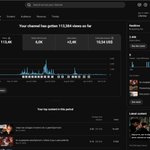
by the end of it, i'd reached 2,000 subscribers, had a few videos cross 10,000 views, and built a pretty decent audience for the niche i'd chosen.
by most external measures, it was working.
and don't get me wrong, i was happy with the progress. i'd made a commitment to myself, stuck to it for a year, and had something tangible to show for it.
but looking back, there's one thing that bothers me.
i was satisfied with my work. but i was rarely proud of it.
and there's a pretty big difference between those two feelings.
satisfaction is when you finish something, look at the result, and think, "yeah, that'll do."
pride is when you look at it and genuinely feel like you've made something that represents the best of what you're capable of.
i think that distinction matters a lot more than we realize.
because somewhere during those 52 weeks, i'd started optimizing for the wrong thing.
i was optimizing for consistency.
not for the work itself.
lemme hit you with a quick hot take:
consistency can become a trap if you're not careful.
and this is coming from someone who spent years believing that consistency was pretty much the answer to everything.
show up every day. build the habit. trust the process. put in the reps.
it's good advice, especially when you're starting out.
because at the beginning, your biggest enemy is usually the resistance to doing the work in the first place.
> you overthink.
> you compare yourself to people who've been doing it for years.
> you spend three hours figuring out the perfect setup instead of recording the damn video.
so consistency helps, since it forces you to get out of your head and actually create something.
you learn by doing. you get comfortable with being bad at things. you develop the muscle of finishing what you start.
and imo, there's no substitute for that stage.
but here's where it gets interesting.
once you've pushed through the initial learning curve, the very habit that helped you improve can start holding you back.
because eventually, the habit itself becomes the goal.
you're no longer asking whether the work is good.
you're asking whether it's ready for friday.
and those are two very different questions.
i remember having weeks where i'd get to the editing stage and realize that the video wasn't particularly good.
the idea could've been explored further.
the storytelling needed work.
the editing didn't quite communicate what i had in mind.
but the upload deadline was approaching.
and breaking the streak felt worse than publishing something i wasn't fully happy with.
so i'd ship it.
another video done. another week checked off. the streak was alive.
but was i actually pushing myself to become a better creator? not necessarily.
and that's the paradox.
the system that was supposed to make me better had started rewarding me for being good enough.
i've come to think about creative work in two different modes.
the first is output mode.
it's when your primary objective is to produce.
> publish the video.
> write the article.
> ship the campaign.
> keep the streak alive.
output mode is incredibly useful, but it has a ceiling.
and that ceiling is often just: acceptable.
good enough to publish.
good enough to meet expectations.
good enough that nobody complains.
which is fine for a lot of things.
not everything you produce needs to be a masterpiece.
but what happens when good enough becomes your default?
you stop questioning whether you could've done something better.
you stop taking creative risks because those risks might push you past the deadline.
and you gradually lose the willingness to sit with work that isn't coming together.
that's when you need the second mode.
craft mode.
craft mode starts when the question changes.
instead of asking: "is this good enough to ship?"
you ask: "is this actually what i wanted to make?"
and that seemingly small difference changes the entire process.
you might spend an entire evening rewriting a paragraph because something about it doesn't feel right.
you might throw away an almost-finished edit because the pacing isn't working.
you might spend hours learning a new technique just to execute an idea that's been sitting in your head.
and sometimes, after all that effort, you realize that the approach was wrong and have to start over.
that's uncomfortable.
especially if you're used to measuring progress by the number of things you've completed.
in february 2024, i decided to stop publishing videos every week to enjoy the process again.
and more importantly, i wanted to find out what i could make if i stopped treating every friday as a non-negotiable deadline.
so i went quiet and created a few pieces since then that i'm genuinely proud of.
i'd pushed myself beyond what i already knew how to do.
@RickRubin talks about something similar.
he argues that when you make doing great work your objective, it can create a ripple effect that extends beyond the work itself.
you raise the standard for one thing, and that standard starts showing up elsewhere.
i didn't fully understand that until i experienced it.
after making those videos, i noticed that the attitude was carrying over into my professional work which eventually led me to joining @KaitoAI a few months ago.
tldr: you can't create your best work in output mode. sometimes you need to slow down, enter the craft mode and let it take you to the place you never dreamt of.
Nick retweeted
opus 5.5, fable 5.1 & astra 6 are cracked.
but here's how you push them to an absolute limit to get world-class outputs.
i'm working on something big for @KaitoAI and these are the stats from a single coding session:
> 19 rounds of feedback with 5,514 words
> 10 screenshots + 1 video used as refs
> 7.6 hours of active work across 42 hours
and i’d say i’m only halfway through.
tldr: never settle for ok results, especially with this incredible tech at your disposal
my thoughts on this topic from a few months ago 👇
Nick retweeted

If you use frontier models (Opus, Sol, Fable, Astra) and know how to use agentic harnesses effectively, you’re already ahead
I’ve been living in Europe for the last 3 years and
∙ most my friends are absolutely not vibe coding or care to
∙ they default to ChatGPT and use it for search or image gen
∙ Revolut Ultra which is one of EU’s biggest fintechs gives you free ChatGPT Go sub, which caps you at Luna
∙ AI subs cost more in Europe, because you have VAT + it’s priced differently in euros
∙ most my friends have never heard of Grok Bot or Hermes
∙ some have recently heard about Muse (power of Meta’s distribution)
∙ I onboarded some to instinct or tab and they’re shocked
Last month in China was interesting for me too. ChatGPT and Claude are both blocked in Hong Kong and Mainland. It’s also illegal to use VPNs in Mainland but I met some people who were accessing western AI because they mentioned reasoning is better + there is better context on the west.
Conversely, I personally found using Deepseek, Dots (rednote’s model), Ant ling’s models, and Wendao’s models best for information while traveling
It’s interesting to observe and think about all of this because frontier models ARE trained on the entire web yet context + token windows and how partitioned geographies can be with what data is available (most of Chinese web is behind superapps and not accessed like a website) mean what we get limited. It’s also why creative output on AI, even frontier models is absolute crap without references and multiple iterations
TLDR if you see this post you’re in a bubble, most of the planet hasn’t caught up yet, and AI usage varies greatly across the world
Nick retweeted
this stuck with me after our recent company town hall @KaitoAI
leadership was talking about how job descriptions are slowly losing their boundaries.
yeah, you can be a marketer, designer, salesperson, developer, whatever. that's your native vertical.
but ultimately, you're there to solve a problem and generate a business outcome.
and with ai getting this good, "that's outside my scope" is becoming less and less of an excuse.
you can learn, experiment, build, and figure things out without needing to be an expert in every single discipline. which is awesome.
but i've been thinking that ai doesn't necessarily give you more free time.
it gives you the capacity to take on more work.
one task takes less time, so you pick up another. then another.
before you know it, you're switching between 8 different contexts and your brain is absolutely fried
so while job boundaries are becoming flexible, our mental bandwidth isn't expanding proportionally
and i think learning how to manage that gap is going to be one of the most underrated skills in the ai era.

Nick retweeted
.@MEXC’s Katalyst campaign brought together 827 creators, generating 17M impressions across 4,051 posts and videos at a $5.88 CPM.
Average daily Crypto Smart Engagement rose 8x compared with the week before launch. MEXC also reached #5 in Exchange Mindshare on Kaito at its peak.
The full breakdown on @KaitoStudio_ ↓


this stuck with me after our recent company town hall @KaitoAI
leadership was talking about how job descriptions are slowly losing their boundaries.
yeah, you can be a marketer, designer, salesperson, developer, whatever. that's your native vertical.
but ultimately, you're there to solve a problem and generate a business outcome.
and with ai getting this good, "that's outside my scope" is becoming less and less of an excuse.
you can learn, experiment, build, and figure things out without needing to be an expert in every single discipline. which is awesome.
but i've been thinking that ai doesn't necessarily give you more free time.
it gives you the capacity to take on more work.
one task takes less time, so you pick up another. then another.
before you know it, you're switching between 8 different contexts and your brain is absolutely fried
so while job boundaries are becoming flexible, our mental bandwidth isn't expanding proportionally
and i think learning how to manage that gap is going to be one of the most underrated skills in the ai era.
Nick retweeted
work ethic is the only universal currency.
at 23 i reliably find myself in the rooms where I shouldn't be.
simply because when I'm asked to do something - it gets done.
it makes people go "holy sh*t, this kid is really up to smth"
this is the whole secret: prove you can execute when given the chance.

Nick retweeted

The @zetachain Select campaign is now live on Kaito Studio, running in two phases.
- Phase 1 (Nov 4-20): ZETA’s migration to Solana and an introduction to ZetaLabs.
- Phase 2 (Dec 1-Jan 9): ZETA and ZetaLabs go live on Solana on Dec 9.
Creators can now join to share how private AI is coming to Solana.
Full terms and applications on Kaito Studio ↓

work ethic is the only universal currency.
at 23 i reliably find myself in the rooms where I shouldn't be.
simply because when I'm asked to do something - it gets done.
it makes people go "holy sh*t, this kid is really up to smth"
this is the whole secret: prove you can execute when given the chance.
writing is the most underrated skill in crypto.
not necessarily copywriting or content writing.
just the act of putting your thinking on paper.
in a world where everyone outsources their opinions to influencers and their thinking to AI – the person who writes daily is the one who actually knows what they believe.
i've written consistently for over a year to produce weekly YT vids, which undoubtedly made me a better marketer.
writing compounds in ways you won't expect - truly can't go wrong with it.
12
37
912
