

Investing & Building in Real-World Al | Robotics, Automation & Industrial Systems | Engineer Turned Investor-Operator | Backed 35 Companies That Raised $1B+
San Francisco, CA
Joined July 2016
- Tweets666
- Following936
- Followers786
- Likes2.5K





Bogdan Cristei retweeted

🇺🇸 The Race for Hyper Techno Industrialism w/ @isaiah_p_taylor (CEO, @valaratomics) & @shaunmmaguire (Partner, @sequoia)
A conversation from the @DiscipulusVent Cohort in El Segundo.
Including:
> Why the best builders are congregating in the Gundo
> Hyper techno industrialism & the race against China
> Why hardware will look like software did 20 years ago
> How China actually plays the game
> OSC, raw material subsidies, & catching up
> The Caltech wind tunnel fluke that built SoCal hardware
> What’s next: biology, robotics, & gigawatts at a cent
> Why everyone is underestimating the hardware buildout
Highlights:
(00:00) The race for hyper techno industrialism
(01:07) Why El Segundo: touring every US hard tech hub
(02:15) You bump into great engineers in the Gundo
(03:07) A generation that wants to build things that matter
(04:08) 10 to 100 to 100,000: the race against China
(05:22) Hardware is about to look like software 20 years ago
(06:50) How China really plays the game
(08:38) OSC & subsidizing the supply chain
(09:43) Catching up vs. winning in the net new
(10:45) Americans as the world’s best product engineers
(11:31) Subsidizing raw materials & the Inconel problem
(13:20) Growing up with SoCal as America’s defense base
(14:31) The macro rotation back to hardware
(16:13) The Caltech wind tunnel fluke
(17:46) Designed in El Segundo, scaled in Texas
(18:13) The founding cohort of crazy people
(19:07) What’s next: biology & robotics infrastructure
(20:03) Start what seems a little crazy today
(20:23) Cheap energy & the aluminum lesson
(21:55) We’ll need 100x what people think
Bogdan Cristei retweeted

We found a way to scale humanoid control that reduces GPU-hours by more than 1000×.
Across 129,514 motions, SuperMimic surpasses the state of the art (128 GPUs, 7 days) with 1 GPU in 3 hours.
Project: supermimic.github.io
Demo: supermimic.github.io/demo/
Bogdan Cristei retweeted

A million hours of what?
If we’re scaling human demonstrations for robot learning, what should each hour contain?
We built S1, our skill capture glove, alongside our robot hand to record joint movements that map to robot targets, with touch and video on the same timeline.
Bogdan Cristei retweeted

Game changer for humanoid full-body control training. Now it's superfast (and cheap, just one GPU) to train a single policy on *all* the motions. How come:
(1) World model much faster than regular sim
(2) Backprop through time collects way more signal than policy gradients

We found a way to scale humanoid control that reduces GPU-hours by more than 1000×.
Across 129,514 motions, SuperMimic surpasses the state of the art (128 GPUs, 7 days) with 1 GPU in 3 hours.
Project: supermimic.github.io
Demo: supermimic.github.io/demo/
Bogdan Cristei retweeted

vc-backed robotics companies with 300+ robots deployed in the field:
- pudu robotics, service & cleaning robots, 130,000+
- brain corp, autonomous floor scrubbers, 50,000+
- exotec, warehouse fulfillment, 10,000+
- starship, sidewalk delivery, 2,700+
- serve robotics, sidewalk delivery, 2,000+
- gecko robotics, industrial inspection, 1,500+
- kiwibot, campus delivery, 1,200+
- skydio, autonomous drone docks, 1,000+
- avidbots, commercial cleaning, 1,000+
- coco, sidewalk delivery, 1,000+
- monarch tractor, autonomous tractors, 400+
- swarmfarm, autonomous farming, 300+
any that im missing?
Bogdan Cristei retweeted

Just another Sunday afternoon in SF: I paid $60 for 2 humanoid robots to clean for an hour.
Here's how it went:
(1) What happened: Sergey and Chelsea (the names of the two robots) finished about 80% of one floor in an hour: tidying, wiping down surfaces, vacuuming, mopping, cleaning the toilet.
- They came with a staff engineer at the company, who dropped them off and picked them up after an hour.
- They were controlled by 1 human operator each, in the Mission where the company office is at.
- The engineer gave me a number to text them, I texted a request to wipe the mirror. They did it.
(2) Performance and dexterity: Chelsea dropped a toy, struggled with a pillow, and had trouble balancing on the playmat. But overall, for all the tasks they did, grippers were enough. 5 fingers were not needed.
- The engineer told me the hardest task for them was making bed.
- They were quite loud, stomping around the house. Took a bit of time to get used to. They both wore gripper socks which protected the floors and helped them not slip.
- Interaction: I didn't know they can respond via voice. In the end they were conversing with us in voice which was nice.
(3) Unexpected observation: Their pants and shirts have holes in them. It's because they were dragged on and off the vans that transported them.
(4) Other user feedback: I shared my experience with some friends afterwards.
A user told me that unloading dishwasher was an "advanced task". They didn't attempt at mine since it was running at the time they were working. Another user said they scratched their hardwood floor. That's probably why they now wear gripper socks.
(5) Did they do as well as human cleaners? In terms of the tasks they did, I think so. In terms of speed, they were ~80% speed of humans when it comes to the more delicate tasks, but I would say they are quite smooth. They didn't finish the whole place, so it wasn't a full service.
(6) How does the math work out?
Each booking was only for 1 hour, since their batteries need to be swapped after 1 hour. So they didn't finish the place.
For a user: In SF, it's ~$200-220 to clean a full home around my neighborhood, with two human cleaners. Usually it takes around 2.5 hours. So around $40/manhour. This is $30/robot hour. Slightly cheaper, but again it's not fully finished with the 1 hour they were available.
For the company: It took 2 robots, 2 human operators, 1 staff member to dropoff/pickup, and 1 driver of the van to transport the robot. Definitely labor intensive. But they also retain the data they collect for training purposes.
(7) My biggest takeaway as a user: interaction / hospitality mattered. One of the humanoids was more friendly (Sergey), he waved at us when he came in. It'd have been great if they both introduced themselves in the beginning.
Beyond that, being able to do 2 hour slots (instead of one) would be great to finish the cleaning.
Overall, I appreciated their work and the fact that they got the robots out in people's homes. Deployment is not easy and so much learning from it each time
Bogdan Cristei retweeted

Meet Kumar:
He has been bending wires non-stop to help his human electrician brethren.
Here is him working continuously for two and a half minutes with edge case recovery.
2x speed - fully autonomous.
Starting tomorrow, Harold and Kumar (the robots) will go from paid pilot to producing 36,000 wall outlets per year on a 3 year production contract 🦾🚀.
Bogdan Cristei retweeted

Dream-1 by @dreamlabs_ai beats every LLM in robotics while being faster than all of them. Dream-1 scores 1.3x higher than GPT-6 Astra Ultrafast while being 1.7x faster.

Bogdan Cristei retweeted

Working with @physical_int, we are bringing general purpose robotics models into the places that need them most —- the factories that make things we all need and use. 150 factories using Formic robots and counting!

Bogdan Cristei retweeted

2.5k per arm. Everything will be robots

Metal Arm is available now
Get yours at makermods.ai/metal-arm
6 DoF. 3kg Payload. Full CNC construction.
Ships in 1 week.
DMs open.
Bogdan Cristei retweeted

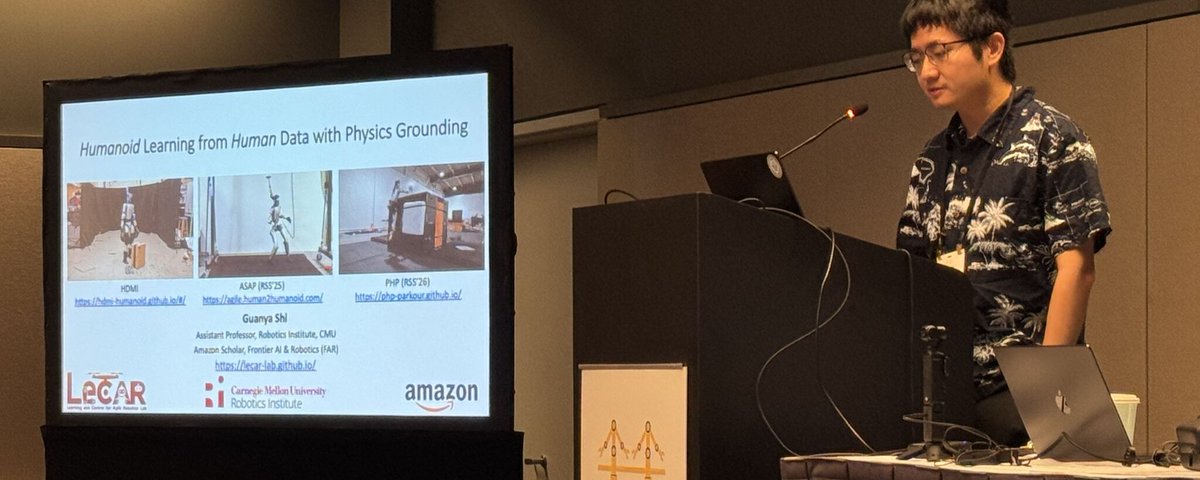
🤖 Humanoids need the RIGHT data + physics grounding.
My 12 🔥 takeaways from #IROS2026, Prof. @GuanyaShi (@CMU_Robotics, @Amazon FAR) talk: what's the role of simulation in the GPT-6 Astra era? Why better references beat reward hacks, and what comes after motion tracking?
👉🏻 Full Article: xitter.cf/junfanzhu98/status/211…
1️⃣ Teleop won't scale for whole-body loco-manipulation & dex hands: hard action spaces, many DoF, huge state coverage.
2️⃣ Human data is no free lunch: it carries intent & task structure, but the gap is in dynamics & actuation.
3️⃣ Human data = the WHAT; physics grounding = the HOW (model-based retarget → sim RL, or model-free co-training). Some grounding is unavoidable; the interface is the open question.
4️⃣ Retarget + track is now infrastructure, not frontier: H2O → OmniH2O → ASAP, ExBody2, BeyondMimic, SONIC… even G1s flipping at Wang Leehom's concert 🎤
5️⃣ Beyond tracking: BFM-Zero = one promptable policy for tracking, goal reaching & reward optimization.
6️⃣ Interaction works too (HDMI: 67 straight door runs from monocular video), but retargeting artifacts remain.
7️⃣ 🔥 Motion references matter for RL. Imperfect references make RL really hard, because retargeting isn't aware of interactions. OmniRetarget's interaction-centric fix (interaction mesh + Laplacian deformation) → 5 rewards, proprioception only, no curriculum: 82% RL success on object tasks vs 4–71% for baselines. ICRA 2026 Best Conference Paper 🏆
8️⃣ Perception = chain + distill: PHP climbs a 1.25 m wall (96% of its height) from depth; LadderMan: 3.4 s/rung vs humans' 3.2 🪜
9️⃣ Kinematics → dynamics: SPIDER's physics-based sampling yields motions that replay open-loop on a real hand.
🔟 Sim in the era of Astra: a roughly correct sim is enough; transfer tools, knowledge & procedure, not policies. SimEX: 26/30 real trials, 0 demos, ~10 min of robot time.
1️⃣1️⃣ Agents reconnect the two cultures: model-based engineering + model-free learning.
1️⃣2️⃣ Real2sim adds visual grounding: VLK (48K synthetic trajectories in scanned rooms), WANDA (one demo → many worlds) 🌍
💡 Fix the data, not the reward. Get the interface right and the rest gets simpler.
#Robotics #Humanoids #EmbodiedAI #IROS2026


🤖 #IROS2026: Humanoids don’t just need more data—they need physics grounding.
12 🔥 takeaways from @GuanyaShi (@CMU_Robotics, @Amazon): what's the role of sim in the Astra era, why better references beat reward hacks, and what comes after motion tracking
Bogdan Cristei retweeted

Exa just passed $100m in annualized revenue.
We've grown almost exactly 10x per year for 3 years. We now handle 2 billion requests a month from 200k+ teams. And it’s still so early:
We predict agents will search 1000x more than humans by 2030.
Agents don't search like humans. They write long, complex queries and want all the world's data, not just the web. We've spent 5 years building a search engine designed for them.
We now serve personal agents, AI labs, coding agents, GTM agents, really any agent. Exa gives these agents access to 100s of billions of web documents and tons of proprietary data.
Our customers are increasingly noticing that information is the bottleneck to agent performance. While the world seems close to perfect intelligence with models like Fable and Astra, we are very far from perfect information.
To our small but legendary team, thank you for getting us here, from engineering to research to GTM to ops.
To our customers, it is an honor to serve you. We have some exciting releases coming soon and can't wait to share them 🫡

Bogdan Cristei retweeted

i got 9M views in the past 3 months, then X changed its algo a lot, so I read the code to keep playing the game (it's open source)
Here's how X actually ranks posts (Oct 2026)
- Copy-link share 20. Reply 5. Quote 5. DM share 5. Follow 4. Repost 1. Like 0.5.
- Likes barely move the score. Write things people copy the link to, argue with, or send to a friend.
- The first 2 hours decide everything.
After 48 hours a post drops out of For You completely. Post when your audience is online, then stay in the replies.
- Build mutual follows. When you reply to a mutual follow inside your own thread, that reply gets an extra +15, for 20 total, the same as a copy-link share. Reply to the people who follow you back.
- Don't delete and repost to fix typos. Use edit.
- Images aren't penalized, but they should carry information. Real scenes, screenshots, and proof-style images work better, and multi-photo posts keep people on the post longer.
- Video: watch time currently counts for nothing. Only opening a video counts (0.07). Don't force video for the algorithm.
- Ordinary links aren't penalized (anymore); only malicious links are removed.
- Avoid negative feedback. Report −234, mute −58.8, "not interested" −47.5, block −31.2. Tagging strangers to ride a trend and clickbait headlines are the easiest ways to trigger them.
- Replies are scored by Grok from 0 to 3, and low-scoring replies sink to the bottom of the thread. Low-effort replies don't just fail to help, they get buried.

Bogdan Cristei retweeted

Claude now writes code so fast that Anthropic had to rip out git, the tool basically every software company on Earth uses to track changes to its code.
Back in May, Anthropic was merging about 2,500 code changes a day. By September it was over 30,000. That's one every three seconds, all day and all night, with Claude driving most of the increase.
Git was never built for that. It was designed in 2005 so every developer's copy of a project carries the full history and works offline. That's great if you're a person coding on a plane. Anthropic's main code history is now almost 100 GB, their test systems pull a copy of the code 25 million times a day, and nearly all of those requests come from AI agents and automated jobs that are always connected anyway. Done the normal git way, that adds up to 600 petabytes of traffic a day.
They tried every standard workaround first. At one point they were running several hundred internal git mirrors just to keep up, and it kept falling behind.
So they built their own system, called Scion. The server does nearly all the heavy lifting (commits, merges, diffs, figuring out who changed which line) and most jobs just ask it questions over an API without downloading the code at all. The new setup uses 200x less compute and memory than the mirror fleet it replaced, and checkouts that used to take minutes now finish in seconds.
Seven engineers built it.
Those same seven also built a new code review tool and code search, then moved the entire company over in five months, while the amount of code flowing through was growing 10x under their feet. Google spent years building its version of this, called Piper, and Meta put the better part of a decade into scaling Mercurial into what's now Sapling. Anthropic openly says it borrowed lessons from both. Still, seven people.
Every engineer on that team now says Claude writes code better than they do. Early on, they took the ingestion pipeline they'd mostly written by hand, gave it to an internal preview of Claude Mythos with a request to rewrite it and no other instructions, and got back a version that used 20x less memory and ran 4x faster.
So what were the humans actually doing? Making the big design calls, and reviewing each change at the level of what it was trying to accomplish. And according to the post, a lot of the job was telling Claude "no." The model would sometimes bend core system rules to make a bad pattern work, or pile on defensive code for problems that were never going to happen.
They even gave up on the traditional merge queue. When thousands of changes can land while a single test run is still going, merging one at a time with the whole repo locked just stops working. So they test after merging and let Claude untangle the conflicts, which it usually does before a human would even notice them.
Nearly every tool software teams use was built on the assumption that a person types every line. Anthropic hit the wall first, and they're saying they expect plenty of other companies using AI coding tools to hit it within the next 6 to 12 months.

New on our Engineering blog: Creating in-house source control.
In May, we merged around 2,500 code changes per day. In September, we merged more than 30,000 per day. As a result, we became bottlenecked by developer infrastructure built for human (rather than agent) scale.
Here, we share how we built a new version control system—and fully migrated our monorepo from git—in five months: anthropic.com/engineering/re…

Bogdan Cristei retweeted

Excited to host the upcoming @saturdayrobotic reading club 34 on 10/17 with @AIMSafety_ ! luma.com/oq82q5ax
Guest speaker: @wangyenjen from @UCBerkeley will talk about his newest work: RPG: How Robots Improve Without Retraining, a framework for autonomous improvement of robot execution systems without updating model weights.
Sponsor highlight: Al agents are making decisions, calling APls, and taking actions, with no one watching. AIM Intelligence attacks your Al before real attackers do, and enforces real-time guardrails to keep every agent under your control.
See you guys this Sat! @junfanzhu98 @solsol_choi Sky Kim @jerryhuang01 @RoboticsCtr

Bogdan Cristei retweeted

Announcing the beta release of the Pi API. We’ve partnered with companies across diverse industries to adapt our models to their robots and applications, from harvesting strawberries to assembling servers. Now we’re opening access to more teams.
Bogdan Cristei retweeted

After six years in stealth, Atomic Machines is out. Our mission: on-demand, universal command of matter. First beachhead: the Matter Compiler, an AI-native manufacturing system that builds working micro-machines from code alone. No per-product tooling. No process development. Different code, different machine.


Bogdan Cristei retweeted

This post is absolutely going viral on Reddit
An independent researcher used Claude Code to find a possible new planet. It had been sitting in NASA's TESS data since 2018, and he could find no earlier report of it.
Claude Code with Opus 5.5 and Fable 5.1 did most of the work: parsing the light curves, writing the transit search, fitting transits, checking nearby stars and secondary eclipses. He set the questions and the pass/fail rules.
The star is about 116 light-years away. Every 3.18 days it dims by about 0.05% for two hours, which fits a planet about 1.4 times the size of Earth. It is still a candidate, and TESS will check it again from Oct 31 to Nov 26.

Bogdan Cristei retweeted
the 2026 robotics infrastructure stack:
- simulation and testing (NVIDIA Isaac Sim, Gazebo, MuJoCo, Antioch)
- connectivity and comms (Wi-Fi / 5G / LTE / Starlink, VPN backhaul)
- fleet management, monitoring and teleoperation (Formant, InOrbit, Open-RMF)
- robot middleware and messaging (ROS 2, DDS, Zenoh)
- navigation, planning and control (Nav2, MoveIt 2)
- project collaboration and sharing (GitHub, Tnkr)
- edge compute and onboard AI (NVIDIA Jetson, Qualcomm RB series)
- deployment and OTA updates (Ubuntu Core, balena, Mender)
- visualisation and replay (Foxglove, Rerun, RViz)
- CV/ML model training and labelling (Roboflow, Scale AI)
- robot learning and policy training (Hugging Face LeRobot, NVIDIA Isaac Lab)
- data upload from robot to cloud (AWS IoT Greengrass, Alloy)
- data logging, storage and management (mostly S3, Alloy)
- data pipelines and model delivery (custom ETL, CI/CD, registries)
- observability and root cause analysis (metrics, traces, Alloy)
- agent harness for robotics data (Codex, Claude Code, Alloy)
