

CEO of Aha! — Seeker of business and wilderness adventure. Proud husband and dad. Author of Lovability. Follow me on LinkedIn.
Menlo Park, CA
Joined March 2008
- Tweets4.7K
- Following269
- Followers9K
- Likes532




It just occurred to me: tokenmaxxing reminds me of “coffee badging.”
Swipe your badge, grab a coffee, and leave. You still get credit for showing up.
Now some companies are ranking employees by how many AI prompts or tokens they use. It is ridiculous. Reward writing prompts and you will get more of it. But more prompting does not equal more value.
Let's focus on what we achieved vs showing up and pouring AI. We have a new powerful technology, but we should not lose what is important.
I told Chris that I had AI token anxiety? It ends up that there is a relatively easy fix. Ironically, more chats. Take a look at the visual.
Here is the explanation.
Each new message in a chat sends the entire conversation history back to the model. The model reads all of it again, including the earlier tasks that have nothing to do with your new question or prompt. You pay for that history again with every message.
Chris Waters compared the two using OpenAI API pricing. One hundred unrelated tasks in one long chat cost $1.49 in input. The same tasks in fresh chats cost $0.25. That is nearly six times less, even with the discount for cached input. (These are illustrative numbers.)
So stay in the same chat when you are on the same problem. Start a new one whenever you switch tasks.

Who in product management at Yahoo! thought that email needs to be gamified? How many days in a row have you checked yours?

Update on our search for a VP of PM and UX.
New insight to share. For better or worse, if the founders are still in the company they very likely still have a north star strategy.
Very few applications I read speak to working collaboratively on a strategy and then boldly executing against it. I get the allure of driving strategy, but the achievement equally comes through the work.
We are still meeting with good people who have led product and driven growth in B2B SaaS +$100M companies.
Chris and I were talking about why AI feature work frustrates engineers who enjoy deterministic programming. I mentioned sports when he raised the point. Sports give you a score, so you know exactly where you stand. You either win or lose (except for soccer of course). The outcome is binary.
Read Chris's take on software development with AI, the loss of a clear end point, and its impacts on engineers: aha.io/engineering/articles/…
I think AI app building is going to create a lot of software that never gets used. That is cliche at this point. Even my kids talk about it.
But it also is going to create solutions to hard problems that are important to small groups of people.
Good.
Not every product needs to become a platform. Not every tool needs a giant market. A narrow product that solves a specific problem well is still a strong product.
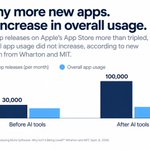
Did you see this? Apple's App Store went from roughly 30K new app releases a month to 100K. BUT. Overall app usage did not go up.
AI has made it a lot easier to release an app. But people are not spending more time in apps just because there are more of them.
Maybe the lesson is that just because you can build does not mean you should. Or maybe it will just take longer for all these new apps to be adopted. You decide.

Brian de Haaff retweeted

Product managers keep coming back to Aha! with the same request: "This prototype is great—now I want it to actually integrate with other systems and do real things."
Chris (Aha!) explains how that moment—prototype meets production—reshaped their roadmap. Instead of handing the app to an engineer, Aha! built the tooling for PMs with zero coding experience to build, run, and operate a working application on their own.
👉 Find a link to the full episode here:
Spotify: buff.ly/8lEkMY3
Apple Podcast: buff.ly/2x6x1RT
YouTube: buff.ly/kJghaE4
Brian de Haaff retweeted
What does it take to build an AI app builder specifically for product managers—not engineers—inside an already crowded market?
In this episode of Just Now Possible, Teresa Torres talks with Brian De Haaff (CEO and Co-Founder), Chris Waters (CTO and Co-Founder), and Sarah Moisan-Thomas (Senior Product Manager) about Aha! Builder, Aha!'s AI-powered app builder built for product managers. Aha! is a fully bootstrapped, profitable, remote-first company that has served product teams for over 13 years without a single salesperson.
Guests:
- Brian De Haaff – CEO and Co-Founder, Aha!
- Chris Waters – CTO and Co-Founder, Aha!
- Sarah Moisan-Thomas – Senior Product Manager for Aha! Builder, Aha!
They walk through Aha!'s five-step product discovery framework—spark, paper prototypes, proof of concept, early access, and general availability—that led them to Builder. They share why their first version, built on containerized Ruby on Rails infrastructure, proved too wasteful to scale, and how they rebuilt it on a single-instance, multi-tenant architecture using V8 isolates. Along the way, they explain their approach to deterministic guardrails for things like authentication, SSO, and databases, and how a multi-phase, multi-agent pipeline generates a design system, a prototype, and a working application in minutes.
You'll hear how they think about the line between what AI should build and what should stay deterministic, how they handle enterprise concerns like SSO and PII, and why they believe knowing what to build—not how to build it—is where product managers will increasingly add value.
Key Takeaways:
- Aha! is fully bootstrapped, remote-first, and profitable—built by product people, for product people
- Containerized infrastructure proved too wasteful for AI app building at scale, pushing Aha! to rebuild on a single-instance, multi-tenant architecture
- Deterministic, pre-built components (authentication, SSO, database, email) cut token cost and guarantee reliability that AI-generated code can't
- A multi-phase, multi-agent pipeline—design system, then prototype, then backend—produces better outcomes than a single open-ended chat prompt
- As building gets easier, knowing what to build becomes the product manager's real differentiator
In This Episode:
- Aha!'s 13-year bootstrapped, remote, no-salespeople business model
- The five-step discovery framework Aha! uses for every new product, including Builder
- Why their first containerized version was too slow and expensive to scale
- Rebuilding for a single-instance, multi-tenant architecture
- Reusing the agent framework and tool set originally built for "Elle"—Aha!'s roadmapping AI assistant
- Deterministic components for authentication, SSO, database access, and email
- The multi-agent, multi-phase build pipeline: design system, then prototype, then full application
- Enterprise governance: authentication policies, deployment guardrails, and PII/PHI considerations
- Why Aha! is optimizing for prototypes, proofs of concept, and internal "meta applications"—not primary line-of-business apps
- What's next: expanded design systems and tighter feedback loops across Aha!'s product suite
Resources & Links:
- Aha!
Chapters:
00:00 Meet the Aha! Team
00:19 Aha! Bootstrapped Remote Story
01:29 What Is Aha Builder
02:27 Leaders Stay Hands On
04:49 Origin and AI Shift
07:44 Why Build in Aha!
14:12 Discovery Framework
17:50 From Slides to Early Access
21:40 Proof of Concept Approach
23:36 Under the Hood Architecture
27:01 Agent Tools and UX
30:59 Deterministic Components
33:42 Skills Docs and Iteration
35:48 Higher Level Building Blocks
36:33 Knowing What To Build
38:57 Builder UX For PMs
44:10 Enterprise Governance Guardrails
47:29 What Builder Is For
50:39 PII Security And Compliance
53:15 Quality Evals And Pricing
55:29 V8 Isolates Architecture
58:22 Multi Agent Build Pipeline
01:01:14 Roadmap Design And Feedback
01:03:01 PMs Engineers And PR Flow
01:05:52 Wrap Up And Thanks
Listen on Spotify, Apple Podcasts, or watch on YouTube.
Spotify: buff.ly/8lEkMY3
Apple Podcast: buff.ly/2x6x1RT
YouTube: buff.ly/kJghaE4
What is next for you?
It could be your next career move. Or something outside of work. I was thinking about this on my walk and am curious what is on your list.
What will product management look like in 2030?
Company leaders keep asking me this. I have my ideas, but I know plenty of you have different views. Help me out.
I just found some good news on a hike (if you are looking for an alternative to all the negativity that swamps us). We can all be grateful that these cones and other "social distancing" measures will not be needed outside or at work this week.

Everyone wants to talk about moats these days and how SaaS companies will survive the emergence of do everything AI. Continuity of data and continuity of workflow. No AI prompt interface will solve that. But I would be as concerned with your "personal moat" as the company you work for. There is only one of you. I think you can apply the same rules though. What you know and how you consistently apply that knowledge to create value is what makes you unique.
Is AI saving us time? I am skeptical that it is.
In reality it feels like we have more work to do now, not less.
More here: aha.io/blog/time-saved-is-th…
I got what I wanted. Engineering can build at a pace I dreamed of.
I assumed I would be ready if and when we got here. I was not.
Increasingly, engineers are ready for the next feature before our PM team is ready to give it to them. And I really do not like being the reason someone else has to wait.
I am certainly not going to ask engineering to slow down. So we made some changes to how our product team works — from how we use AI to review customer feedback to the ways we prototype major new capabilities.
aha.io/blog/i-do-not-like-my…
I wrote about the 10 practices we are using and why I think product managers who deeply understand the strategy and the customer will become even more valuable.

It is a little humbling. So many terrific people have reached out regarding the VP of PM/UX role that we are hiring for. I try to share feedback with everyone who directly messages me. If someone takes thoughtful time to connect I feel responsible for responding. This is what we are generally looking for:
A VP with significant tenure at a $100M+ SaaS company in the general B2B productivity space that has led a team of at least ten folks and helped drive growth.
aha.io/company/careers/curre…


I just got back from a weeklong backpacking trip in the Eastern Sierras. On day three it rained/hailed for three hours in the afternoon.
So, I did what I have a hard time doing. Nothing.
I laid in my tent for three hours and listened to the thunder roll through and the rain pound the tent. Was it a good use of time? I think so, because I was just present with my thoughts. But that is hard to quantify ... which might be the point.