


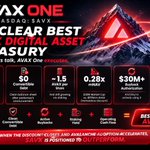



Pinned Tweet
19 September 2030. avalanche-2:native is $1,000.
What if and how could I have seen it in 2026?
Not because @FIFAcom used Avalanche. Not because @NYSE tested it. Because of what happens to AVAX if institutions actually land on the network and stay there.
Institutions do not all pile onto one public chain. They launch their own @avax L1s. Own rules. Own compliance. Own validator set. Still connected to the rest of the ecosystem.
That is the setup. This is the value accrual.
AVAX is the asset that secures the Primary Network. Staking AVAX is how the base layer stays honest. If Avalanche becomes settlement infrastructure for tokenized securities, stablecoins, trade finance, ticketsand consumer rails, the economic weight of that security layer goes up. The token that backs it becomes more important, not less.
Usage also hits the token directly. Primary Network fees are paid in AVAX. C-Chain fees are paid in AVAX. A large part of that fee flow is burned. More real activity does not just create “adoption headlines.” It removes AVAX from circulation while demand for blockspace and security is rising.
Then there is the L1 link. Sovereign Avalanche L1s no longer have to lock giant AVAX stakes the old Subnet way. They pay a continuous validator fee onto the Primary Network instead. That fee is denominated in AVAX. One bank chain is a rounding error. Hundreds of institutional L1s, each running validators year after year, is recurring demand tied to the same asset.
Add the network effect on top. Tokenized stocks, funds, receivables and stablecoins do not stay trapped on one private island if those L1s remain interoperable.
Assets move. Liquidity meets public markets. Settlement, payments and issuance start sharing one fabric. The economic importance of the network can grow faster than the number of press releases.
That is why $1,000 is a mechanics thesis, not a partnership thesis.
2026 already had the raw inputs: NYSE testing @avax for tokenized securities infrastructure. Securitize listing its own public stock onchain on Avalanche. @Securitize choosing Avalanche for a regulated EU trading and settlement system. Progmat moving Japan’s security-token stack onto an Avalanche L1. Hyundai testing stablecoin treasury payments. POSCO putting real trade receivables onchain. FIFA running ticket rights on a dedicated L1.
One deal does not reprice AVAX. A mesh of institutional L1s, burning fees and paying ongoing network costs, can.
Looking back from 2030, $1,000 is not the crazy part.
The crazy part is that the signals were already there in 2026.
Not financial advice. Not a prediction. A map of how the value is supposed to accrue.

avalanche-2:native TREASURY UPDATE - $AVX vs $AVAT (Monday morning edition covering the prior 7 trading days; data as of latest U.S. market close, Friday Nov 13, 2026)
1. Market close snapshot (LIVE / close Nov 13, 2026)
• AVAX USD: $8.23 (7D ≈ -13.1%, 30D ≈ -26%)
• AVX: $3.86 (7D -10.0%, 30D -23.9%)
• AVAT: $1.08 (7D +31.7%, 30D -18.8%)
2. Treasury details
AVX (LATEST REPORTED as of Sept 30, 2026: company PR Nov 12 / 10-Q filed Nov 12):
14,170,184 AVAX tokens and equivalents (~99.7% staked at ~5.85% annualized; includes ~850k deployed into Treehouse). No material sales/purchases or staking changes disclosed since prior report beyond ongoing rewards (not separately quantified post-Q3).
AVAT (LATEST REPORTED as of Sept 30, 2026: 8-K Nov 5 / 10-Q Nov 12):
13.31 million AVAX (7.93M unlocked / 60%, 5.38M locked / 40%; weighted-average remaining lock ~16.5 months). ~91% (~12.1M) staked throughout September. FalconX collateralized loan repaid in full during Q3.
3. Calculated metrics (using freshly verified share counts)
AVX shares outstanding: 9,480,988 as of Nov 12, 2026 (SEC 10-Q; down from 9,746,196 at Sept 30 due to net buybacks).
• AVAX/Share: 1.495 (CALCULATED)
• AVAX Treasury Value at $8.23: $116.6M (CALCULATED)
• Treasury Value/Share: $12.30 (CALCULATED)
AVAT Class A outstanding: 37,292,522 as of Nov 9, 2026 (prospectus/10-Q related; Class B 5,805,639 noted).
• AVAX/Share: 0.357 (CALCULATED)
• AVAX Treasury Value at $8.23: $109.5M (CALCULATED)
• Treasury Value/Share: $2.94 (CALCULATED)
4. Cash, debt, net debt, collateral
AVX: Cash $8.5M as of Sept 30 (LATEST REPORTED). Convertible debt eliminated to $0 (remaining ~$970k converted post-Sept 30). Net cash positive; no material AVAX collateral disclosed.
AVAT: Cash + USDC ~$4.9M as of Sept 30 (LATEST REPORTED). $10.0M collateralized term loan due Jan 10, 2027 remains. FalconX facility repaid in full in Q3 (AVAX collateral released). Some AVAX previously pledged under the remaining note.
5. NAV / premium-discount
AVX equity $165.3M as of Sept 30 (LATEST REPORTED); shares trade at a discount to current AVAX treasury value/share.
AVAT equity ~$137M as of Sept 30 (LATEST REPORTED); similar discount to treasury value/share. Mark-to-market sensitive to AVAX price.
6. What changed in the last 7 days
• AVX: 10-Q filed Nov 12 (Q3 net income $49.9M driven by unrealized digital-asset gains). Remaining convertible debt to $0. Share count verified at 9,480,988 as of Nov 12 (explicit call-out: net reduction from Sept 30 level via buybacks of ~810k shares Oct 1–Nov 12 offsetting prior conversions). Holdings unchanged from Sept 30 stated total.
• AVAT: 10-Q and 424B3 prospectus supplement filed Nov 12 (resale of up to 15.7M Class A shares). Class A count confirmed at 37,292,522 as of Nov 9. No new buybacks or share count changes in the week (prior Q3 repurchase of 2.89M shares held as treasury). Debt status stable post-FalconX repayment.
7. Side-by-side core KPIs
AVX shows higher AVAX per share (1.495 vs 0.357) and cleaner leverage (convertible debt $0 vs $10M term loan). AVAT has larger absolute share base and a portion of locked AVAX. Both advanced balance-sheet transparency via filings dated Nov 9–12, 2026.
Do your own research. No financial advise
Cardano founder @IOHK_Charles Hoskinson says cardano:native’s roadmap is complete and “everything I said is going to be built has been built.”
Most top crypto 50 projects will meet the same fate. Roadmaps finish, but there’s still no meaningful onboarding of real infrastructure and businesses that actually see the value.
These tokens still trade at multi-billion dollar market caps that don’t reflect what’s been built. The market is starting to price that in. That’s why so many people quietly feel the pain watching @avax onboard major players. They know that’s where the long-term roadmap, real adoption, and price discovery through usage will happening, while the coins they stayed loyal to for years slowly die. $ADA avalanche-2:native

90% of Crypto Twitter spent YEARS chasing glorified fortune tellers and digital snake oil salesmen. The Pied Pipers of crypto. Selling dreams, extracting liquidity, building absolutely NOTHING.
And now they hate on @avax ??? Funny how the chain actually building infrastructure for REAL DEMAND is suddenly the target.
While the clowns were selling narratives, Avalanche was building. Now the biggest financial players are showing up, putting real assets and real infrastructure on-chain.
The joke is no longer on Avalanche.
The joke is on everyone who spent years laughing instead of paying attention.
🤖 Made with AI

Look at @Cardano for example 👇 cardano:native is done imo
decrypt.co/383221/roadmap-is…

1
80
Let’s be honest about some of the narratives Crypto Twitter has been sold for years:
Some chains sold decentralization but became dependent on a handful of insiders.
Others sold infinite scalability without demonstrating sustainable economic demand.
Some built entire ecosystems around incentives, airdrops and mercenary capital rather than genuine users.
Others promised to become the global financial system while struggling to attract actual institutional adoption.
A narrative is easy to sell. Sustainable infrastructure is much harder to build.
The difference is simple: speculation attracts attention. Real utility attracts capital, institutions and long-term demand.
And that’s exactly why I’m paying attention to Avalanche.
2
112
Resharing this because I’m noticing a pattern. A lot of influencers (the ones who get paid by projects that have never been interested in building real infrastructure) are suddenly trying to downplay the @avax /@NYSE announcement. These are the same people who live off hype and marketing to pump their own tokens.
Be careful who you believe out there. 99% of crypto projects are scams. Most of them just buy influencers to hype tokens that have no real infrastructure, will never get adopted, and will die. Now that something with actual institutional weight is happening on avalanche-2:native , they’re trying to drag it down. Don’t fall for it.
🔺

@LarkDavis you can do better…You are downplaying it on purpose. This is actually a big deal. Here for you to understand how regulatory legal advisors would frame it 👇
The NYSE (via ICE) is building a real 24/7 tokenized securities venue with atomic settlement on Avalanche. They’re calling it an “NYSE-affiliated” ATS because the main NYSE is a registered national exchange. Running novel blockchain settlement, 24/7 hours, and stablecoin funding directly inside the exchange would force them through a long, heavy rule-change process and expose the core exchange to the new risks.
So they put it in a separate affiliate that operates as an ATS under Regulation ATS through a broker-dealer. Matching still uses NYSE’s Pillar engine, the clearing ledger is Avalanche, and it’s still ICE/NYSE group infrastructure. The affiliate structure is how they protect the main exchange while still launching something ambitious. It’s not them trying to make it sound smaller. It’s them doing it in a way that can actually get approved and operate. Just be happy that blockchain gets a big adoption push from one of the largest firms in earth. Just because they have not chosen the scammy chains paying you as KoL for ages, it does not mean you need to downplay it 😅
$AVX (@avax_one) just held its Q3 2026 earnings call, and the message was clear: this is now a focused pure-play Avalanche treasury vehicle.
Interim CEO Pete Wylie confirmed they are fully exiting the modular AI/HPC data-center initiatives (started by the ex AVX CEO, including the BlueFlare project). The reason was straightforward: capital and resources are better directed at growing the @avax treasury than at capital-intensive infrastructure projects in a tougher funding AI environment. That strategic clean-up is a meaningful positive for anyone looking at the stock as an Avalanche proxy.
Key numbers from the call and release: • ~14.17M avalanche-2:native and equivalents held, with ~99.7% staked • Staking generated ~141k AVAX in the quarter for a ~5.85% annualized yield • Revenue $2.4M (up more than 4x YoY), driven by $1.8M staking plus $0.7M Bitcoin mining • Convertible debt fully eliminated, now at $0 outstanding • Share buybacks continuing: ~384k shares in Q3 plus 710k in October, with ~$30.4M still left under the $40M authorization • Management views repurchases at a discount to the underlying asset value as an attractive use of capital.
Wylie also highlighted real institutional adoption on Avalanche, specifically the NYSE selecting the network as core ledger technology for its planned tokenized-securities platform. Combined with other activity such as Progmat moving large volumes of regulated digital securities onto Avalanche, the ecosystem story supporting the treasury continues to strengthen.
For new investors, the setup after this call is cleaner than it has been:
• Pure Avalanche treasury focus with productive staking yield
• Debt-free balance sheet
• Active capital return via buybacks
• Bitcoin mining providing a supplemental cash-flow buffer so they are not forced to sell AVAX to fund operations
• Institutional validation of the underlying network
In a market where many digital-asset treasury companies are still figuring out their capital allocation, AVX is narrowing its strategy, cleaning up the balance sheet, and buying back stock. The call reinforced that they are prioritizing long-term AVAX ownership per share over side projects.
Not financial advice. Always do your own research. But the strategic clarity coming out of yesterday’s call is worth paying attention to.

b-dog 🔺 retweeted

AVAX One (NASDAQ: AVX) Q3 2026 results:
• Revenue $2.4M, up more than 4x YoY
• 14.17M AVAX held, ~99.7% staked at ~5.85% annualized
• $14.9M+ of convertible debt eliminated in Q3; balance now $0
• ~384K shares repurchased in Q3, 710K more in October
Call at 5 p.m. ET today.
BREAKING NEWS: Detailed Q3 2026 Earnings Comparison: AVAX One ($AVX) vs Avalanche Treasury ($AVAT). Both companies are pure-play @avax treasury vehicles, so their reported results are heavily driven by the same factor: mark-to-market gains on avalanche-2:native holdings during a period when the token was stronger. The differences that matter for judging quality are operational efficiency, capital structure, holdings quality, and capital return.
1. Net Income
AVX: $49.9 million ($6.11 per diluted share).
AVAT: ~$54.6 million ($1.53 per diluted share, preliminary).
Winner: Slight edge to AVAT on absolute dollars, strong edge to AVX on a per-share basis. Both numbers are almost entirely non-cash unrealized (and some realized) gains on AVAX. AVAT’s higher absolute profit reflects a similar-sized treasury and price movement. AVX’s dramatically higher EPS reflects a much smaller share count after its reverse split and aggressive buybacks. For existing shareholders, per-share earnings are more relevant; for the company as a whole, the absolute figures are comparable. Quality of earnings is low for both because the gains can reverse.
2. Staking Revenue
AVX: $1.8 million.
AVAT: ~$0.6 million.
Winner: AVAX One (clear).
AVX generated three times the staking revenue despite only modestly larger holdings. This points to higher utilization (99.7% staked vs ~91%) and/or better timing of staking deployment. Staking is the only recurring, relatively stable revenue stream for these companies, so the gap is meaningful.
3. AVAX Holdings & Staking Efficiency
AVX: 14.17 million AVAX and equivalents (99.7% staked, ~5.85% annualized yield).
AVAT: 13.31 million AVAX (≈91% staked; 60% unlocked / 40% locked with ~16.5 months remaining average lock).
Winner: AVAX One.
Larger absolute holdings, near-complete staking, and a higher reported yield. AVAT’s locked portion reduces flexibility and near-term yield. AVX also has a residual Bitcoin mining contribution that AVAT does not.
4. Revenue Overall
AVX: $2.4 million (staking + Bitcoin mining).
AVAT: Effectively staking-only at ~$0.6 million (plus non-operating gains).
Winner: AVAX One.
Higher total operating revenue and more diversified (though still treasury-centric) sources.
5. Cash & Liquidity
AVX: $8.5 million cash.
AVAT: ~$4.9 million cash + USDC.
Winner: AVAX One.
Stronger cash position provides more runway and optionality for buybacks or opportunistic accumulation.
6. Debt
AVX: Convertible debt fully eliminated (to $0 after post-quarter cleanup of the remaining ~$970k).
AVAT: $10 million remaining (FalconX facility was repaid in full during the quarter).
Winner: AVAX One (clear).
Zero convertible debt is a meaningful structural advantage. Lower financial risk, fewer potential dilution events, and cleaner capital structure. AVAT’s remaining debt is manageable but still a claim on the treasury.
7. Share Buybacks / Capital Return
AVX: ~384k shares in Q3 + 710k in October (average $5.46), cumulative ~1.5 million shares under a $40 million authorization.
AVAT: 2.89 million shares at an average of $1.14 (≈8% of Class A shares).
Winner: Context-dependent: AVAT on absolute volume and percentage, AVX on price paid relative to its post-split structure.
Both are returning capital while trading at discounts to NAV. AVAT’s buybacks were larger as a percentage of the company and executed at a very low absolute price. AVX’s buybacks are aggressive relative to its smaller float and continue at higher prices. Both are shareholder-friendly; AVAT edges it on scale of capital returned this quarter.
8. Strategic Focus & Other Items
AVX: Explicitly dropped modular data-center initiatives to concentrate solely on the AVAX treasury.
AVAT: Pure treasury focus throughout.
Winner: Slight edge to AVX for the clarity of the pivot. Removing non-core initiatives reduces distraction and capital leakage. Both are now pure-play AVAX treasuries.

Overall Judgment
AVAX One (AVX) is the stronger operator this quarter on the metrics that matter most for a digital-asset treasury: higher staking revenue and utilization, larger holdings, zero debt, stronger cash, and superior per-share earnings. The absolute net-income edge for AVAT is real but largely cosmetic given that both results are mark-to-market driven.
AVAT remains a credible peer with a similarly sized treasury and more aggressive percentage buybacks, but it trails on efficiency, balance-sheet cleanliness, and per-share economics. Both stocks are high-beta leveraged bets on AVAX price and ecosystem growth; neither generates high-quality recurring earnings independent of token price. The cleaner capital structure and higher operational yield give AVX the edge in this head-to-head.

👇

The NYSE L1 will not directly cause deflationary pressure, as burning 1.33 AVAX per validator is negligible. However, giant L1s like the NYSE, South Korea's Hanwha, and Japan's Progmat will attract major liquidity providers to the C-Chain. Platforms like Aave V4, BlackRock's BUIDL, and many others should migrate to the C-Chain to provide liquidity for these institutions. Whenever an L1 interacts with the C-Chain, it burns AVAX, which will eventually lead to a massive amount of burned tokens.
Another factor to consider is the network effect. When other large firms see the NYSE, Hanwha, and Progmat operating as Avalanche L1s, they will want to launch their own L1s alongside them. Interchain Messaging (ICM) will also allow these chains to communicate seamlessly with one another. Over time, having numerous firms burning 1.33 AVAX per validator will add up to a meaningful burn rate. All of these factors combined will eventually create real deflationary pressure.
107
b-dog 🔺 retweeted

Trade 24/7.
NYSE’s Michael Blaugrund explains how bringing markets onchain will make them more efficient and improve the experience for investors and businesses alike, and how Avalanche is playing a key role in this.
Avalanche Originals. Episode 2.
b-dog 🔺 retweeted
The world’s financial markets are evolving.
@NYSE President Lynn Martin shares her perspective on the next generation of market infrastructure, as Avalanche technology prepares to support core clearing infrastructure for the upcoming NYSE-affiliated securities platform.
b-dog 🔺 retweeted

Why Avalanche for NYSE?
It’s important to note that this was not a quick, monetarily-driven decision made without due diligence, as I’ve seen a few posts speculating that. After more than a year of evaluating and testing multiple blockchain networks, NYSE arrived at Avalanche for a multitude of reasons.
For those who have followed Avalanche closely, this shouldn’t come as much of a surprise. For everyone else, it’s worth understanding the fundamental difference between building for speculative crypto markets and building the infrastructure that underpins global capital markets.
For regulated financial institutions, high TPS and low transaction fees are the baseline. Most modern blockchains can offer some version of both, with the much harder problem being architectural.
Monolithic chains share consensus, execution, and blockspace. Conventional EVM L2s introduce dependencies on external settlement layers, sequencing, and data availability. Both models come with constraints that become particularly consequential when institutions need direct control over their infrastructure, especially when it comes to regulatory compliance.
Avalanche was designed around a different premise.
Avalanche L1s operate with independent consensus, dedicated validator sets, customizable virtual machines, configurable fee markets, and protocol-level permissioning. Institutions can define who validates, who participates, how transactions are processed, and how their networks are governed, with the flexibility to implement regulatory requirements directly into the infrastructure.
They can do so without inheriting the congestion or settlement dependencies of another chain, while retaining the ability to interoperate with other networks and access the broader Avalanche ecosystem’s assets and liquidity.
This combination of sovereignty, customization, performance, and interoperability is what makes Avalanche uniquely suited for true capital markets. It’s one thing to offer institutions a place to deploy applications, anyone can do that. It’s another thing to give them the ability to operate the underlying infrastructure on their own terms.
We’ve spent years building around the conviction that the world’s largest financial institutions would eventually need purpose-built blockchains of their own, rather than forcing entirely different businesses and regulatory environments onto a single shared network.
NYSE’s decision is a powerful validation of that thesis.
And I believe we’re only beginning to appreciate just how important these architectural decisions will be as global financial markets continue to move onchain.
Everyone is asking what the New York Stock Exchange’s (@NYSE)choice of @avax means for the $AVAX token. The people who say it means nothing are missing how infrastructure actually scales. Part (1/2)👇
Amazon Web Services does not publish one official customer total, but third-party analyses put the number of businesses using AWS in the millions. HG Insights tracked approximately 4.19 million businesses buying AWS cloud services in 2025 data. Other estimates have placed the figure in the 1 to 2 million range in recent years. These organizations run their own servers and instances because they want direct control, low-latency access, redundancy, and independence from a single third-party API or node. Paying a monthly or usage-based fee for that infrastructure is a normal operating cost once the system matters to the business. The same pattern appears in payment networks, identity systems, and enterprise software: millions of participants pay recurring fees to stay connected and verified.
Why the same logic applies to Avalanche L1 validators?
Avalanche lets any party launch a sovereign Layer 1 that sets its own permissions, rules, and gas token. The chains share the P-Chain for coordination and use Warp Messaging and Interchain Messaging to connect with each other and with the public C-Chain. Launching is inexpensive. Each active validator seat pays a continuous fee of approximately 1.33 AVAX per month at the base rate. The fees are burned. One L1 can have as many validators as parties choose to run.
In a production system the reason to run a validator is operational, not ideological. On a securities clearing ledger, a payments network, or a digital identity chain, independent parties need their own view of the canonical state. They want to verify transactions themselves, confirm balances without relying on someone else’s API, maintain resilience if the operator’s nodes are disrupted, and meet internal or regulatory requirements for direct cryptographic access. A firm active in multiple markets has the same reason to validate several L1s that a company has to run multiple AWS instances. Each seat is a monthly cost for participation and data access, comparable to the fees merchants already pay for payment processing, cloud hosting, or identity verification services.
Why the NYSE announcement and other institutional deployments matter?
The New York Stock Exchange’s parent company selected Avalanche for the clearing ledger of its tokenized securities platform. A clearing and settlement system is exactly the environment where external parties have strong incentives to run their own validators. Broker-dealers, custodians, transfer agents, auditors, and data consumers do not want to depend solely on the operator’s nodes. They want their own seats for verification, speed, and continuity. The same pattern applies to tokenized fund platforms, bank networks, and payments systems once they handle material volume. Institutional adoption does not mean one entity runs a handful of validators and stops. It means the network of participants around that institution, counterparties, service providers, and users, each has a reason to run one or more validators. Big-name deployments create the live systems that make multi-party validation routine. When several such chains exist, and when firms validate across more than one of them, the total number of fee-paying seats scales from the current hundreds toward the millions.
A concrete payments or identity example:
Consider a regional or national payments L1, or a digital identity system of the kind being built in parts of the Middle East and elsewhere. Every merchant, payment service provider, or verification node that wants direct settlement confirmation, low-latency status checks, or independent auditability has a reason to run a validator. Part (2/2) below 👇

(2/2) The continuous AVAX fee becomes a monthly operating cost, similar to the fees merchants already pay for card processing, point-of-sale systems, or cloud infrastructure. If even a fraction of the merchants and service providers in a large payments or identity network choose to run their own seats for operational control, the validator count on that single L1 moves into the tens or hundreds of thousands. Multiple such networks, plus securities and fund chains with their own participant sets, push the network-wide total into the millions. This is the same dynamic that took cloud hosting and payment acceptance from thousands of users to millions: once the system is useful, participants prefer direct access and are willing to pay a recurring fee for it.
The numbers that make AVAX net deflationary:
Staking rewards are the primary source of new AVAX. At a roughly 6 percent rate on 200 to 240 million AVAX staked, annual issuance is approximately 12 to 14 million AVAX. The rate declines over time as supply approaches the 720 million hard cap. Nearly 5 million AVAX have already been burned historically, almost all from C-Chain fees.
At the base continuous fee rate:
• 1 million total L1 validators burns about 1.33 million AVAX per month, or roughly 16 million AVAX per year.
• 2 million total L1 validators burns about 32 million AVAX per year.
• 5 million total L1 validators burns about 80 million AVAX per year.
These are minimum-rate figures. Once the network-wide total exceeds 10,000 the fee rate rises for every seat, so actual burns at multi-million scale are higher. At 1 million validators the continuous L1 fee burn already matches or exceeds current annual staking issuance. At higher counts the validator channel alone produces a multiple of staking rewards.
C-Chain gas burns add the second channel. Institutional L1s that settle positions, post collateral, or access public liquidity increase transaction volume on the C-Chain. Interchain Messaging connects the specialized L1s so that activity on permissioned chains still drives burns on the shared public layer. In addition, large institutions that become deeply integrated have a direct interest in staking on the Primary Network itself. Running or supporting Primary Network validators requires staking AVAX and strengthens the security and coordination layer that all L1s rely on. Those stakes lock supply while the same institutions generate the activity that burns AVAX through both L1 fees and C-Chain gas.
When millions of validators are paying continuous fees, the associated institutional and merchant activity lifts C-Chain burns, and major participants stake on the Primary Network, the combined effect exceeds staking issuance. Net supply growth turns negative. The hard cap and the declining staking rate make the outcome durable.
Why millions of validators is a reasonable outcome?
The current numbers are early: tens of L1s and a few hundred fee-paying validators. The architecture and the fee mechanism are already live. AWS and payment networks reached millions of paying participants because organizations and merchants prefer to control the infrastructure that matters to their operations. The same preference applies once Avalanche L1s carry production financial, payments, or identity workloads. Institutions and their partners do not run validators for the token. They run them for independent access, verification, and resilience. Big-name deployments create the systems that make that decision routine. When that happens across multiple chains and multiple participants per chain, the total seats reach the millions. At that scale the continuous AVAX fees, reinforced by C-Chain burns and Primary Network staking from the same participants, exceed annual staking issuance and make the token net deflationary.
The mechanisms exist today. The institutional use cases that expand the validator set are beginning to arrive.
A few years from now, people will look back at this very day and realise it was the beginning of something massive for $AVAX.
Charles Schwab. New York Stock Exchange. (@NYSE)
You simply cannot ask for stronger endorsements in this space. The market just hasn’t caught up yet. 🚀

As of today, Schwab Crypto™ clients can buy and sell solana (SOL), avalanche (AVAX), and chainlink (LINK), in addition to bitcoin and ethereum. These new tokens are part of Schwab’s plans to thoughtfully expand its digital asset offering.
Learn more: spr.ly/6019BHFa25