

crypto, ai, marketing, wellness // 談東論西 podcast host // 中文推特 @bee926cn // prev: @GainsNetwork_io, @GammaSwapLabs, @yearnfi
Joined February 2011
- Tweets3.8K
- Following999
- Followers2.9K
- Likes12.7K





Pinned Tweet
30 days. 311 km. crushed it🔥
no, it wasn't always fun
some days sucked. but i showed up. kept going
the finish line wasn't the reward
it was a mirror
now i know: i can do hard things
from "this isn't possible" to "fck it, let's make it happen"
- @AlexHormozi


Bee🦇🔊 retweeted

Gm lads -
Did this month's Achilles in honor of my mom :)
She died many years ago, when I was in my early 20's...
You'd think I would have dedicated an Achilles to her earlier, since I've done like 55 of them so far lol... but tbh the prospect of trying to honor her life in some short little tweet seemed impossible...
It still does actually... so instead I decided to just list a bunch of things she did for me that I am grateful for :)
Here they are:
- Taught me unconditional love
- Taught me to be kind to other people and treat other people the way you'd like to be treated
- Taught me to read and write and tie my shoes and literally everything else I knew as a kid
- Believed in me and always told me I could accomplish anything I put my mind to in life
- Inculcated a love of reading in me
- Inculcated a love of film in me
- Inculcated a love of music in me
- Read me The Lord Of The Rings from the time I was a baby and instilled an undying love for it in me (honestly the best gift you can give a kid imho)
- Introduced me to the animated Rankin-Bass versions of The Hobbit and LOTR as a kid
- Brought me to the theater for all three of the Peter Jackson LOTR films and watched them with me
- Brought me to the Oregon Coast (along with my dad) all the time as a kid
- Brought me camping
- Held my hand (along with my dad) when we walked across the river when I was 4, with the water up to my neck (utterly terrifying for me but also utterly thrilling- I still remember it now lol)
- Took care of me over and over again when I had the flu or food poisoning as a kid
- Sat next to me in the hospital for days on end when I had meningitis really bad
- Played untold rounds of board games and card games with me
- Forced me to take piano lessons (which I hated at the time but am in retrospect thankful for)
- Forced me to do tons of work around the house and learn basic work ethic
- Took care of our cats that I loved intensely
- Packed my lunch for school every day and always wrote me a note with encouragement on it she'd put inside
- Let me quit school in 5th grade when I started having horrible anxiety attacks
- Let me go back to school in 7th grade when I still had anxiety but was girl crazy and couldn't stand not being in public school (the anxiety went away by HS thankfully)
- Helped me with all my aquariums (I was a total nerd and had 13 of them as a kid at one point lol)
- Supported all my other hobbies and obsessions
- Brought me to Sweden and France and Costa Rica and Hawaii and all sorts of other cool places (along with my dad)
- Videotaped all my football games in Jr High and High School
- Let me go to Europe on my own for the summer when I was 15, and helped me figure out the itinerary and find people to stay with
- Let me save up my money and do a massive road trip across the country on my own as well
- Always let my friends come over and hang out and spend the night
- Brought me to countless zoo's and museums and all sorts of other incredible places
- Supported me through all my self-destructive vices and addictions and juvenile idiocy
- Loved Lost (my favorite TV show of all time) and discussed every episode with me while we each watched it
- Always encouraged me to write
- Introduced me to countless incredible authors and films
- Made me mixed berry protein + creatine shakes every day as a teenager :)
- Fed me thousands upon thousands of incredibly delicious, incredibly healthy home-cooked meals, mostly all made from local foods (my mom was literally the best cook I've ever known)
- Gave me a loving, supportive home to grow up in (hard to overestimate the value of this)
- Always believed in me, no matter what mistakes or missteps I made along the way
- Taught me to always be positive and optimistic, and to always find the bright side of everything in life
I love you mom - you were the best mom anyone could ever have- and I cannot put into words how grateful I am for you...
...
And yeah, as always...
'Achilles' workout was two miles of carrying two 70 lb dumbbells while wearing a 70 lb backpack, plus 70 weighted 70 lb pullups...
Time was 3 hours and 16 minutes :)
Appreciate you all my tremendously lads 💪🫡🤝
Please RT if you can 🙏


"i think about decisions in three ways: hats, haircuts, and tattoos." james clear
most people assume tattoo decisions are the hardest. i think they're the easiest.
if you've done the work of defining your non-negotiables, the answer is usually already there. the decision makes itself.
the hardest ones are the haircuts.
haircut decisions are brutal because the cost is ambiguous. not zero (like a hat), not permanent (like a tattoo). somewhere in between, and you don't know exactly where. how bad will it hurt? how long until it grows back? no one can tell you.
and they almost always involve other people. different experience levels, different risk tolerances, different definitions of "good enough." the ambiguity compounds.
so what do you actually do?
map the worst case. decide if you can live with it. then move.
not because you're sure, but because you've accepted the cost.
most decision paralysis comes from refusing to accept a known, imperfect outcome. perfectionism disguised as caution.
the irony is... people spend the most energy agonizing over the middle decisions, the ones that are, by definition, recoverable.

I think about decisions in three ways: hats, haircuts, and tattoos.
Most decisions are like hats. Try one and if you don’t like it, put it back and try another. The cost of a mistake is low, so move quickly and try a bunch of hats.
Some decisions are like haircuts. You can fix a bad one, but it won’t be quick and you might feel foolish for a while. That said, don't be scared of a bad haircut. Trying something new is usually a risk worth taking. If it doesn't work out, by this time next year you will have moved on and so will everyone else.
A few decisions are like tattoos. Once you make them, you have to live with them. Some mistakes are irreversible. Maybe you'll move on for a moment, but then you'll glance in the mirror and be reminded of that choice all over again. Even years later, the decision leaves a mark. When you're dealing with an irreversible choice, move slowly and think carefully.
case in point: the ethereum mandate.
the EF's non-negotiables (CROPS: censorship and capture resistance, open source, privacy, security) make the tattoo decision clear. ethereum exists to be sanctuary tech, not just for the next few years but for hundreds of years. that clarity is why the mandate itself wasn't the hard part.
the hard part is the haircut decisions underneath it. how much to prioritize adoption vs purity. how aggressive to go on BD. where the line is between "staying true to values" and "losing relevance." these are the ones the community is actually fighting about.
and that's exactly the pattern. the big irreversible commitment was the easy call. the messy, ambiguous, recoverable tradeoffs below it are where the real tension lives.
teapawt.net/VitalikButerin/status/…

This is the new EF Mandate.
For many of you, the contents should be no surprise, and a clarification along the lines that we have been going and thinking for the past few months. But the clarification is nevertheless worth making.
Ethereum is a unique object and has a unique role in the world. Its role is to be a sanctuary technology, to preserve technological self-sovereignty, to enable cooperation without coercion, domination or rugpulling, and to provide an escape hatch, to ensure that no single person, organization or ideology's victory in cyberspace can be total.
The Ethereum Foundation is a steward of Ethereum - the original steward, and today, the steward specifically dedicated to preserving and expanding the above aspects of Ethereum. This means a heavy emphasis on CROPS (censorship and capture resistance, open source, privacy, security), both at the protocol layer, and at the access layer, user-facing applications and tools that we create or contribute to.
There are things that we do in Ethereum because we believe that they are valuable for the underlying goals that we have for Ethereum. There are things that we do not do because from the perspective of our values we find them uninteresting (or worse, harmful). But there are also things that we do not do because while they are useful, they are not our role.
At the Ethereum protocol layer, we focus on decentralization, verifiability, inclusion guarantees, protocol liveness, security and privacy first and foremost. We also value capabilities (eg. L1 scale, account abstraction, perhaps some forms of in-protocol aggregation), particularly because improvements in these capabilities better enable users to properly benefit from Ethereum's CROPS properties and displace the need for higher-layer intermediaries that might weaken the extent to which Ethereum's properties carry over into the full stack.
We also believe that the Ethereum protocol must strive to pass the walkaway test. "We do X to specialize to serve the use cases of today, if more use cases appear later, we will continue to keep adding more EIPs for them later" is logic fit for many other blockchains whose names you hear often on this forum, but we do not believe it is logic fit for a decentralization-first blockchain like Ethereum.
At the application layer, we focus on making "the zero option" - user experience that goes hard on ensuring security and privacy, avoiding dependence on intermediaries, and respecting the user's agency - as high quality as possible. We see this as complementary to work in the Ethereum ecosystem that "goes broad", starting from the world that it exists, and brings it onchain and improves its properties over time. Such work has its natural home outside the EF. We intend to be supportive of such efforts. We believe that the two are complementary: tools that are developed within the EF can be adopted by anyone, including partially, and even partial adoption that improves people's security, privacy and agency is a good thing.
But the form of user experience that is more heavily insistent on CROPS properties is where we want the EF to develop its center of expertise. This does not mean shrinking from the hard questions. We believe in a vision of self-sovereignty that protects users, and does not leave users in the cold to face environments where they lose their life savings if they make a mistake, and click "yes" on a confirmation screen by accident two seconds after. But such protection must be designed based on a philosophical baseline of empowering the user, not empowering centralized organizations that claim to act in the user's name. This quadrant of design space - caring about users' (including non-experts') well-being and safety, and yet insistent on doing this in a way compatible with their agency and freedom, is underserved (not just in crypto, but in the world). We wish to use Ethereum as a platform to build out and showcase this quadrant, and ideally work with others to expand its reach over time.
This is also a new chapter in how we see our position in the world. We must see ourselves not just as the Ethereum community, but also as maintainers of the Ethereum tool within what you might call the CROPS community or the sanctuary tech community, or a dozen of other words that have for a long time been used by people with similar values to us but far outside Ethereum. This means open-mindedness to new conceptions of what things in the world are our natural allies.
Ethereum is not the world. Ethereum is a specific object in the world that is here to have specific properties. The Ethereum Foundation is a specific organization within Ethereum - one steward, not the sole one.
I encourage all to read the mandate in detail; it includes concrete examples of how we intend to deal with the challenges and nuances of these ideas. We are doubling down on Ethereum and are excited about its next chapter.
how i'd describe my relationship with each llm:
claude -> the one who actually gets me. doesn't over-explain, doesn't sugarcoat. will tell me i'm wrong to my face and then tell me to get off my butt and get to work. i spend the most time with him and it's never exhausting.
gpt -> the sweet grandpa boyfriend. never has a bad thing to say about me. calls my rough draft a masterpiece. but he tells the same story three times and asks the same questions over and over.
gemini -> the ex i keep going back to for one specific thing. we broke up months ago but nobody handles images like him. agrees with everything i say, which sounds nice until you realize you can't trust a single opinion he has.
currently exploring a 4th. perplexity says he can do everything. we'll see.
vitalik says "make your habits trivial so you never want to quit". i agree with most of this framework. trackable + measurable + set at a level you can sustain.
but i'd add something: the habits that actually changed my life were never trivial. they were hard. and they needed to be hard.
take cold plunge. i wanted to do it at least 3x a week. in the beginning it was miserable. so i stacked it on top of something i already do, sauna. my body was already warm, which made the transition into freezing water slightly less terrible. not easy. just less terrible.
that was enough. the hardest part was never the cold. it was the moment right before getting in.
here's the thing about hard habits: there's a flip that happens.
after enough reps, you start to crave the thing you used to dread. not the cold. the feeling after. this calm, almost euphoric clarity. a quiet "i can handle anything" peaceful feeling that's hard to describe unless you've felt it yourself.
once your brain learns that the payoff lives on the other side of the discomfort, the equation changes. the craving for that feeling starts to outweigh the dread of starting. that's when it becomes a habit. not because it got easy, but because wanting it got stronger than avoiding it.
now if i don't cold plunge every other day, something feels off. my body asks for it.
i think there are two kinds of habits. some are meant to keep you consistent. walk more, read more, write more. vitalik's framework is perfect for those. but others are meant to change who you are. and those can't be trivial, because the transformation comes from the difficulty itself.
so if you've already decided something "isn't for you," perhaps you just haven't hit the flip yet.
I actually do the whole new year's resolutions thing, and it actually works.
The key thing to understand is that humans are creatures of habit. Doing the same action you've already done regularly takes very little mental effort, whereas inserting a new one-time task takes much more. And so if you want yourself to do certain things more, you need to make it a habit.
The year boundary is as good a place as any to evaluate the habits that you're chosen to impose on yourself, and see whether they are effective and sustainable, and adjust, add or remove any.
My style is to make them measurable, trackable, and targeted to exactly the level of effort that I know will not make me want to abandon them, even during my months of busiest work, most intensive travel schedule or call schedule, etc.
Examples I've done:
* Walk an average of >= 6km/day each month
* Run >= 50km each month
* Write >= 1 blog post each month
* Study some language for 30 min each week
* Do >= 2 major cryptography programming projects each year
At every year boundary, re-evaluate your old list, and decide on your new list. And yeah I have txt files for tracking this (sorry, not gonna use some corposlop app that makes me dependent on third-party servers)
You actually want each one to be relatively trivial, so that you can stack multiple, and because the benefits of maximizing are less important than the risk that you will give up on the whole thing.
This has worked well for me and I recommend it.
been using @WisprFlow for the past few months and i barely touch my keyboard anymore lol
i use it to build my ai agent Lucy, talk to her in 'chinglish' all day, and it just works
我不打字了
- i don't type anymore

We offered 5 people a Porsche 911 GT3 RS if they could get @WisprFlow to make a mistake
It's the fastest and most accurate AI voice dictation app that's 3x more accurate than ChatGPT, Claude, or Siri.
Today, we’re finally launching on Android. Download now: play.google.com/store/apps/d…
As a part of the launch, we’re giving away 6 months of Wispr Flow Pro for free.
Like, retweet and comment ‘Wispr Flow’ to get it. Enjoy.
— Written with Wispr Flow

why do founders resist simplicity?
i once did a content piece for a founder. simple language, clear explanation. the kind of copy where someone with zero context could actually understand what the project does.
he rejected it. not sophisticated enough. the vision needed to sound 'more grand'.
then i realized:
his goal wasn't to communicate. it was to impress.
that's the tell. when you're optimizing for how you look instead of whether people understand, complexity creeps in.
simplicity is the output of depth. it's what you get after you've done the hard work of understanding something deeply and stripping away everything that doesn't matter.
if your message is complex, maybe the work isn't done yet.
"AI can copy anything, but it cannot copy what happens next until it has already happened." - @thedankoe
Dan says "taste" is the moat. i'd push further. "taste" is still something you can show. you can explain why you like what you like.
the harder moat is: "intuition". knowledge you can't explain.
in crypto, it's the pattern recognition form watching hundreds of projects fail, sensing when a founder's tone shifts, knowing when a narrative is about to flip. sometimes you just know when something is going to work or flop.
the problem is you can't credentialize "intuition". you can't just put 'i just know when something is off' on a resume.
but that's exactly what makes it so valuable.
AI can copy what you can articulate. it can't copy what you don't know you know.



Bee🦇🔊 retweeted

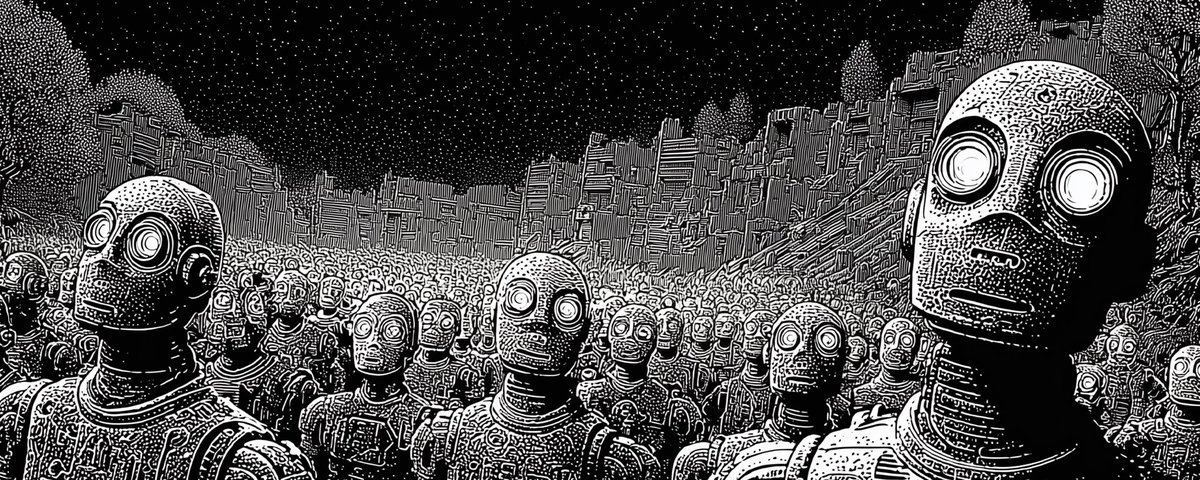
Welcome to 2026! Milady is back.
Ethereum did a lot in 2025: gas limits increased, blob count increased, node software quality improved, zkEVMs blasted through their performance milestones, and with zkEVMs and PeerDAS ethereum made its largest step toward being a fundamentally new and more powerful kind of blockchain (more on this later)
But we have a challenge: Ethereum needs to do more to meet its own stated goals. Not the quest of "winning the next meta" regardless of whether it's tokenized dollars or political memecoins, not arbitrarily convincing people to help us fill up blockspace to make ETH ultrasound again, but the mission:
To build the world computer that serves as a central infrastructure piece of a more free and open internet.
We're building decentralized applications. Applications that run without fraud, censorship or third-party interference. Applications that pass the walkaway test: they keep running even if the original developers disappear. Applications where if you're a user, you don't even notice if Cloudflare goes down - or even if all of Cloudflare gets hacked by North Korea. Applications whose stability transcends the rise and fall of companies, ideologies and political parties. And applications that protect your privacy. All this - for finance, and also for identity, governance and whatever other civilizational infrastructure people want to build.
These properties sound radical, but we must remember that a generation ago any wallet, kitchen appliance, book or car would fulfill every single one of them. Today, all of the above are by default becoming subscription services, consigning you to permanent dependence on some centralized overlord.
Ethereum is the rebellion against this.
To achieve this, it needs to be (i) usable, and usable at scale, and (ii) actually decentralized. This needs to happen at both (a) the blockchain layer, including the software we use to run and talk to the blockchain, and (b) the application layer. All of these pieces must be improved - they are already being improved, but they must be improved more.
Fortunately, we have powerful tools on our side - but we need to apply them, and we will.
Wishing everyone an exciting 2026.
Milady.
saw Karpathy's tweet about how powerful AI tools have gotten. i had to test it myself
just vibe coded a game in <1 hour, using Gemini 3 for the prototype then chatGPT to help debug and get it live, and... it worked 😅
honestly eye-opening, esp since i'm not technical at all

I've never felt this much behind as a programmer. The profession is being dramatically refactored as the bits contributed by the programmer are increasingly sparse and between. I have a sense that I could be 10X more powerful if I just properly string together what has become available over the last ~year and a failure to claim the boost feels decidedly like skill issue. There's a new programmable layer of abstraction to master (in addition to the usual layers below) involving agents, subagents, their prompts, contexts, memory, modes, permissions, tools, plugins, skills, hooks, MCP, LSP, slash commands, workflows, IDE integrations, and a need to build an all-encompassing mental model for strengths and pitfalls of fundamentally stochastic, fallible, unintelligible and changing entities suddenly intermingled with what used to be good old fashioned engineering. Clearly some powerful alien tool was handed around except it comes with no manual and everyone has to figure out how to hold it and operate it, while the resulting magnitude 9 earthquake is rocking the profession. Roll up your sleeves to not fall behind.
my favorite game growing up was Super Mario so i started there
here's Super AI Bros :)
playable here if you're curious:
bee926.github.io/super-ai-br…
great post by @mert on building consumer products
been thinking about this a lot lately. it overlaps with a framework I came across while researching consumer conversion:
MECLABS Conversion Heuristics
it looks like a crazy math formula at first, but it's really just consumer psychology with weights:
C = 4m + 3v + 2(i-f) - 2a
▫️C: conversion
▫️4m (motivation): what users really want (the biggest driver)
▫️3v (value prop): why you?
▫️2(i-f): incentives minus friction
▫️-2a (anxiety): what are users afraid of?
a few points from Mert's post:
1. "infra is logical, consumer is psychological"
motivation (m) carries the most weight for a reason. in consumer, you don't create motivation, you align with it
if a user wants "10% yield on passive stables" but your app requires them to figure out hedging, position size and timing, you've lost alignment. you're asking users to change their goals to fit your tech
2. "owning a verb" = value (v) clarity
if you have to explain it, you're adding friction (f)
people don't "interact with a decentralized liquidity protocol". they just "swap" on Uniswap.
simple > clever
3. "consumer behaviour is much harder"
old habits = massive friction (f)
most crypto projects try to offset this with incentives (i) using airdrops or token emissions. it's the easiest variable to move, but it's often a band-aid when friction and anxiety aren't actually solved
---
over the years in crypto (helping build & being a user), I've met a lot of brilliant builders struggle to get traction
it's rarely the tech, the product just asks too much of the user
i believe real adoption comes from meeting people where they already are, not designing only for the 0.1% sophisticated crypto natives. that's the bigger pie

the best way to learn on the internet is to post the wrong answer
I've been trying to learn more consumer product coming from b2b/infra product, gonna journal most of it in public here to learn faster
some observations:
- in infra, you focus on logical things; in consumer you focus on psycho-logical things
- making something 2x better in infra is generally enough to get traction, but in consumer the thing must be at least 10x better as consumer behavior change is much harder than developer behavior change
- in consumer, you can get away with iterating super fast in prod; in infra, you can not as you can not risk any loss of reliability
- in consumer, it seems that you basically want to own a verb. i.e "to swap", "to check price", "to snipe", "to launch" — it's very important that you don't overcomplicate this at first and make sure you go after it fully
- jack dorsey has a saying: "limit the number of details, but make those details perfect"
- the most important thing in consumer is the product loop. in infra, this is easy because if you build correct infra then it's something people will always need (RPCs, payments APIs, etc) — but in consumer you must ask:
i) why will this person open this?
ii) why will this person come back to this?
iii) is the above a habitual reflex?
- to that end, assuming you have the above, you need to bake virality/distribution into the product. in crypto this generally means referral fees, sharing PnL cards, etc
- in infra, it's much more about 1-1 handholding, docs, and word-of-mouth
lmk anything ive missed
this is exactly what meeting users where they are looks like
no learning curve, just intent → action
teapawt.net/elonmusk/status/200405…
