

@ Databricks / ex-Google DeepMind / ex-Google Research Interested in research at the intersection of IR & AI.
Joined May 2010
- Tweets533
- Following397
- Followers1.8K
- Likes529



Pinned Tweet
Really excited to share our latest research on the Instructed Retriever - a novel retrieval architecture that reimagines search for the agentic era.
databricks.com/blog/instruct…
Amazing work by @cindyxinyiwang and @mrdrozdov who co-led this effort!

Back to the future, small rerankers are in vogue again :) Really nice work from @lintool lab, as usual

What are we up to? 🏡 Project Greenhouse: Progress Toward Fully Open and Sovereign Agentic Search w/ @Sahel_Sharify @Lingwei_Gu @nour_jedidi arxiv.org/abs/2610.11922

Really cool agentic memory benchmark from @Letta_AI . Exciting to see the community thinking more about long-horizon, evolving tasks, and not just static memory recall scenarios.


Really great work done by @ShichengGLiu during his @DbrxMosaicAI internship!

(1/n) Before trusting AI to make scientific discoveries, can it reproduce existing research - and go one step further to test whether conclusions survive reasonable alternative analytical choices?
Sharing work from this summer with @DbrxMosaicAI, @StanfordNLP, and @StanfordOVAL on using AI agents to reproduce published medical findings and autonomously investigate analytical choices that could change their conclusions.

Michael Bendersky retweeted

Databricks is investing in New York for the long haul. Very excited to continue growing our AI research lab in NYC, now one of the largest in the city!

New York is becoming one of Databricks’ biggest AI hubs. 🗽
We’re expanding at 5 Bryant Park to ~120,000 square feet across five floors, including a dedicated Engineering and Research floor.
With teams building technologies behind Genie, Unity Gateway and CustomerLake, our momentum in NYC is only growing.
Cool counterintuitive result from our team: on 2 hard chart-retrieval benchmarks, a small text embedding + up-front parsing (ai_parse_document) matches or beats a big multimodal embedding model.
Big congrats to @amruthaaa___ , who led this work! 👏
databricks.com/blog/enhancin…


Charts contain important information in enterprise documents, but agents often struggle to retrieve and reason over them accurately. Chart images can be misread, while captions often omit the precise values and labels needed for retrieval.
That’s why our team at @DbrxMosaicAI developed structured chart extraction for ai_parse_document, converting chart content into JSON that can be indexed and used by Genie and other RAG systems.
Across two chart-heavy benchmarks, our approach, which uses a lightweight 300M-parameter text embedding model, outperformed multimodal embedding baselines which were up to 10× larger.

Michael Bendersky retweeted

We are excited to share @databricks 's new AI Extract achieves the new frontier at complex document processing tasks! It addresses a few key customers' pain points:
- Process documents with 500+ pages that exceeds 1M tokens
- Large, nested schema with 1k+ of objects
- Complex schema that requires frontier reasoning
Here is how we achieved it:
- In-house custom model for document extraction that is trained for complex real-world examples and optimized for serving large volume of workloads
- Custom agent harness that is designed for long document extraction. It decomposes large extraction jobs, executes smaller tasks in parallel, and reconciles them into one final structured output.
This is the methodology behind many of our work: identify key large workloads of enterprise customers, build in-house models + harness to address it, and ship to the customers through a close collaboration between the research + product!

Michael Bendersky retweeted

This was a super cool event at Data + AI Summit, probably the first live competition for AI researchers and agents! Check out the video and congrats to the winning teams from Stanford, UMass Amherst and Yale! m.youtube.com/watch?v=MNkmRt…
Blog on winning ideas: databricks.com/blog/evaluati…

Really cool results from our team on task-aware model routing with 30%+ lower costs. Even better, routing is already available in Beta at @databricks Unity AI Gateway.

We are in a Cambrian explosion of frontier models. Even as a researcher who spends a lot of time evaluating models, I find it hard to keep up. New models are arriving constantly, and the mental overhead of choosing the right setup for each task keeps growing.
That motivated us to build Smart Routing: an intelligent layer that automatically matches each task to the right model based on its complexity and the capabilities it needs. Our early results are promising: frontier level quality with 30%+ lower cost, and more than 50% savings on public benchmarks.


Michael Bendersky retweeted

📣 Excited to introduce OfficeQA Pro V2, the next generation of OfficeQA Pro!
It's built on a new corpus of 120,000 PDFs provided by the U.S. Treasury.
Frontier AI agents average 26% accuracy. More info below 👇
databricks.com/blog/introduc…

Michael Bendersky retweeted

Most agentic search systems get better by thinking longer: more tool calls, more reason-act loops, each step waiting on the last. Quality goes up, but so does latency.
Instructed-Retriever-1 takes a different route. Instead of scaling test-time compute sequentially, it scales it in parallel. One retrieval-specialized model fans the work out: it generates multiple query and filter formulations to widen recall, then reranks the merged evidence with a multi-pivot reranker to sharpen precision. Both stages run at once, so searching more broadly no longer means searching more slowly.
The result inside Knowledge Assistant: search time drops more than 3x and answer time 2x, with time to first token around two seconds, and no drop in quality (it matches Claude Sonnet 4.5 retrieval quality on KARLBench). For the people using it, that means far less waiting between question and answer, the freedom to ask more follow-ups, and more of the knowledge base actually surfaced. Rolling out to all customers now, with no reconfiguration.
Read how we did it: databricks.com/blog/3x-faste…

Really exciting new collaboration with @NegarEmpr @mrdrozdov and @matei_zaharia on query utility gap between ranking and generation (to appear #SIGIR2026). Check it out!

1/ "Can QPP Choose the Right Query Variant?" has been accepted at #SIGIR2026!🇦🇺
You can easily over-generate multiple query variants at low cost, but running RAG for all of them is expensive!
Can we pick the winner query before paying the generation cost?
arxiv.org/abs/2604.22661

Michael Bendersky retweeted
Most enterprise questions don't live in one dataset. They span structured systems and unstructured sources like documents, reviews, and reports.
In our latest research, we show how Agent Bricks Supervisor Agent handles this by decomposing queries across structured and unstructured tools, then synthesizing results over multiple reasoning steps.
The results across STaRK and KARLBench: 20%+ improvement over SoTA baselines, with the biggest gains on tasks requiring tight integration of structured and unstructured data.
All built declaratively — no custom code, just precise instructions and the right tools. databricks.com/blog/agentic-…

Michael Bendersky retweeted
Applications are officially open for the Grounded Reasoning Cup at Data + AI Summit 2026! 🏆
We’re looking for students who want to:
- Tackle high‑impact enterprise challenges
- Showcase work to top researchers/engineers (with recruiters in the room)
- Compete for $100k in model credit prizes
Apply here: forms.gle/ijdHDbAJFZpFLi1b7
Competition overview: bit.ly/groundreasoningcup-st…

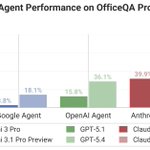
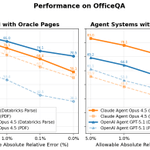
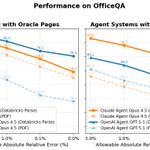
We just published OfficeQA Pro - a set of 133 challenging questions from the original OfficeQA benchmark. Even the best frontier agents still struggle on OfficeQA Pro with common issues stemming from errors in parsing, retrieval, and visual reasoning.

All of these are realistic problems that @databricks customers face in their daily work, and we hope that OfficeQA Pro will contribute to advancing SoTA on grounded reasoning tasks.
Technical Report: arxiv.org/pdf/2603.08655
Github: github.com/databricks/office…
Congratulations to @kristahopsalong @arnav_thebigman @jazco @ivanzhouyq Erich Elsen @matei_zaharia and everyone at @DbrxMosaicAI who made this work possible!
Special thanks you to our partners @USAFacts @superannotate @turingcom and to all Github contributors!
I thought about posting a thread on KARL, a new Pareto-optimal model for retrieval and grounded reasoning tasks. But @jefrankle did a much better job than I ever could. If you have any interest in information retrieval and/or RL, check it out! Full report: databricks.com/sites/default…

Meet KARL, an RL'd model for document-centric tasks at frontier quality and open source cost/speed. Great for @databricks customers and scientists (77-page tech report!) As usual, this isn't just one model - it's an RL assembly line to churn out models for us and our customers 🧵


This was an incredibly fun collaboration with
@j_nadan_chang @mrdrozdov @ShubhamToshniw6
@owenoertell @alexrtrott @WenSun1 @jefrankle and many others here at Databricks AI Research.
Michael Bendersky retweeted
Agent memory is a simple and powerful way to do continual learning! With the new MemAlign method from Databricks Research, we can build better LLM judges from examples of human ratings, and they scale with more data. Now in Databricks and @MLflow. databricks.com/blog/memalign…

Instructed retriever is not just better than RAG, but it is also a much more effective tool in a multi-step agentic setting, where it not only delivers better results, but also does it faster and in fewer steps.

Instructed retriever is now available for all of our Agent Bricks Knowledge Assistant customers. Consider trying it out for your next retrieval agent project. docs.databricks.com/aws/en/g…
