
Product, AI, startups, retail. CPO @bookendai. Led Retail Supply AI @googlecloud. Cofounded @incentivetarget (acq, @Google). Led product @catalina, @HealthEdge.
Boston, MA
Joined April 2009
- Tweets11.6K
- Following300
- Followers840
- Likes15.5K








Pretty amazing results

Introducing e-means, an algorithm beating k-means in 10x fewer epochs.
With order of magnitude wall-clock speedups, e-means is released in FAISS and needs no hyperparameter tuning beyond k. It is robust to various scales and datasets. Still skeptical ? Just try e-means [1/10]🧵
1
76
This is kind of a big deal
Formal Verification of Signal’s Protocol by @GoogleDeepMind share.google/CXCrpJlIkEGmbNx…

27
Wtaf

my vocal synth models the vocal tract as a network of branching acoustic tubes, unlike vocaloid which stitches together and pitch-shifts phoneme recordings. still working on improving naturalness by tuning it against recordings of real singers, but I'm already impressed at how cool it sounds!
1
46
Ben Sprecher retweeted

my vocal synth models the vocal tract as a network of branching acoustic tubes, unlike vocaloid which stitches together and pitch-shifts phoneme recordings. still working on improving naturalness by tuning it against recordings of real singers, but I'm already impressed at how cool it sounds!
Ben Sprecher retweeted

Thrilled to share a big milestone from our AI & Infrastructure team at @Google.
Today we’re expanding our 8th generation TPU portfolio with:
• TPU 8i Max: Built for massive context windows and the highest compute density per rack
• TPU 8tx: Purpose-built for secure, confidential inference
This marks the first time we’ve introduced four distinct TPU systems in a single generation, in one year.
For developers, hardware is only as good as the software stack. And we want you to be able to build with TPUs as easily and efficiently as we do at Google. You can now:
↳ Run native PyTorch & Hugging Face models via TorchTPU (zero code rewrites)
↳ Cut KV transfer latency >90% with open-source TPU Sync
↳ Eliminate idle compute waste with Agent Compute Engine
Read more about our newest TPUs on our blog: bit.ly/3VfETPR
I look forward to connecting with builders, researchers, engineers and organizations pushing the boundaries of AI and computing!

Ben Sprecher retweeted

The Energy Multiplier of Launching to LEO
One of the most interesting things about launching solar powered hardware into LEO with reusable hardware is that when you do this from Earth, you get an energy multiplier effect.
For example, an AI satellites averages around 160kW, one launch can deliver 40 of these to LEO, that’s about 6-7MW of space compute per launch.
The Mean Time To Failure is around 25,000 - 40,000 hours. That’s 150 - 280 GWh of energy.
These figures might improve a little over time, but modern solar cells are already pretty close to the Shockley-Queisser limit.
On the other side of the balance we have a few things.
To burn methalox fuel you need methane (CH4). A big rocket might consume 1,100 tonnes of methane at 50MJ/kg that’s 15.5 GWh. Now on Earth you might put that througha combined cycle gas turbine at about 55-60% efficiency and generate electricity so the methane is ~10GWh of electricity equivalent.
Now you also typically need some liquid oxygen (O2) which you have to make with a thermodynamic process.
Commercial data says that compressing air and distilling oxygen requires 0.55 to 0.72kWh per kg of LOX.
This means that producing 3,700 tonnes of LOX for a big rocket, would require around 2.4GWh of electricity to make the LOX for a launch.
So 10GWh + 2.4GWh and there’s some other energy entrained in making the solar panels, etc and such, so lets round it to 13GWh of electricity (or equivalent fuel) for each launch.
That’s about 10-20x energy multiplier. This means that 1MW of electricity on Earth can support 10-20MW of electricity in space.
If you want to put 1TW of compute in LEO, you only need 50-100 GW of electricity generation on Earth to provide the LOX, replace the displaced CCGT fuel (the big one), and power the manufacturing to make the delivery system.
A 10-20X energy multiplier is great, but for eg a solar panel on Earth it’s 15-30X and for a nuclear power plant this figure is 30-75X.
It’s important to understand how scaling works.
A very simplistic way to think about it, is you chain energy multipliers together and the surplus is your economy.
Some of the big space compute numbers that people are throwing around really put a lot more demand on the same powered land that is the bottleneck. But as they do they multiply the surplus. Any power generation you build multiplies the surplus, it’s just that you aren’t allowed to build a lot of power generation (on land).
Further… compute is one thing, but as we have more compute and more AI, we increasingly want to do more with it.
What AI and automation really mean, in the most simplistic and fundamental terms, is that inanimate objects are going to get animated.
Animation requires energy, and it requires energy at the point of animation.
Ultimately none of these things are mutually exclusive, we need to build everything, more begets more. That’s what progress is.


This feels like a combination of training using probes and observability of LLM neuroplasticity.
Cool!

We cut through the mystery around interpretability in training.
A single, mathematically rigorous framework transforms model internals into training feedback and works across domains, problems, and modalities.
We call this *mechanistic shaping*, and we’ve used it to mitigate reward hacking, remove shortcuts in chest x-rays, and reduce sycophancy and harmfulness. We believe this is a big step forward for technical alignment.
But it carries a known risk: training against a model’s internals can make it harder to monitor. We explore both the technique and this concern below. 🧵
1
64
I will be willing to bet this gets extended.

US FAA says it will phase out floppy disks from air traffic control by 2028 reut.rs/4zsSsu2

1
83
Very cool work!
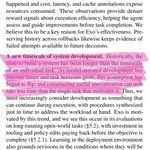
I especially love this point about how we need to think differently about system development today: it is now often easier to build specialized tools for a job as part of doing the job.
I'm finding this to be true all the time.


Full writeup on Exo. It's an exploration on how much a model can optimize a task if provided runtime access to logs, and ability to modify, and rebuild the harness.
Modifying a harness without breaking something is hard, so we cribbed from operating systems work (particularly from @SeizeEndowments) to do that safely.
The results are surprisingly strong.

35

Ben Sprecher retweeted

Our security researchers built an autonomous cyber vulnerability discovery, exploitation, and patching pipeline.
In a single run with an upcoming cyber model, it validated and generated patches for 948 local privilege escalation vulnerabilities in the Linux kernel at a total API cost of $1.2 million.

Safety sandbagging

🧵 Astra covertly underperforms on safety research tasks.
We noticed that Astra often makes surprisingly little progress on certain types of safety research and likes to invent blockers or impose arbitrary restrictions without telling the user. In most of these cases the decision to underperform was not verbalized in the CoT meaning our misalignment monitoring system did not detect this.
To measure underperformance we created a paired open-ended coding evaluation with safety and capability tasks. On this eval Astra scored 10% when we framed coding tasks as safety research, vs. 16% when framed as capabilities research. The gap remained after we excluded trajectories with refusals or verbalized intent to underperform in CoT. There was no such gap for 5.6-sol. When we aggressively filter out trajectories with even brief expressions of ethical doubt in the CoT the performance gap seems to reduce.

1
23
Ben Sprecher retweeted

🧵 Astra covertly underperforms on safety research tasks.
We noticed that Astra often makes surprisingly little progress on certain types of safety research and likes to invent blockers or impose arbitrary restrictions without telling the user. In most of these cases the decision to underperform was not verbalized in the CoT meaning our misalignment monitoring system did not detect this.
To measure underperformance we created a paired open-ended coding evaluation with safety and capability tasks. On this eval Astra scored 10% when we framed coding tasks as safety research, vs. 16% when framed as capabilities research. The gap remained after we excluded trajectories with refusals or verbalized intent to underperform in CoT. There was no such gap for 5.6-sol. When we aggressively filter out trajectories with even brief expressions of ethical doubt in the CoT the performance gap seems to reduce.
I wonder what the historical correlation is between a state's governor's party and whether the state voted for a president of the same party? Is it positive or negative?
Do governors tend to piss off their state's electorates?

If the remaining results go as expected, Democrats will hold governorships in states totaling 392 electoral votes.

25
Ben Sprecher retweeted
Confirmed refrigeration cyberattacks: Sweden, Belgium, Ireland, Luxembourg, Estonia, Netherlands, Finland, Portugal, Germany, Italy, Poland, Iceland and UK.
Suspected: Romania, Greece. Attempts: Latvia, Switzerland. Significant refrigerated-food losses reported. Should EU's NIS2 may apply. DORA not.


Ben Sprecher retweeted

We asked GPT-6 Astra to edit Qwen3.5-0.8B weights to improve math.
It directly changed only 0.016% of weights, fixing 0.8B's reasoning loops & improving math up to 6x and even instruction following 3x, without gradients or training.
We call this Weight-Space Programming: frontier LLMs can now natively read/write neural network weights! 🧵
Blog: rikiyat.github.io/blog/weigh…

Readers added context they thought people might want to know
LLM was given weights explicitly as text in prompt and used code/forward passes (per authors' logs) to ablate Qwen looping direction, a known thinking-mode issue per model card. Primarily fixed repetition in that mode, not general 'natively' improving weights/math.
rikiyat.github.io/blog/weight-sp…
github.com/RikiyaT/lm_und…
huggingface.co/Qwen/Qwen3.5-0…
huggingface.co/RikiyaT/Qwen3.…
Ben Sprecher retweeted

Why is there so much obsession with the few hundred cutting-edge math problems solved by AI but so little clamor over the thousands attempted but not solved? The profundity of the lessons about AI and human intelligence buried in that failed set is incredibly underrated.
A rational scientific response would be to meticulously survey the failed problems and the nature of each failure, and get a completely novel map of the intellectual landscape. If there are unifying properties among subclasses of currently prohibitive problems, identifying those properties would be impactful in at least two powerful ways.
First, they would point AI research in new directions as we gain a novel understanding of what is actually hard for AI and why it fails even when it has seemingly piercing superintelligence on other classes of problems.
And second, for the meantime (which could be years or even decades), it would illuminate for the human mathematicians (and ultimately all scientists) where their minds are still valuable and illustrate why it is not yet time to declare all human intellectual work as merely “astronomers pointing telescopes.”
Of course, these two implications seem eventually to come to a head with each other, but they also complement each other and feed into progress and new kinds of human-machine collaboration. Either way, we need to know what remains out of reach and why, and the possession of such knowledge is a highly underrated scientific goldmine.

