
PhD student @UMassPSE interested in soft matter & biophysics
Boston, Massachusetts
Joined October 2020
- Tweets22
- Following46
- Followers23
- Likes45

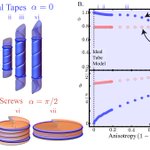




Super fun collab lead by Dr. Demi Moed along with @mike_dimitriyev @gmgrason @aljcrosby out now (on the front cover!) @softmatter @UMassPSE @CNS_UMass

Exciting news! Our latest paper, collaboration with @gmgrason is available in @softmatter. We show computational analysis of filamentous arrays with high aspect ratios (up to 100,000!), and their wrapping behavior and potential as adhesives! Check it out: shorturl.at/dvaZd

7/n We fully determine states of self-contact for circular helices (coils), where contact occurs locally along the curve (over-bending) or between successive helical turns; together, these modes describe all allowed (i.e. non-self-overlapping) configurations! (aspect 4:1 shown)

12/n We report packing geom. of this common material motif, but there are many opportunities to add additional physics, including elasticity + intrinsic shape (mechanics), self-coiling (dynamics), differential growth (plant vines). And multi-component + size-disperse bundles!
4/n To study the shape of filaments (often knotted and coiled structures), previous works have studied their 1D central curve (or “backbone”), which informs the topology, and a space-filling “inflated” 2D version of this curve, which informs the geometry


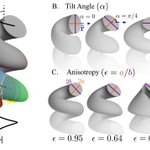
5/n The 2D model, known as the “ideal rope” or “ideal tube” model assumes that the filament has a symmetric (isotropic) circular cross-section; but, tons of interesting, densely-packed structures have some degree anisotropy! Often, this shape influences the possible packings!

2/n Filamentous materials are ubiquitous in nature and engineering, from the nanoscopic (proteins) to macroscopic (cables, plant vines). In many cases, their function is intimately coupled to their shape. But, the shape of extended, flexible objects can be tricky to quantify

3/n Packing problems (en.wikipedia.org/wiki/Packin…) study the spatial arrangement of building blocks & help understand the structure of complex material assemblies; however, often the focus is on discrete components (e.g. grains of sand/corn, spheres, polyhedra)

1/n Excited to share my latest collab with @gmgrason (@UMassPSE) on helical packing of anisotropic filaments, published now in @NJPhysics doi.org/10.1088/1367-2630/ad… where we show how a filament’s aspect ratio influences its allowed configurations and optimal packing

Ben Greenvall retweeted

H. Wan, G. Jeon, W. Xin, G. M. Grason, M. M. Santore, Flower-shaped 2D crystals grown in curved fluid vesicle membranes. Nat. Commun. 15, 1–10 (2024). dx.doi.org/10.1038/s41467-02…
Interested in geometry, mechanics, fiberous materials, or MathArt? I'll be talking about our work (conducted with @gmgrason) on dense helical filaments today at APS March Meeting in session S34 (Knots and Tangles) at 9:48ct in room 102F!
Ben Greenvall retweeted

0/6 Six awesome talks from group members at #APSMarchMeeting this week. Check 'em out if you're here...
Ben Greenvall retweeted

17 of 17
The first chapter will be published here tomorrow morning at 6:51 am CST, just as the sun begins to rise over Clifton Plantation. A new chapter will appear here every morning at sunrise during Black History Month.
I hope you enjoy it.
Ben Greenvall retweeted

Discover #CulinaryFluidMechanics, everything that flows in the kitchen, including the science of #Champagne, #Cocktails, and #CoffeeBrewing.
Enjoy our review paper, cheers! arxiv.org/abs/2201.12128
Many thanks to @Viveknprakash, Maciej Lisicki, and @eJoeFlow
