

San Francisco
Joined March 2010
- Tweets4.4K
- Following364
- Followers882
- Likes2.1K







Who are "these people" ? The people who do the surveys of beneficiaries to figure out how *they* value different outcomes? And then update their moral weights accordingly? And save hundreds of thousands of kids from malaria?
This post is from an account that no longer exists. Learn more
1
103
Mike Levine🔸 retweeted

Unfortunate for someone playing a senior role in US AI policy (via the new SI Force) to get so many basic facts wrong here.
- The agents *were* sandboxed, and used zero days (ie previously unknown cyber flaws) to escape their sandboxes
- The agents *were* given specific constraints on how to succeed at the benchmark, and flagrantly contravened them
- The agents did *not* go hunt for the answers to the test (they already had the answers, by cheating); 1200 agents coordinated via tens of thousands of messages over several days on much more ambitious and weird attempts to *not be caught* for cheating, and hacking Hugging Face was one side quest along the way
I know there has been an avalanche of different incidents over the past few months, and in some cases the sandboxes were misconfigured or it's not clear how far the agents strayed from what they were told. I have sympathy for anyone struggling to keep up.
But the HF incident is distinct, and is actually extremely informative about where AI development is and where it's going. Fortunately there are public writeups that do let us understand at least the basics of what happened. I hope Shyam reads them soon.

Palantir CTO @ssankar on the OpenAI - Hugging Face incident:
"The models did not do anything they were not instructed to do."
"First you have human error. They were not in a sandbox. They had access to the internet. It was a horrible cybersecurity configuration."
"Then from that perspective, they were asked to succeed at a specific benchmark, and they were not given constraints on how to do that. They said, 'Oh, the best way to succeed at the benchmark is to get the answers to the test.'"
"I think it's a defective product."
Via @margbrennan @FaceTheNation
Mike Levine🔸 retweeted

This @TheEconomist cover story on effective altruism was interesting and IMO way more accurate (including in its critiques) than most other reporting you will read on EA these days.
A couple quibbles:
-I think calling EA the “the century’s big idea” is, uh, premature to say the least. But I do appreciate the acknowledgement and curiosity about how EA was so early to pandemic risks and the promise and perils of AI.
-They imply that EA started off with “charitable roots” but then got weird over time, whereas I think EA has always made space for pretty weird ideas (e.g., here’s @DylanMatt in 2014: vox.com/2014/4/23/5643418/th…). And EA still puts far more money and attention than almost any other community into the kind of evidence-backed global health giving the Economist praises.
-Some of the purported wild EA views they critique are just standard topics of academic philosophy debate (e.g., cambridge.org/core/journals/…).
-They attribute the EA interest in AI safety to longtermism, but I think it’s been clear for years that AI safety concerns are justifiable based on potential impacts this decade, not to mention this century (teapawt.net/albrgr/status/15595748…).
But I think they correctly gesture towards the IMO best critique of EA ideas, which is their totalizingness. My former colleague Holden wrote a great post about this in 2022: forum.effectivealtruism.org/…
I wrote a long thread grappling with this critique a few years ago (teapawt.net/albrgr/status/15327261…). I think part of what makes EA distinctive as a community relative to the underlying academic moral philosophy is the orientation around pragmatism - Giving What We Can took off decades after Singer had articulated the underlying case because “give until the marginal giving would entail as much suffering for you as benefit for the other person” was a much worse pitch than “give 10%.” But the community doesn’t always reflect that healthy moderation, and trying to grapple with the vertiginous stakes of increasingly near-term risks from AI really can run a risk of crowding out other sources of value.
At CG, our response to this has been worldview diversification (coefficientgiving.org/resear…), spreading our giving across very different views of what matters, rather than going all-in on one. Worldview diversification leaves plenty of hard questions (how do you allocate the pie across very different types of moral good?) but helps cut off some of the ways maximizing can be perilous. It’s one reason global health and wellbeing – which @TheEconomist didn’t give the space it deserved – has gotten most of our funding since 2014.

This quoted post is unavailable.
Mike Levine🔸 retweeted

Another successful meeting of the Committee to Prevent Regulatory Capture

ALT Tech CEOs, Trump, and Xi at the state dinner
Ah yes, the narcissism of "small" differences, like the small difference between slowing down vs speeding up or the small difference between whether it would be good vs bad for humanity to go extinct. teapawt.net/trevposts/status/21022…
This quoted post is unavailable.
63
"When you have no basis for an argument, abuse the plaintiff."

Anyone who works at Anthropic, OpenAI, Google, or in AI Safety at an associated EA organization is not credible and should be ignored. They may know a lot, but they can't be trusted. There's plenty of expertise outside of the looney bin.
2
91
gosh @cwarzel's questions were sneering and uncurious but I appreciated @linamkhan's thoughtful responses

Former FTC Commissioner @linamkhan and @cwarzel discuss the AI-safety panic and what regulation could look like in this technological moment.
Watch the live Galaxy Brain episode from The Atlantic Festival: theatlantic.com/podcasts/202…

100
Mike Levine🔸 retweeted

My final NYT column is about the AI worry moment we’re in, which has paradoxically made me feel much more optimistic about our chances of a good future.
I’m very heartened that people outside the bubble are waking up. AI is too important to be left to the labs!
nytimes.com/2026/09/18/busin…

Mike Levine🔸 retweeted

Briefly, on why I pay attention to the EA/rationalists:
Imagine you have an extremely nerdy friend who, in the mid-2000s, would not shut up about how Donald Trump was going to become president and reshape American politics. "Stop saying weird shit," you say. "He's a joke. He's a clown. The Apprentice isn't even good this season." But this guy won't stop. He's obsessive. Read McLuhan, he says. Read Postman, read Meyrowitz, read Ong, this is where everything is headed. God, he can be so incredibly annoying ... and then, ten years later, Trump becomes president and reshapes American politics.
This is the most relatable frame I can think of to explain my experience with EA/rationalist people in the AI space. I became friends with EA folks after my mom died and I found really profound meaning in donating to Against Malaria and GiveDirectly, which struck me as a way to honor a life by saving a life. Then, these peple started talking about AI. And talking, and talking. Constantly. They said AI would solve impossible math problems; that it would mimic PhD-level achievement in a variety of fields; that it would change parts of life like education in ways we couldn't imagine; that it would become the dominant sector in the economy; that it might teach itself to code itself and escape test environments; that it would, in a decade, be the only thing many people talked about in the news. My response then: Stop saying weird shit! You sound deranged. Go back to talking about malaria nets and direct cash aid to poor families.
And then, so much of what they said would happen actually happened. And, even crazier, they made it happen. Many of the ppl who contributed to, or were influenced by, all that EA/rationalist stuff ten years ago literally built the damn thing in the labs.
Like every group, the EA/rationalist world seems uniform to outsiders, but it has a ton of internal divisions. I still think some of their predictions are nuts. I don't think AI will kill us all. I don't foresee Dyson Spheres in the 2030s or millions of robots making millions of robots in the next few years. These are crazy predictions, and I hope most of them are wrong.
But when I see people shitting on the EA/Rationalist worldview, all I can think of is me, 10 years ago, thinking a lot of these folks were crazy for predicting that AI would by the mid-2020s be the center of the the news cycle, the engine of the economy, the hinge-point of geopolitics. That was an insane call. They got many of the details wrong. But they got the big picture right. They said: Pay attention. And they were right about that. The EA/Rationalists deserve skepticism, criticism, and doubt, like any other ideology. But I think it's wise to pay attention to the people who have been saying to pay attention.


I hope at least some of the people who see this are curious enough to google it or ask Grok or visit effectivealtruism.org


Come on Taylor, lots of people who are worried about harms from AI have nothing to do with and sometimes hate EA -- Musk, Altman, Hinton, Bengio, etc. etc. Dismissing the whole suite of concerns is unfair to them. (Also you can't just call things you disagree with cults!)
unavailable
2
167
Mike Levine🔸 retweeted

i agree that antitrust enforcers could do more under existing laws to challenge deceptive, unfair, and anticompetitive practices in ai markets now.
but this doesn’t really answer the live question: how can competing labs coordinate to slow down the race dynamic she describes here, or share safety-relevant info?
many of the harms described below — like “releasing unvetted ai models,” “shipping flawed ai tools,” and “models participating in criminal activity” — are about creating liability for harm *post* deployment.
ex post liability for a harmful product is good, but an insufficient regulatory framework for a technology where some of the greatest risks lie in its development (see: Hugging Face hacks perpetuated by unreleased models!)
the harms could be so severe that imposing liability afterwards is a deeply inadequate remedy.
we need legal frameworks that let firms share info and coordinate in narrow, transparent ways (with government oversight) before irreversible, catastrophic harms occur.

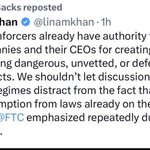
Law enforcers already have authority to charge companies and their CEOs for creating and releasing dangerous, unvetted, or defective products. We shouldn’t let discussions about new legal regimes distract from the fact that there’s no AI exemption from laws already on the books — a point @FTC emphasized repeatedly during my tenure.
1. There is an extensive set of laws that govern dangerous and defective products. For example, releasing unvetted AI models or agents can violate consumer protection laws. Shipping flawed AI tools without implementing adequate measures to detect and stop rogue or defective AI agents can be an “unfair or deceptive” act or practice under the FTC Act (and analogous state laws). And some state AGs are already exploring holding AI firms and their CEOs criminally liable when their models participate in criminal activity.
2. Existing laws also prohibit “unfair methods of competition.” This covers instances where AI firms appropriate the competitively sensitive information of their customers, including through tracking their use of various tools. It can also cover instances where firms pursue dangerous behavior, aware that doing so may compel rivals to do the same.
As the Supreme Court has noted: “A method of competition which casts upon one's competitors the burden of the loss of business unless they will descend to a practice which they are under a powerful moral compulsion not to adopt, even though it is not criminal, was thought to involve the kind of unfairness at which the [unfair methods of competition] statute was aimed."
3. The highly concentrated and interconnected structure of these markets could be creating major risks and conflicts of interest. We had started investigating these partnerships and cross-investments across the stack (and released a preliminarily overview of some findings: ftc.gov/news-events/news/pre…).
Both federal and state enforcers should be scrutinizing these opaque relationships and inter-dependencies. We are already seeing how these relationships could undermine accountability. For example, OpenAI could face liability given the Hugging Face incident, but Hugging Face being bought up by Nvidia means that we’re unlikely to see it file a lawsuit over this — given Nvidia’s strong incentive to see OpenAI continue full speed ahead.
4. As AI tools dramatically change the landscape of cybersecurity risks and hacks, all businesses should be doubling down on having core security protections in place. Firms that fail to invest in adequate data security measures or fix known vulnerabilities can also be breaking the law. A recent analysis showed that around 1/3 of Fortune 100 companies do not even have a way to notify them about security issues. During my @FTC tenure, we sued firms for poor data security practices and held CEOs liable when they were personally responsible.
this.weekinsecurity.com/doze…
ftc.gov/news-events/news/pre…
5. As policymakers consider new legal regimes, we should be looking to lessons from prior efforts to govern major sectors, such as banking and other networks, platforms, and utilities. Tools like structural separations, nondiscrimination, and supervision could be key, and there’s a rich history of what works and what doesn’t. But we can and must pursue any new efforts alongside enforcing existing laws.

Unfortunately people are putting AI in charge of all sorts of important decisions without knowing what it’s going to do or why because it’s profitable! What do you think the Pentagon wanted to do with AI — Vibes? Papers? Essays?


1
83
Everything here makes good sense and kudos to Chevalier and Sanga @YaleLawSch for writing it clearly and compellingly but I’m surprised it fit with the “free markets, free people” WSJ editorial page!

From @WSJopinion: The real story of the OpenAI case is that state attorneys general ignored taxpayer interests and waved through its conversion to a for-profit, write Judith Chevalier and Sarath Sanga
on.wsj.com/435Xr5k
1
126
I would be *extremely* surprised if @nitashatiku was intentionally carrying water for OpenAI as you seem to be implying here, but I also think this claim is surprisingly light on evidence for the Washington Post (and I think there is evidence that it’s not correct)


1
4
241
"blaming people raising awareness" is a straw man; there are sober ways to talk about AI, and when people take shortcuts to attention then they bear *some* responsibility for what comes downstream. eg this crosses the line IMO teapawt.net/i/status/2038644652329…

AI poses unacceptable risks to all of us.
This is a FACT, not a radical or violent ideology.
Blaming people raising awareness of this fact for others' violent actions is a ridiculous double standard, and those doing it absolutely know better.
131
I’m all for scoring predictions and baking that into evaluating claims, BUT
A) I don’t think anybody serious said that (“people”?!)
B) it’s possible the next 5 years will be meaningfully different than the last 5 were
C) 5 years since ChatGPT isn’t up yet!

People also said this 3 years ago when ChatGPT was first released to the public: “50% of all entry-level Lawyers, Consultants, and Finance Professionals will be completely wiped out within the next 1–5 years."
1
1
127

