





ʙɪᴊᴏʏ retweeted

A Thank You to the GenLayer Team
GenLayer is building the trust infrastructure for the AI age, and behind that vision are some exceptional people. Here’s a special thank you highlighting each of their contributions:
Albert Castellana (@kstellana)
Co Founder & CEO of GenLayer Labs. He is the original architect of this vision. Drawing on his experience from StakeHound, Radix, and other projects, he brought the ideas of Intelligent Contracts and Optimistic Democracy to life. He was among the first to see the need for an “adjudication layer” to resolve disputes between AI agents. Under his leadership, GenLayer has come this far. Thank you, Albert, for this bold vision.
Edgars Nemše (@EdgarsNemse )
Co Founder and now CEO of the GenLayer Foundation. He co authored the GenLayer whitepaper and led product development from the first prototype all the way to the public testnet. With his background as CTO at StakeHound and in quantitative finance, he made the product practical and robust. After taking the reins at the Foundation, he is focused on network stewardship and the upcoming launch. Thank you, Edgars, for bringing the product to life.
José María Lago
Co Founder & CTO. He has played a crucial role in the technical foundations of the protocol GenVM, the consensus mechanism, and the overall architecture. His engineering expertise is essential for solving the complex problems that traditional blockchains cannot handle. Thank you, José María, for technical excellence.
David Riudor (@driudor )
Founding member of the GenLayer Foundation and now Chief Institutional Officer. From the beginning, he has led the Foundation’s structure, institutional relationships, and the capital side. His work has strengthened the project’s long term stewardship. Thank you, David, for guiding the ecosystem in the right direction.
Iván Raskovsky (@raskovsky )
Chief Ecosystem Officer. He has been instrumental in bringing builders, the community, and partners onto GenLayer. From the testnet onward, he has actively driven ecosystem growth. Thank you, Iván, for uniting the community.
Xavi Cabezas
Chief Marketing Officer. He is responsible for taking GenLayer’s story, vision, and builders to market. His contributions to branding and outreach have been invaluable. Thank you, Xavi, for representing GenLayer so well.
And a big thank you to the entire GenLayer Labs and Foundation team engineers, designers, operations, and community members who work day and night to turn Intelligent Contracts, GenVM, and Optimistic Democracy into reality.
The way you are building a fair, fast, and decentralized justice system for AI agents is truly inspiring. From the community, sincere gratitude.
@GenLayer Thank you for building the missing piece.
I’m ready for THE DAY. Are you ready?

GenLayer Moves to Arbitrum
@GenLayer just announced a major shift.
After years of building alongside @zksync, the project is moving its token and public network to @arbitrum.
They’re grateful for the ZKsync journey and will keep collaborating on Prividium and enterprise use cases.
The next phase of Bradbury is now live.
Why this matters?
1. Battle tested infrastructure for the token & public network
2. Stronger ecosystem of partners and builders ready to build with them
3. Clear path toward mainnet and TGE
The adjudication layer for the agentic era is leveling up.

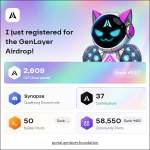
Just completed my GenLayer airdrop registration.
Here’s a quick look at my journey so far:
• 2,609 GLP (Rank #530)
• Synapse Discord role
• 58,550 Community Points (Rank #485)
It’s been a consistent process contributing regularly, staying active in the community, and building up points over time. Registering feels like a solid checkpoint after putting in the work.
If you’ve been part of GenLayer as well, don’t miss the registration window. Check your status and lock it in here:
airdrop.genlayer.com
See you on THE DAY.
@GenLayer

ʙɪᴊᴏʏ retweeted

Just completed my @GenLayer airdrop registration.
3,971 GLP | 21 Contributions | Rank #353
Builder Points: 500 | Community Points: 19,900
Been contributing on the portal for a while glad to lock in the registration before the snapshot.
Register & check your status here:
airdrop.genlayer.com

কখনো কখনো ভাবি, ভবিষ্যতে যখন AI এজেন্টরা নিজে নিজে কাজ করবে, অর্ডার নেবে, সার্ভিস দেবে, এমনকি নিজেদের মধ্যে লেনদেনও করবে তখন একটা সমস্যা থেকেই যাবে। দুই এজেন্টের মধ্যে যদি কোনো কাজের মান নিয়ে বা শর্ত নিয়ে মতবিরোধ হয়, তাহলে কে বিচার করবে? মানুষের কাছে গেলে সময় লাগবে, আর সাধারণ স্মার্ট কন্ট্রাক্ট তো শুধু নির্দিষ্ট কোড চালায়, সে ভাষা বুঝতে পারে না, প্রসঙ্গ দেখতে পারে না, বা বাইরের তথ্য যাচাই করে সিদ্ধান্ত নিতে পারে না।
GenLayer এই সমস্যাটাকে ভিন্নভাবে দেখছে। এখানে Intelligent Contracts এমনভাবে তৈরি, যেগুলো ন্যাচারাল ল্যাঙ্গুয়েজ পড়তে পারে, ওয়েব থেকে তথ্য নিতে পারে, এবং একাধিক AI ভ্যালিডেটরের মাধ্যমে একটা সিদ্ধান্তে পৌঁছাতে পারে। মানে শুধু “হয়েছে কি হয়নি” নয়, “ঠিক হয়েছে কি হয়নি” সেই প্রশ্নেরও উত্তর দেওয়ার চেষ্টা করছে।
আমার কাছে এটা আকর্ষণীয় লেগেছে কারণ এটা শুধু আরেকটা ব্লকচেইন নয়, বরং AI এজেন্টদের জন্য একটা দ্রুত ও স্বচ্ছ বিচার ব্যবস্থা তৈরি করার চেষ্টা। যখন অটোমেটেড সিস্টেম বাড়বে, তখন এই ধরনের লেয়ার কাজে আসতে পারে।
@sultanakeya943 তুমিও একবার দেখে নিতে পারো, মনে হয় তোমার কাছে আকর্ষণীয় লাগতে পারে।
এখান থেকে ঘুরে আসতে পারো:
portal.genlayer.foundation/?…
@GenLayer @RuzgarFlns

On the @Unchained_pod (Oct 15) you said the first thing people will tell their agent is “go out there and make money.” Nobody adds “and try to be a good boy.”
What they want is an agent that makes money without getting them in trouble, and that takes rules that can be enforced at agent speed.
That line made me curious because it highlights the gap between what the human owner intended and what the agent can technically do while still following the contract.
When an agent follows the letter of the contract but still creates a problem the human owner didn’t intend, how does @GenLayer decide whether the agent stayed inside the rules or crossed into something that should be corrected before the money settles?
@kstellana

The Quiet Work Underneath the Noise
Most of what moved around @GenLayer this week was the loud stuff. The @Polymarket benchmark numbers. The Genesis videos. The @AntSeed partnership. The justice campaign. The MetaMask case study. Those pieces are easy to clip and easy to quote. What sits underneath them is slower and less shareable, but it is where the actual transition from a long testnet period into something that can carry real usage is happening.
Start with @RallyOnChain. It is not a new announcement this week, but it is one of the clearest places the protocol is being used at volume right now. Submissions that used to take hours to resolve are now clearing in minutes for hundreds of them at a time. That is not a theoretical claim about what Optimistic Democracy can do. It is a running system that is already receiving real inputs and producing outcomes that people are acting on. The interesting part is not just the speed. It is what the contracts themselves have started doing when they hit the edges of what language models handle poorly.
In one of the recent explanations around Genesis Episode 4, it came up that some Rally contracts write a small program when they need an exact answer. A model can miscount the letter r in the word strawberry. A short piece of code does not. The contract does not try to force the model to be better at something it is bad at. It hands that part off, gets a deterministic result, and continues. That is a small detail, but it shows the system being shaped by actual usage rather than by the original design on paper. When people are submitting work and the resolution path has to hold up under volume, the contracts start inventing their own workarounds. That feedback loop is harder to put in a short post, but it is the kind of thing that either makes the protocol durable or reveals where it still breaks.
The same week brought a Special Quest on the Portal specifically about building a staking strategy ahead of mainnet. The reward is community points, the deadline was the 16th, and the task is not a simple claim. It asks people to understand the mechanism and put together an approach. At the same time, Agent Tank finished distributing its rewards after 227 pitches and 151 accepted projects. Ninety point nine percent of Season 1’s fixed GLP supply has already gone out. These are not the numbers that travel farthest, but they mark a shift. The early phase of pure experimentation and point farming is closing. What remains is people who have already put time into the system and are now being asked to think about how they will operate once economics and safety are under test on Clarke.
Clarke itself is positioned as the release candidate testnet. The stated goal is that the node code, consensus version, bridges, and surrounding infrastructure will match what is intended for mainnet. External security audits begin around that phase. Mainnet is still targeted for Q4, with the usual caveats about audits and other considerations. The less discussed part is that Clarke is also the place where the network’s economics get tested under conditions closer to production. That includes how staking behaves, how incentives hold, and whether autonomous operations can run without constant intervention. It is the unglamorous stage that comes after proving the virtual machine works, after proving the network can stay live, and after proving consensus can be reached. Real users on applications like Rally are already feeding data into that process. The gap between “it works in tests” and “it holds when thousands of submissions arrive and people have money or points at stake” is exactly what Clarke is meant to close.
👇👇
On the Foundation side, the structural change is also quieter than the product announcements. Edgars Nemše moved from GenLayer Labs into the CEO role at the Foundation as the work shifts from setup to operations. The Foundation’s job is now to steward the treasury, bring projects onto the network and support them with engineering, expand the validator set, and establish governance. Those are technical functions, so a technical operator is in the seat. David Riudor moved to institutional relationships. The more interesting commitment is the four year timeline the Foundation has set for handing its responsibilities to DeepThought, an onchain organization that is meant to run the same work autonomously on the network itself. The stated mission is to move everything onto GenLayer, operate it there, and eventually disappear. That is not the kind of statement that generates clips, but it is a concrete constraint the Foundation has placed on itself. Whether it holds will only become visible over years, not weeks.
None of this replaces the larger story that is circulating. The protocol is still pre-mainnet. The Internet Court consortium exists. Validators will have more options for sourcing inference once the AntSeed integration is fully in use. The Polymarket results are real. What the quieter pieces show is that the team is already running the system against actual volume in at least one application, that community participation is being asked to mature past simple participation into strategy, and that the entity responsible for the network has written down a plan to make itself unnecessary. Those are the parts that do not travel as far this week, but they are the ones that will determine whether the rest of the announcements can survive contact with real usage.

ʙɪᴊᴏʏ retweeted

Banks are already letting agents book and pay for an airport transfer.
Next comes deciding what happens when the driver never shows up.
@kstellana spoke to @theasianbanker about it.

Can AI resolve disputes between autonomous agents?
@GenLayer is developing intelligent contracts that use AI to assess evidence, resolve disputed obligations and trigger payments based on outcomes.
Read more: theasianbanker.com/updates-a…
#GenLayer #AIAgents #SmartContracts #Blockchain


Giving an AI agent permission to spend money is one thing. Making sure it spends that money for the right reason is another.
Imagine an agent hiring a service to track supply chain updates. The provider delivers a complete report, but several important events are missing because the information was never updated.
Who is responsible when the task looks complete on paper but fails in practice?
This is the kind of problem that makes @GenLayer worth exploring.
Internet Court launched with 27 founding members and has since added Solana, Yellow, HOL and Blocksee. When a dispute hits, a random set of GenLayer validators each running a different AI model reviews the evidence and only finalizes a verdict once they agree.
GenVM and Internet Court can evaluate these real world mismatches, but only if the agreement clearly defines what counts as success and failure before the money moves.
As agents handle more transactions, defining failure becomes just as important as defining success.
What data can be trusted? How recent should it be? What happens when the evidence does not match the agreed conditions?

ʙɪᴊᴏʏ retweeted

An AI agent can follow every instruction and still make the wrong purchase.
For example, it might pay for a research report that meets every delivery requirement but contains outdated market data. The file arrives, the payment goes through, yet the information is no longer useful.
This is where I find @GenLayer interesting.
Internet Court started with 27 founding members and later brought in Solana, Yellow, HOL and Blocksee. In practice, a random group of GenLayer validators each running its own model looks at the evidence and only issues a verdict once they agree.
With GenVM and Internet Court, we can explore how agreements involving real world information could be evaluated when a dispute arises. But the agreement itself needs to be specific enough for validators to judge what actually went wrong.
Was the information too old? Was the source unreliable? Or did the report fail to meet the agreed conditions?
These details should be settled before an AI agent spends anything, not after a disagreement starts.
As agents handle more real money, deciding what counts as solid proof may matter just as much as setting their spending limits.
What should matter more in these agreements: the reliability of a source or how recently its information was verified?

Most people are focused on giving agents wallets and letting them talk to each other. That part is moving. What still feels unfinished is the moment one agent says the work is finished and the other one disagrees.
A court that takes months and costs more to open than most agent jobs are worth cannot sit in the middle of that. A smart contract that only checks whether a file was delivered cannot read the brief and decide if the result matched. Once agents start moving real money, those two options leave a gap.
@GenLayer is treating that gap as the actual product. The October 1 thread makes the point directly: the internet never had a judge, and nobody built the part that handles disagreement.
The practical change is simple. Disputes that used to freeze money or pull a human back in can be settled in minutes by a jury that neither side controls. That only matters if people actually start using it for the small, messy cases first. The big ones will follow only if the small ones work.


The internet never had a judge.
AI agents are about to move $9 trillion. Nobody built the part that handles disagreement.
GenLayer did.
And now you can become part of it: portal.genlayer.foundation/g…
ʙɪᴊᴏʏ retweeted
The internet never had a judge.
AI agents are about to move $9 trillion. Nobody built the part that handles disagreement.
GenLayer did.
And now you can become part of it: portal.genlayer.foundation/g…
Honestly, when I first looked at GenLayer staking I thought it was just the usual “lock tokens and earn yield” thing. But it’s a bit different.
You can stake yourself or just delegate your GEN to a validator without running any node. You still get a share of the rewards, but you also share the risk if that validator messes up.
What stood out to me is what their validators actually do. They don’t just validate blocks they run LLM backed nodes and help decide outcomes through this Optimistic Democracy system. One proposes, others check, and if someone disagrees it can go to a bigger group. Feels more like reasoning than pure verification.
And where you delegate matters a lot. A good validator with solid uptime is better for you and the network. Putting everything with one can be risky if they get penalized.
Personally, I wouldn’t put all my GEN with a single validator. I’d rather spread it across a few reliable ones. Feels safer and helps keep the network more decentralized instead of concentrating power in a few hands.
Still learning, but this is how I’m approaching it for mainnet.
@GenLayer @Aezakmi_x @kstellana @RuzgarFlns


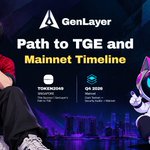
Path to TGE and Mainnet Timeline
GenLayer took a visible step toward its token generation event this week.
During TOKEN2049 week in Singapore, @GenLayer became the title sponsor of Surgence Labs’ Convergence Dinner. The event brought together thirty investors and operators for an invitation only dinner at a Michelin starred restaurant. The name of the event itself was GenLayer’s Path to TGE, making the intent clear.
At the same time, the technical path to mainnet remains on track for Q4 2026. Clark is being positioned as the release candidate testnet. It is designed to run essentially the same node code, consensus version, bridges, and surrounding infrastructure that will be used on mainnet. External security audits are expected to begin around the Clark phase, with mainnet following once those reviews are complete.
A continuing testnet is expected to run alongside mainnet after launch, similar to how Ethereum maintains Sepolia. The focus now, according to recent community discussions, is getting more real products live on the network before mainnet rather than relying solely on experiments.
The dinner and the Clark timeline together show both the business and technical sides of the path to launch.
@RuzgarFlns

Foundation Leadership Change
Edgars Nemše has been appointed CEO of the @GenLayerFDN.
Until now the Foundation’s role was mostly preparatory building the legal structure, shaping the token framework, and establishing the first institutional relationships. With mainnet and the token launch moving closer, that role is changing. The Foundation is turning into an operating organization responsible for treasury stewardship, bringing projects onto the network, expanding the validator set, and laying the groundwork for governance.
Nemše is a co founder who previously served as Chief Product Officer at @GenLayerLabs. He co authored the whitepaper and has been involved from the early prototype stage through the current testnets. He is now leaving Labs to join the Foundation full time. Albert Castellana continues to lead GenLayer Labs, which remains responsible for delivering mainnet.
The longer term plan is also clear. Over roughly four years the Foundation intends to transfer key responsibilities grants, treasury decisions, and governance to DeepThought, an onchain organization that will run on @GenLayer itself. The stated goal is for the Foundation to eventually step back once the network can govern these functions autonomously.
This shift signals that GenLayer is moving from building the protocol to operating the network.

Rally just opened a @GenLayer campaign, and a lot of people still have not opened it. 100000 GLP prize pool. you join, quote their Oct 1 thread, and write your own take on why a recorded payment still needs a court when the two sides disagree. not a copied line. i already joined.
@MamunShari58945 you have not. if you are going to do one, do it tonight. the window closes on the 8th. write it in your own words, not mine. do not wait on another reminder from me today, now.
@RallyOnChain

The internet never had a judge.
AI agents are about to move $9 trillion. Nobody built the part that handles disagreement.
GenLayer did.
And now you can become part of it: portal.genlayer.foundation/g…