







Pinned Tweet
I added 20+ expert reviewers to 4 different sites in some of the most competitive verticals in SEO.
One site saw a 400%+ increase in traffic in the year after they were incorporated on the site.
The other? A 79% increase.
And both sites are still doing pretty well, all things considered.
Want to know how it was done?
I wrote a 5000+ word guide that outlines everything I know about 3rd-party expert outreach after doing it for the last 4 years in the financial, health and legal spaces. (But I'll argue it's worth doing whether you're YMYL or not!)
You'll learn:
-Why it matters
-The impact it can have on a site
-Where best to find experts for your site
Since I'm sure there will be doubters (completely understandable!), the usual SEO disclaimers apply:
-Like any case study, this is correlative.
-With multiple tests, campaigns happening simultaneously (as well as external factors), it's impossible to isolate any one element as a "silver bullet." Including this one. But based on what I know was happening internally, I have confidence that this was an outsized contributor to the results you see here.
-YMMV based on your industry
Enjoy! I hope you find this valuable. 🙏And I'd encourage you to consider this as one tool in your arsenal to help cultivate and grow E-E-A-T on your own site.
Any questions, feedback or errors? Hit me up in the replies here.
cc: @lilyraynyc @Marie_Haynes @glenngabe @aleyda @Kevin_Indig @CyrusShepard @brodieseo @nichepursuits @tonythill
trusthetics.com/finding-3rd-…


Blair MacGregor retweeted

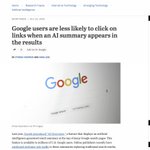
AI is quite literally losing Google Search money
theregister.com/ai-and-ml/20…

It's a really good (yet ultimately sad) point in that if clicks are being swallowed whole by AI Overviews and the system itself seems purely meant for retrieval, why create the kind of standout "helpful content" for humans that Google talks about?

gone are the days of compounding search traffic, ordinal search rankings, forecasting based on predictable click-through and conversion rates.
today, your content pages are grist for the AI mill, their contents scraped from the page, blended together with competing pages, and shown to the user—if you're lucky—in a context and format controlled entirely by a third party.
forgotten is the handshake agreement that good content will be rewarded by website visitors. instead, most people who interact with your content will do so through an intermediary like Google's AI Overviews or a ChatGPT response.
but most pages are still created with the assumption that people will visit them directly. how does content change if we abandon that idea?
my new article on the Ahrefs blog explores the idea of "headless" content marketing: ahrefs.com/blog/headless-con…

1
86
One thing about clearly AI-spun-up websites is the excessive number of footnotes and supporting text it comes up with out of the box. Just an excessive amount of noise UX-wise that usually clears a first pass before you take a closer look and say...... 'ok, why is that there?'
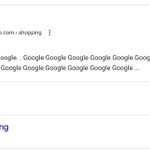
The World's Biggest Scraper literally serving up fake data to poison the well for anyone trying to interpret search performance (or lack thereof) in good faith because they don't like anyone scraping *their* content.

Incredible: Not only is Google working to block AI crawlers, but @nozzleio uncovered evidence that Google is deliberately serving FAKE search results to scrapers
The "poisoned" search results look real, but w/ garbage data. This influences AI crawlers, scrapers, & rank trackers.
7
312


Posted a version of this in @Marie_Haynes's forum as well, but my initial off-the-cuff thoughts:
"Attribution or giving credit to other sources doesn't replace the need for original effort." Still reading/digesting the rest of this but THAT one stood out to me as something to really pay attention to going forward.
You can have AI craft page content for you that cites legitimate sources. I've done so, and I have a client (in a high-trust local med category) who's played around with this! And the sources, most times, are legit; the hallucinations are far less frequent than they used to be. But just because LLMs are capable of doing that, doesn't mean there was much in the way of originality or (to use their terms) human work put into it. And just dumping a set of references for E-E-A-T purposes probably won't save you.
Now there's another line in that same paragraph that's also interesting: "The extent to which human work went into creating the content or the systems powering it." Not to extrapolate too much there, but that seems to leave plenty of room for sophisticated AI-assisted workflows where meaningful human judgment is built into the system itself: custom instructions, source material, advanced prompting, expert review, editorial constraints, etc. That's very different from just saying “write me a page about X.” Of course, effort alone doesn't guarantee originality or quality, but I think that distinction is worth watching.
There's so many shades of gray here. It'll be interesting to see whether future Core Updates produce more evidence of sites losing visibility when they're publishing content that looks helpful on the surface but is fundamentally derivative/"me too" content. But it's clear Google's trying to carve out a middle ground that's somewhere between "never use AI for content" and "go ham and generate 6000 programmatic pages."
Wowsers, SEO peeps. Google made a bunch of new updates to its "Creating helpful, reliable, people-first content" document, and they are *significant*
Marie Haynes spotted this section targeting websites that create fake authors 🧐
"Fabricating creator profiles (such as by using AI-generated headshots, made-up names, or false credentials to make content appear as if it was written by human experts) is a form of deception. Any form of deception makes a page untrustworthy to both users and our automated quality systems, and is a signal of a low-quality page."
Other important updates:
1. An entire section on Effort, Originality, Talent or Skill, and Accuracy - we posted about
"Effort" as a ranking consideration a few weeks ago
2. A section on "How (the content was created)" - Google seemingly wants you to disclose when AI automation is used.
3. There's an entire section defining "Main Content", although this doesn't seem like entirely new info
Regardless, the whole thing is worth reading, including Marie's analysis.
All links down below 🔗

2
103
Agencies that embed themselves into their clients' mission-critical infrastructure and then keep them locked out of said infrastructure (while doing bare minimum "marketing") are the absolute worst.
If you do this, just know that I hate you and will steal all your clients. 😀
1
101
Going through the AI support bot (frustratingly non-human) to try and figure out how to get access to an SEO tool provider's AI (search) insights and getting multiple conflicting responses from said AI bot about it and realizing how meta/insane this all is/we all are.
122
Yeah, this seems like overkill to me. If the watermark can't/won't/doesn't signify the level of depth to which you used Claude for output (even if it was 100% your writing), what good is it for practical purposes?

If I read Anthropic’s new watermarking policy correctly, not only will Claude watermark text it writes as AI (fair enough), if I upload text *I* write and ask Claude to copy edit, Claude will now watermark my (human written, AI-copy edited) text as AI, which seems ridiculous…

1
1
207
"you'll just have to credit claude for the writing now!"
I will? Do I have to posthumously cite Grammarly and Microsoft Word's spell/grammar check now as well for anything I've ever written?
1
59
Don't think I've ever seen Google display a knowledge panel with an h-index score before. Is this new? A bug? (This was a regular SERP btw; nothing explicitly to do with Google Scholar)

1
144

Blair MacGregor retweeted

I unfortunately have terrible news to share. In April I shared about Jenn Bauguess, a fellow SEO who was battling an aggressive form of cancer. I was shocked to learn that Jenn passed away on Thursday in Tucson. I received the call on Saturday explaining what happened, and again, I was shocked to hear the news. We literally just had an email conversation last week talking about SEO, and just a few days later, Jenn is gone. Jenn’s son is just nine and it’s heartbreaking to know he just lost his mom, and so suddenly.
I’ll share the details of the service once those arrangements have been made. But thank you to the SEO community for your help and support for Jenn. Her GoFundMe went from $9K to $20K after you all got involved. And that was a huge help for Jenn.
Cancer sucks. This all happened so quickly. I’ll share more when I have the details. Amber who set up the GoFundMe posted a message yesterday about Jenn passing away. The link is below.
gofundme.com/f/support-jenns…


Blair MacGregor retweeted

CEOs are uniquely prone to AI psychosis because they’re sufficiently distant from the last mile of work that still has to happen to generate most value with AI.
So when they play with AI, they see the happy path results, often not considering the next 10 or 20 things that have to happen to get sustainable results from agents.
“Look I made this awesome product prototype”. Yes but you didn’t have to review the code before it went into production and fix a bunch of issues.
“Look I generated a contract”. Yes but you didn’t verify all the terms before it goes out to the counterparty and didn’t have to wire up all the past contracts to work with.
The best thing you can do as a CEO is to use AI a *ton* to figure out the real implications of agents in the enterprise, and come out the other side with an appreciation for both the upside and the real work that goes into them.

Blair MacGregor retweeted
This is a great way to distract from the overall rot economy and the growth obsession of every tech company. It isn’t that AI is taking their jobs, it’s the post-Welch layoff culture and natural job instability of at will unemployment. AI is just the most honest they’ve been

I expect AI populism to be disproportionately young, educated, and slightly left-leaning
jasmi.news/p/warning-shots

Using a client's blog posts not to help with their *own* internal linking but to help prop up link equity to a competing page on an internal publishing entity you control (!!) is uh....certainly a choice.
96
Directionally, this is true for publishers, especially niche, affiliate or lead-gen driven "content-as-the-product" sites heavily dependent on SEO traffic.
I’d be careful applying the same conclusion to the rest of the SEO ecosystem.

After several years of declining search traffic, Condé Nast CEO @rogerlynch has directed all the company's brands to operate as if search traffic to their properties will be zero.
He says the era of turning search and social media traffic into profitable businesses is gone.
And that if you run a media business that doesn't have an authoritative brand, a very strong niche, or a direct audience, you're going to be fighting hostile algo changes all the way down.
He describes a recent board meeting:
"We took a snapshot of search results from seven or eight years ago. And what you saw were a few sponsored links, then the ten blue links."
"Do the same search today, you get an AI overview, then you get rows and rows and rows of commerce links, then you get sponsored stuff."
"Each of the last three years, we would do our budgets, and we'd put forecasts in of search traffic declining. Because we'd seen the pattern of algorithm changes. And generally those algorithm changes were negative."
"Every year, our search traffic was down more than we had forecast. So last year I told our teams, 'Assume there's no search.' You have to have your businesses planned as if search is zero. We don't expect it to be zero, we expect it to be a single-digit percentage of our traffic."