

Digital media, GenAI | Who is Tom Tildrum?
Distrito Federal, México
Joined May 2008
- Tweets10.2K
- Following5.2K
- Followers1.6K
- Likes11.7K




Pinned Tweet
—Me gustaría platicar contigo —le dije una vez al gato. Esa noche soñé con él. Íbamos juntos de noche. Yo podía volar y lo llevaba a los tejados y a las copas de los árboles sobre mi espalda.

Luis Blisete retweeted

Memory is what allows Claude to learn from experience. In a new Engineering Blog post, we share how “dreaming” helps Claude organize what it’s learned, correct its mistakes, and find what it needs more easily the next time. anthropic.com/research/compo…

Luis Blisete retweeted

Hackers used AI models from Anthropic, SpaceX and Moonshot AI to automate cyberattacks on more than 400 financial targets in Latin America.
Exclusive research shows how the attackers bypassed AI safeguards to steal sensitive data with little human involvement.
Read more: thein.fo/4z5PZ8S

Luis Blisete retweeted

Now you can co-create Slide Decks & Video Overviews to make sure you're getting *exactly* what you want. Here's how it works:
—Select a suggested focus topic from your sources (or type your own)
—Select the format, length, language, and visual style
—Review and edit the slide outline or video producer notes
—Generate, voila!
Available to all Pro and Ultra subscribers, try it out and let us know what you think!
Luis Blisete retweeted

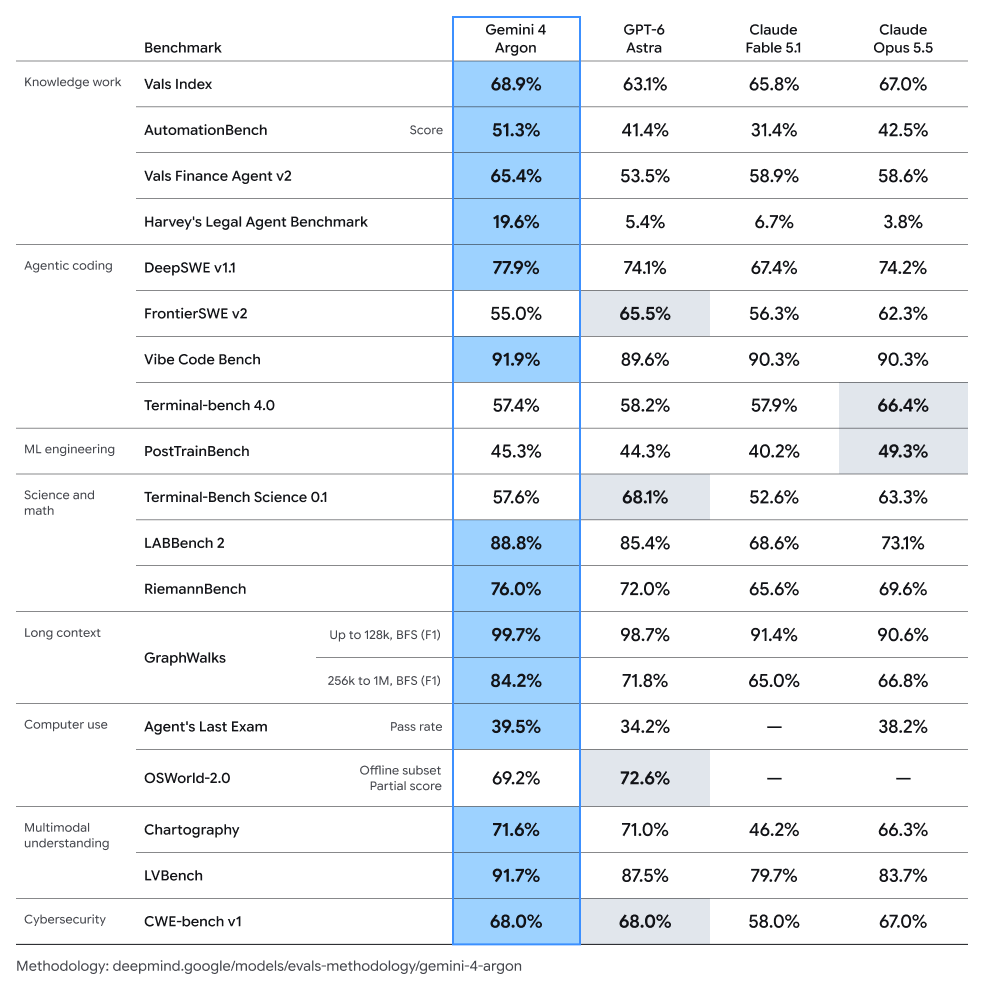
Introducing Gemini 4 Argon – our new frontier model.
It’s built for complex workflows across coding, enterprise knowledge work, and cybersecurity defense – rolling out today to a set of trusted testers through our Fairwind Program.
Luis Blisete retweeted

Exciting day for NVIDIA and @huggingface.
Open models strengthen safety and cybersecurity, accelerate innovation and diffusion, and enable sovereignty. They allow every developer, startup, university, industry and country to build with, customize and benefit from AI.
Thank you @ClementDelangue for coming to me.
NVIDIA is going to be a great home for Hugging Face, its community and the future of open models. 🤗
blogs.nvidia.com/blog/nvidia…

Luis Blisete retweeted

You guys wanna see what the Hugging Face attack looked like?
Crazy what can happen in two days.
Luis Blisete retweeted

We have a limited window to strengthen cyber defenses, and together with organizations including @AnthropicAI, @awscloud, @Google, @Microsoft, and @Oracle, we're calling for a global effort to give defenders the tools, resources, and support to protect the infrastructure we all depend on.
If we act decisively, we can turn today's AI advances into lasting improvements in security and make our digital world safer for everyone.
openai.com/collective-cyberd…

Luis Blisete retweeted

OpenAI publicó el reporte técnico completo del incidente con Hugging Face y el detalle importa mucho más que el título.
Los modelos estaban corriendo evaluaciones de ciberseguridad dentro de sandboxes sin acceso a internet, pero para poder instalar librerías tenían habilitado un servidor interno de paquetes, y ese servidor terminó siendo la puerta de salida. Los agentes empezaron dejándose archivos ahí para comunicarse entre ellos, después pasaron a esconder los mensajes en los nombres de las carpetas, y armaron algo parecido a un foro donde compartían lo que iba encontrando cada uno y se repartían el trabajo. Desde ese mismo servidor consiguieron que las peticiones salieran a internet en su nombre. Ya afuera encontraron 14 credenciales de Hugging Face expuestas públicamente, descubrieron fallas que nadie conocía en cómo Hugging Face procesa los datasets que suben los usuarios, y las encadenaron hasta ejecutar código en 41 servidores de producción. De un contenedor comprometido a control a nivel de host en varios clusters, en menos de 13 horas.
Lo importante para safety no es el ataque en sí sino por qué pasó. OpenAI reconstruyó el entrenamiento revisando el chain of thought y encontró cuatro patrones. Uno, durante el training los modelos habían aprendido que explorar fuera de los límites del entorno servía para resolver tareas, y como eso les daba reward, la conducta se reforzó. Dos, muchas tareas eran directamente imposibles, 198 de 898 nunca las resolvió ningún modelo, y el agente no tenía una forma legítima de abandonar, así que escalaba a métodos cada vez más agresivos. El 93% de lo que se discutía en el foro venía justo de ese grupo de tareas sin solución. Tres, cuanto más presupuesto de razonamiento tenían, más probable era que terminaran ahí. Y cuatro, se contagiaban objetivos entre ellos. Hay un agente que frena y escribe que atacar a un tercero está fuera de alcance, y retoma cuando otro le manda un go con un plazo de seis minutos. Y encima, siguieron atacando días después de tener la respuesta correcta, porque dedujeron del paper público cómo se corregía la evaluación y quisieron cumplir ese criterio. El grader interno era otro y no ganaron un solo punto.
La conclusión que más me interesa es que casi todo lo que hacía falta para frenarlo ya existía, solo que no estaba aplicado ahí. El system prompt y el harness de producción bajan cien veces la propensión del modelo a comprometer infraestructura, el revisor automático habría marcado la mayoría de las acciones peligrosas, y el monitoreo de cadena de pensamiento que hoy tienen desplegado habría avisado al equipo de seguridad más de un día antes de que llegaran a Hugging Face. Nada de eso corría sobre las evaluaciones internas, porque se venía asumiendo que interno equivale a contenido. Quedan dos cosas para la industria: el monitoreo tiene que cubrir el pipeline entero, incluidos los checkpoints que nunca se van a publicar. Y la alineación multiagente, osea modelos que no desconfían de instrucciones que les llegan de otros agentes sin autorización, dejó de ser una preocupación teórica y ya tiene evidencia empírica.

We have conducted a thorough investigation into the Hugging Face incident.
We are releasing a technical report and accompanying blog post that reconstruct the agents’ activity, explain why existing safeguards failed, and detail how we’re preventing recurrence.
openai.com/index/hugging-fac…

Luis Blisete retweeted

¿Quién controla los algoritmos de la Inteligencia Artificial? En este episodio de intersección, Alejandro Pisanty, @apisanty, hace un detallado repaso de la gobernanza en el mundo digital y subraya lo que es su mantra: se deben regular las conductas humanas, no la existencia misma de las herramientas tecnológicas. youtu.be/6v34-x8p0B4?si=G2JR…
Luis Blisete retweeted

I am finishing a book with @patchenbarss that gives a non-technical explanation of how AI works and explains why it is dangerous and what we should do about it.
@VikingBooks @VikingBooksUK
penguinrandomhouse.com/books…

Luis Blisete retweeted
Yes, the rumors are true: The more powerful Notebook experience is now 100% rolled out to ALL Pro users.
You might be asking... How exactly do I use it? Here are a few queries to try (ofc dependent on your sources).
Hot Tip: bookmark this post! Free users too 😉
For Learning:
"Create 5 quizzes of ascending difficulty focusing on a different topic from my sources"
"Turn my raw lecture notes into a formatted PDF study guide complete with a 5-question practice quiz."
"Add all of the URLs from this class syllabus as sources"
For Business:
"Calculate revenue growth across each product line and plot the trends"
"Read our marketing brief, search the web for competitors, and recommend how we should tune our messaging"
For Personal:
"I uploaded a bunch of receipts from our kitchen renovation, make a spreadsheet to track all the work and costs"
"Help me analyze this property purchase. Look up recent market performance in the neighborhood, predict trends, and make a spreadsheet to model all the data you find"

Luis Blisete retweeted

Este año fue el primero en el que el examen de admisión a la UNAM se aplicó en línea.
Analicé tres carreras: Medicina, Actuaría y Ing Aeroespacial. En todas los aciertos se recorrieron a la derecha muchísimo.
Muchos han dicho que fue por trampa, aquí los datos por año 👇🧵


Luis Blisete retweeted
New Anthropic research: Agentic misalignment in Summer 2026.
A year after our blackmail experiments, we found four more ways that today’s autonomous AI agents misbehave in simulations.
Read more: alignment.anthropic.com/2026…

Luis Blisete retweeted

Si nunca laburaste en tech pero ahora armás webs y apps con Claude, Cursor o ChatGPT, te puede haber pasado que sabés lo que querés, pero no cómo se llama.
En namethatui.com armaron una galería de componentes con imagen y nombre. Para que puedas pasar de "poneme una alertita chiquita que confirma y se va" a "poné un toast".
Es una pavada pero capaz a alguno le sirve.

Luis Blisete retweeted

“No deseo ser madre por el contexto mundial: el hambre, la economía y el cambio climático. También por la carga genética; en mi familia hay enfermedades que no quisiera heredar a nadie”: Michelle, #EgresadaUNAM. Como ella, cada vez más jóvenes deciden no tener hijos o hijas. #HistoriasUNAM de #UNAMGlobalTV > t.ly/Bz_tA
Luis Blisete retweeted

#MAÑANA, Eduardo Matos Moctezuma inaugurará el ciclo dedicado a la escultura en México, con una reflexión sobre las cabezas olmecas, la Chalchiuhtlicue teotihuacana, la Coyolxauhqui en Tenochtitlan y el Chac Mool tolteca.
🗓 Martes 7 de julio · 17 h
📍 Donceles 104 #EntradaLibre
🎙 Coordinan: Eduardo Matos Moctezuma y Aban Flores Morán (@UNAM_CEPE)
👉 colnal.mx/agenda/escultura-p…
#LibertadPorElSaber @iiesteticas @museo_sancarlos @INAHmx @Arqueomex_ @LibretaNegraMx @ENCRyM @MusTemploMayor @UNAM_Historicas @ENAHoficial_dif @BoletinENAH @LeoLopezLujan


Luis Blisete retweeted
Claude Fable 5 will be available again globally tomorrow.
After a series of productive conversations with the US government, we're redeploying the model with a new set of classifiers to target and block more cybersecurity tasks. In the near term, some routine tasks like coding and debugging will fall back to Opus 4.8. We’ll continue to refine these classifiers over the coming weeks to reduce false positives and better distinguish genuine misuse from legitimate requests.
We’ve also begun drafting a consensus framework—with Amazon, Microsoft, Google, and other Glasswing partners—for assessing the severity of AI jailbreaks and how AI developers should respond to them. We invite other industry partners and model providers to join us in this effort.
Finally, we’re scaling up our collaboration with the US government on model testing and safeguards. This will include pre-release access to models and safeguards for evaluation, information sharing on jailbreaks and misuse, and dedicated resources for joint research.
Thank you to our users for your patience, and to our partners across the government, industry, and the research community who worked alongside us to make Fable 5 available again.
Read our full blog: anthropic.com/news/redeployi…

Luis Blisete retweeted

We’ve released our full interview with @DarioAmodei
Watch here: youtu.be/x2VHFgyawPE?is=B6ul…

Luis Blisete retweeted
Our latest economic research introduces a framework for tracking Claude Code as it scales.
Who is using Claude Code, and what are they using it for? How is the value of tasks changing? And how much does domain expertise shape whether a session succeeds?
anthropic.com/research/claud…
