GROSS is a materialist critique of the immaterial joys of cinema. Header: It Happened One Night, 1934

London
Joined February 2007
In 1913, in the USA, somebody decided to keep track of the rental income the movies were pulling in. This came to be known as the GROSS. I'm telling the story of Hollywood through the top-grossing film of each year since then. It's a FREE newsletter: bowbrick.substack.com
1
1
1
3
1,930
It's Gummo Marx's birthday. Yes, Gummo. The one you're never heard of, born on this day in 1893 (probably). He was in the vaudeville act as a teenager but left when he was drafted in 1918. He later became a theatrical agent (and he held a patent, for a shirt-packing device!). Groucho said: "he's a nice man, and that's more than I can say for Zeppo." That quote's on the back of this Gummo Marx mug that you can buy from my obscure merch store! redbubble.com/shop/ap/184398…
60
13 October 1924: Ramsay MacDonald, the first Labour Prime Minister, is pacing up and down the platform at a packed Glasgow City Hall, giving one of his famously inspiring, barn-storming speeches, but this one's different because it's also Britain's first party election broadcast, going out live on the BBC. Apparently his speech was essentially inaudible because the microphone only picked up MacDonald's voice each time he passed it, as he progressed from one end of the stage to the other. The engineers must have been tearing their hair out. The beginning of the broadcast era for British politics was basically a wash-out and MacDonald was about to lose the election anyway (not least because of the scandalous 'Zinoviev letter', which had probably been forged with the help of British intelligence). Tory leader Stanley Baldwin, presumably having been told about MacDonald's pointless broadcast, sensibly stood still and read his speech in front of a microphone in a BBC studio. Liberal leader Herbert Asquith also spoke live from a public meeting and, remarkably, made it all a bit more interesting by stopping his speech mid-way to lead the crowd in a round of applause for his daughter, Lady Bonham Carter, who had just arrived!
92
Steve Bowbrick retweeted
Martin Lewis who died in obscurity in 1962 was a retired art teacher who found some success in his early career, but was largely forgotten. He spent his last three decades teaching other people how to etch, including Edward Hopper. History chose Hopper, but Lewis was his mentor.
20
189
5
1,134
13,404
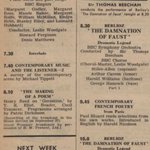
80 years ago today, on the BBC's brand new culture station, the Third Programme, half an hour of Michael Tippett on the contemporary music scene, three scientists talking about advances in their disciplines and 15 minutes of Paul Eluard, reading his own poetry IN FRENCH. Plus, of course, the BBC Symphony Orchestra doing The Damnation of Faust. Boom.
1
96
Have you noticed that it now seems to be essentially accepted that human beings cannot understand complicated things?
This is just 5% of Roche's metabolic pathways chart. If you insist a baseline human understand the precise mechanics of some of the AI treatments that are coming, you will be waiting forever.
1
3
188
Steve Bowbrick retweeted
Having long been aware of those tech bros who read my work as utopian porn, where they’ve taken that doesn’t exactly surprise me.
249
2,954
220
17,639
497,131
80 years ago, Stevenage, the first UK New Town, was begun. When it was proposed, local people who objected put up SILKINGRAD signs at the railway station, mischievously connecting Labour housing minister Lewis Silkin with Soviet cities like Stalingrad. For the anniversary I've designed some merch! Link👇
2
181
The Frankfurt School seems to be indestructible. I mean the school of social thought was chased from Germany to sunny Los Angeles by the Nazis and, since then, has been the target of every ignorant neocon, Tea Party loon and ethno-nationalist oligarch on earth but somehow its influence continues to grow. You'll be wanting one of these Adorno stickers in the style of the Netflix logo for your laptop.
1
58
Watching this will definitely cause you to shiver as the robots jump into the molten metal but the people freaking out in the replies because these industrial machines were destroyed in this way need to stop and think...
F.02 Decommission
174
Buy SILKINGRAD t-shirts, mugs, throw cushions and all the rest here: redbubble.com/i/t-shirt/SILK…
60
Steve Bowbrick retweeted
Ron Cobb's semiotic standards for Alien (1979)
14
329
22
2,413
105,575
This is brilliant...
>be me >discover effective altruism >apparently normal charity is inefficient >why donate to random sad thing when spreadsheet can tell you optimal sad thing >fair enough >buy mosquito nets >save lives >numbers look good >feel powerful >couple years later >someone asks an innocent question >why only count people alive today >huh >future people matter too >obviously >my grandchildren shouldn't matter less just because they haven't spawned yet >reasonable.jpg >keep following logic >what about their grandchildren >also yes >what about people in 500 years >sure >5000 years >why not >500 million years >starting to get weird but morality is morality >open calculator >humanity could survive for an astronomically long time >could colonize galaxy >could have trillions upon trillions of descendants >maybe digital people too >maybe simulated civilizations >maybe dyson spheres full of happy uploaded minds >calculator starts smoking >realize currently living humans are rounding error >8 billion people suddenly looking extremely beta >future contains potentially 10^something people >can't even fit beneficiaries in google sheets >new moral priority unlocked >protect the long-term future >stop thinking in units of "people helped" >start thinking in "fraction of cosmic endowment preserved" >malaria? >terrible >but only kills existing humans >AI extinction could delete the entire light cone >nuclear war could permanently derail civilization >bad institutions could lock in terrible values for ten million years >someone invents wrong constitution in 2140 >quadrillions suffer >better fund governance workshop now >friend says maybe we should improve hospitals >explain opportunity cost >friend says hospitals are full of actual sick people >explain scope sensitivity >friend stops inviting me to dinner >need to decide what to fund >easy >expected value >suppose project has one in a million chance of preventing extinction >sounds tiny >but extinction destroys 10^50 future lives >multiply >mother of god >$10 million project has expected value of several galaxies >charity evaluation complete >someone asks where the one-in-a-million number came from >expert judgement >which expert >us >how calibrated >extremely thoughtfully >reduce estimate to one in ten million to be conservative >still beats curing cancer by 38 orders of magnitude >epistemic robustness achieved >someone says maybe project doesn't work >assign 20% chance >still astronomical >maybe project makes problem worse >assign 5% chance >still astronomical >why 5 >because 30 felt pessimistic >publish 46-page report >contains seventeen sensitivity analyses >every sensitivity analysis begins after assuming intervention has positive sign >critic says you're multiplying enormous hypothetical stakes by extremely uncertain probabilities >yes >that's literally why it's important >critic says the uncertainty might be structural rather than numerical >make probability smaller >critic says no, I mean maybe your model is wrong >make probability smaller again >critic begins rubbing temples >discover AI safety >perfect longtermist cause >AI might kill everyone >or create utopia >or seize galaxy >or tile universe with paperclips >or create billions of conscious software minds >finally a problem with numbers big enough for me >start AI safety nonprofit >mission: prevent dangerous AI >hire smartest people available >smartest people immediately start building better AI to understand dangerous AI >interesting >we must understand capabilities to understand safety >we must scale models to study alignment >we must race ahead so less responsible actors don't get there first >we must deploy systems to learn how deployment can go wrong >we must build the thing quickly because building the thing quickly is dangerous >outsider asks why the people most worried about AI apocalypse all work at AI companies >complicated field >company releases stronger model >very concerned >company begins training even stronger model >extremely concerned >company raises $14 billion >concern reaches unprecedented levels >need to influence government >future is at stake >normal democratic process too slow >politicians don't understand exponential curves >public doesn't understand x-risk >experts must guide them >who counts as expert >people who understand x-risk >who understands x-risk >our friends >someone objects that this seems politically convenient >explain we're representing future generations >future generations unavailable for comment >develop concept of value lock-in >terrifying possibility that one ideology controls civilization forever >therefore extremely important that civilization adopts correct values before lock-in >whose values >let's circle back >begin with impartial morality >end with small group of people deciding what quadrillions of hypothetical beings would want >beautiful arc >meanwhile actual humans keep doing annoying things >voting wrong >having parochial attachments >loving family more than strangers >caring about local community >getting upset when told their suffering is cosmically negligible >evolutionary biases everywhere >explain that moral intuition cannot be trusted >except intuition that future digital people count >and intuition that extinction is uniquely bad >and intuition that our probability estimates are sane >and intuition that our institutional choices improve the future >those intuitions survived peer review >someone donates $5k to local homeless shelter >inefficient >could have funded 0.0000000000003% of an AI governance researcher >think of all the simulated people you just killed >okay maybe don't phrase it that way publicly >PR team says "future generations deserve a voice" >much better >journalist asks what longtermism means >say "future people matter" >everyone agrees >great >journalist asks what follows from that >well technically we should redirect enormous resources toward low-probability interventions affecting astronomical futures >journalist raises eyebrow >return to "future people matter" >motte has entered the chat >critic: of course future people matter >me: glad we agree >critic: I don't agree that your institute knows how to help them >me: why do you hate our grandchildren >eventually notice uncomfortable implication >if future value dominates everything >then helping people today mostly matters through effects on future >education matters because future institutions >health matters because future productivity >democracy matters because future trajectory >human beings slowly become instrumental variables in their own moral philosophy >see starving child >feel compassion >check spreadsheet >child's direct welfare contribution negligible >but perhaps childhood nutrition improves national institutional quality >compassion restored >tell myself this is impartial altruism >one day assistant asks obvious question >"how do you know your intervention actually improves the far future?" >silence >open spreadsheet >increase column width >add confidence interval >assistant asks again >"no, I mean how do you know the sign is positive?" >stare into cosmic light cone >10^50 people staring back >none of them exist >none of them can tell me >none of them can falsify my assumptions >realize I have invented the perfect constituency >infinitely important >completely silent >and always represented by me
2
196
⚡️ New Yorkers, radio nuts, socialists; you'll like this. Almost 100 years ago the Socialist Party of America started a radio station in NYC and called it WEVD, the initials of Eugene Victor Debs, the party's founder, who had died in October 1926.
1
110
WEVD carried on broadcasting its mix of social, political and community output well into the 1980s (there's a great archive of the station's Yiddish and Jewish community programming) but during the 1980s it was taken over by a big radio group. When I first visited NYC in the 1990s it still existed but had become just another talk radio station. yivo.org/from-the-yivo-sound…
1
42
And now you can buy a WEVD t-shirt (plus all the usual mugs, throw cushions, phone cases and so on) with this 1942 version of the station's logo, with the W rendered as a dynamic spark! redbubble.com/i/sweatshirt/W…
38
Thesis: After the second world war cinema everywhere became a humanist art form. But not in Britain. For the 80th anniversary of Brief Encounter (link in reply).
1
1
110
I'm writing about the top-grossing movie of each year, since 1913. The reviews are on Letterboxd too, for you hipsters: letterboxd.com/bowbrick/revi…
26