

Sports PT. Athletic injury RTP, with a focus on ACL. Papers → what I’d actually do Monday. DPT · SCS · CSCS
Minneapolis / Twin Cities, MN
Joined February 2016
- Tweets971
- Following468
- Followers365
- Likes755




Pinned Tweet
In pro football after ACLR, “return” isn’t one number.
Meta-analysis of 20 studies (n=1,992): pooled RTS ~92% (95% CI 88–94%), mean ~261 days (~8.7 mo). Match play took longer than training (278 vs 203 days); concomitant procedures stretched timelines vs isolated ACLR (294 vs 229 days). High heterogeneity—benchmarks, not guarantees.
Key Provider Considerations: counsel training vs match separately, and build in extra time when meniscus/cartilage work is bundled.
link.springer.com/article/10…
#SportsMedicine #ACL #ReturnToSport

Frame meniscus repair as a trade: more reoperations, fewer knee replacements.
Repair vs trim (partial meniscectomy), 2 yr: 7.3% vs 5.8% reoperated; 0.5% vs 0.9% knee replaced.
Clinical takeaway: I'd plan slower rehab.
Retrospective; tear type unmatched.
doi.org/10.1002/arj.70853

21
Test your ACL return with a cue the athlete can't predict, not only planned cuts.
In 43 LaLiga ACL ruptures on video, 26 were non-contact. 80.8% showed attention or response errors just before injury, at ~21 km/h.
I'd add dual-task cutting to late phase rehab.

1
48
Patellar/quad tendon ACL grafts: 20.3% of male athletes had a thigh muscle injury in year one vs 9.1% hamstring grafts.
Clinical takeaway: I'd keep eccentric-specific quadriceps strength training within the return-to-performance program.
Retrospective.
doi.org/10.1002/ksa.70695

54
Time from ACL injury to surgery belongs in the gait check, not only the chart.
Across 16 studies, people operated 12+ months after injury had a lower peak knee flexion moment (bending load) walking than controls (SMD -1.97, 95% CI -3.77 to -0.17). Association; I² 88%.

1
1
109
Esmaeili et al., Sports Med 2026. Systematic review + meta-analysis, 16 studies (moderate quality), ACLR vs healthy controls, walking biomechanics by injury-to-surgery interval. Association, not proof delay caused it. doi.org/10.1007/s40279-026-0…

12
Ankle dislocation with no fracture is rare. Reduced on the field, no surgery.
Now the timeline rides on the soft tissue: deltoid, lateral ligaments, syndesmosis, capsule.
For a guard, the test is a stable ankle under lateral load and anchoring in pass pro.

#Steelers G Mason McCormick, who was carted off in an air cast on Sunday, suffered a dislocated ankle that unbelievably did not feature a fracture, sources say.
No surgery needed, as the ankle was popped back in place on the field. There is a chance he’s back for the playoffs.

41
Put the whole women's squad on ACL prevention, not just poor screeners.
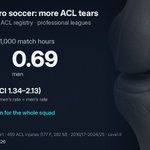
Pro soccer: women's ACL rate 1.19 vs 0.69 per 1,000 match hours (1.69x men), more often non-contact.
Clinical takeaway: I'd build it into every warm-up.
Registry cohort, not causal.
doi.org/10.1002/ksa.70692

2
132
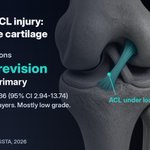
Revision ACLR changes the question: check the cartilage, not only the graft.
In 331 futsal players, chondral lesions were found in 55.9% of revisions vs 16.2% of primaries (OR 6.36, 95% CI 2.94-13.74). Mostly low-grade; not significant at Grade 2+.

Barastegui et al., Knee Surg Sports Traumatol Arthrosc 2026. Retrospective single-centre cohort, n=331 futsal players (indoor soccer) undergoing ACLR. Association, not causation. doi.org/10.1002/ksa.70675

22
Let the diagnosis guide the return-to-sport timeline.
Pro men's soccer: pubalgia (pubic-bone pain) was 6.4% of hip/groin cases but the longest median absence: 41.5 days.
Clinical takeaway: I'd let it set expectations.
Public data, unconfirmed diagnoses.
doi.org/10.1002/ksa.70677

50
The ACL is completely tore. Don’t need MRI to confirm complete ACL injury/tear. Why? The tibia will sublux/slip out only AFTER a complete ACL tear.
MRI will confirm damage to secondary structures such as the lateral meniscus.
journals.sagepub.com/doi/abs…

#Lions star Aidan Hutchinson is feared to have suffered a significant knee injury that knocks him out for the foreseeable future, per me and @MikeGarafolo.
More details coming. But Detroit is not expecting good news on the injury suffered celebrating an early sack.

1
79
Cost alone shouldn't pick the ACL graft. A 5-year model barely separated them.
BPTB: $3,917, 4.589 QALYs. Quad tendon: $4,901, 4.612. QT won 55.7% of simulations, BPTB 44.3%.
I'd ask what the donor site will tolerate in rehab first. It's a model, not patient outcomes.

1
1
92
Dean et al., Arthroscopy 2026. 5-year Markov cost-effectiveness model (Level III): BPTB, quad tendon, hamstring, allograft. Small cost or donor-site changes flipped the preferred graft; authors say keep graft choice individualized. doi.org/10.1002/arj.70713

1
25
Young athlete, little bone loss, Bankart (labrum) repair: plan for recurrence, not a one-and-done fix.
n=96, age ≤24, ~5 yr: 33.3% recurred, 19.8% revised. Contact sport was tied to failure.
Clinical takeaway: I'd flag contact risk pre-op.
Case series.
doi.org/10.1177/036354652614…

1
118
Use the hamstring:quad ratio after ACLR as a signal, not a clearance test.
n=3,458: each +10 in the 6-mo ratio, OR 0.81 for revision by 2 yr. AUC 0.64: poor at picking who fails.
Clinical takeaway: I'd pair it with quad strength.
Cohort. Association.
doi.org/10.1002/ksa.70679

1
143
Return to sport after ACLR is not return to preinjury level.
In a meta-analysis of 25 studies (7,174 patients after primary ACLR), 79.3% returned to sport but only 44.1% returned to their preinjury level. The ACL-RSI readiness gap between those who got back to preinjury level and those who did not widened over time (mean difference 16.09 at ≤6 months → 18.64 at 6–12 months → 27.07 after 12 months).
Key Provider Considerations:
• Functional gaps (strength LSI, hop LSI, IKDC) stayed smaller and more stable across time windows than the readiness gap.
• IKDC differences stayed below usual MCID cutoffs, so a “pass” on PROMs can still miss the readiness story.
• Clinical takeaway: I’d keep serial ACL-RSI past the usual clearance window, not just a single mid-rehab score, before clearing preinjury-level sport.
Caveat: systematic review and meta-analysis of observational comparisons; association, not proof that raising ACL-RSI causes return.
doi.org/10.1016/j.jshs.2026.…

68
A contact ACL tear and a non-contact one aren't the same knee.
Across 482 primary ACL surgeries, contact tears had 2.68x the odds of a higher overall structural damage grade, after adjustment.
I'd read the surgical report before borrowing a non-contact timeline.
Association.

Source: Malhamé ZM, et al. KSSTA, 2026. Retrospective analysis of prospectively collected data, 482 consecutive primary ACLR patients, Level III. ACLISS mean 4.6 contact vs 3.8 non-contact; adjusted OR 2.68 (95% CI 1.68–4.27).
doi.org/10.1002/ksa.70660

28