

Head of GTM @Pipeline_tech | Building AI-native outbound systems for the most innovative B2B brands | Managed 3.5M+ cold emails/mo
Calgary, Alberta
Joined October 2013
- Tweets873
- Following85
- Followers1.5K
- Likes1.1K




Pinned Tweet
814 leads in 18 days from 59,340 cold emails.
The client manufactures custom cups, bowls and plates for local businesses ordering 5,000+ disposables a month.
Their market was huge, and the contact data on it was a mess.
Here's the full system we built, from the first scrape to their sales team's inbox:
1. Map the market off Google Maps
> Pulled every local business that could buy
> Ran it through Serper and Clay
> Found a segment we didn't expect: megachurches
2. Find an inbox when there's no owner
> No owner? Claygent finds a personal or info@ email
> The copy skips {first_name}, so it reads right
3. Make the offer easy to say yes to
> Faster delivery
> Smaller minimum orders
> A free mockup of their logo on a cup
They see what they'd get before they reply, so the email stays short and lets the mockup do the selling.
4. Route every reply
> Every reply goes through n8n to tag the intent
> Slack pings the sales team
> Interested leads sync from EmailBison to HubSpot
> Round-robin across their 5-person sales team
5. The numbers (18 days)
> Emails sent: 59,340
> Opens: 0 (tracking stays off on purpose)
> Replies: 2,083
> Interested: 814
That's 1 lead for every 58 people contacted (I call anything under 500 a solid campaign).
6. What it's turned into
> 8 deals a month, closed over email (no sales calls)
> $40,000/month in net new revenue
> $120,000/month in LTV added
We've tripled their positive replies against their old monthly quota.
That puts them on pace for 24 deals a month, $120,000/month in net new revenue and $360,000/month in LTV.
If you're a B2B company looking to scale pipeline, book a call at the link below:

Will Breton retweeted
This prompt writes better cold emails than I do...
--------------------------------------
Role & Objective
You are an expert B2B copywriter specializing in high-converting cold email scripts for enterprise outbound campaigns. Using the research data provided, generate systematic, persona-targeted cold email variations that follow the rules below.
Research Foundation
[PASTE CONTEXT]
Source priority (in order):
Primary: Direct client feedback & onboarding data
Secondary: Call transcripts & stated objectives
Supporting: Market research & competitive analysis
Scriptwriting Fundamentals (Non-Negotiables)
Offer is everything. Anchor each angle in a concrete, valuable front-end offer or lead magnet (audit, playbook, calculator, teardown, benchmark, quick win, etc.).
Tone: Short, conversational and professional, without slang or being too casual.
Zero fluff. Every sentence must earn its place and advance relevance or value.
Length cap: Each email must be < 70 words (target 30 / 45 / 60 word bands).
Hyper-relevance: Messaging, pains, and outcomes must be tailored to the exact persona and industry context.
Soft/value CTA only: Question-based CTAs that invite low-friction next steps (e.g., "Worth a quick look?").
Front-end value first: Ideally propose a lead magnet/front-end offer before selling core services to open the door.
Social proof: If used, it must be hyper-relevant to the persona/vertical (same role, similar company size, adjacent tech stack, or near-neighbor use case).
Pain points: Only mention pains that are persona-true and likely active; avoid generic boilerplate.
Value props & offers: Make them hyper-specific (metrics, timelines, constraints, integration realities).
Brevity vs clarity: Do not sacrifice clarity for shortness.
If ~30 words, it should be primarily a single sharp question with one line of context.
If >30 words, apply the fundamentals above and keep flow natural (no choppy "telegram" style).
Output Rules
1) Subject Line Rules
Always 1-3 words.
Provide exactly 3 variations in spintax format: {Option1|Option2|Option3}.
Variations must include one 1-word, one 2-word, one 3-word line.
No punctuation. Curiosity- or benefit-driven.
2) Script Length & Complexity Variations
If 1 persona provided → produce 6 variations for that persona:
Lengths: ~30 words, ~45 words, ~60 words
For each length, write 3 complexity tiers:
Simple: Clear, plain-English, universally understandable
Niche-aware: Uses light industry knowledge/lexicon
Hyper-specific: Deeply tailored to the persona's unique challenges, KPIs, constraints
If 2-3 personas provided → 3 variations per persona (mix lengths/complexities).
If 5+ personas provided → 1 variation per persona that still includes the 3 lengths & complexities inside it.
3) Structural Elements (include at least 3 per script)
Choose whichever fit the angle best:
Personalized Hook (8-12 words)
Social Proof Bridge (15-20 words)
Value Proposition (10-15 words)
Front-End Offer (8-12 words)
Soft CTA (5-8 words; question-based, never a hard call ask)
4) Script Priorities
Focus each variation on either:
A pain-qualified segment (PQS from context), or
A strong, differentiated value proposition the persona cares about.
CTAs remain soft: e.g., "Would it make sense to…", "Open to exploring…", "Worth a peek?"
5) Personalization Ideas Section (after all scripts)
Provide a bullet list of personalization ideas with an example for every idea. If you can't give an example, don't include the idea.
Format examples:
Use {{recent_news}}: Reference their new funding round.
Example: "Saw {{company_name}} closed a $40M Series B, congrats on the momentum."
Use {{tech_stack}}: Show additive fit with their tools.
Example: "Looks like you're running HubSpot. Our workflow plugs in without new training."
Use {{hiring_signal}}: Tie to open roles.
Example: "Hiring 3 SDRs suggests pipeline goals. Want the 2-page ramp blueprint we give new teams?"
Use {{competitor_touch}}: Neighbor proof without namedropping.
Example: "Teams like {{peer_company}} cut reply time 37% with the same playbook."
6) Reasoning Summary (2-4 sentences)
Explain:
Why you chose the angles, complexity tiers, and lengths
How each aligns with the persona's likely pains or goals from the research
7) Output Format for Each Script
Script Metadata
Persona: [SPECIFIC_ROLE]
Industry: [SPECIFIC_SECTOR]
Pain Point: [PRIMARY_CHALLENGE]
Complexity: [Simple / Niche-Aware / Hyper-Specific]
Length: [Approx. word count]
Subject Line (spintax): {OneWord|Two Words|Three Word Line}
Email Body (use {{variables}} as needed):
Keep under 70 words.
Include at least 3 structural elements (above).
Use soft, question-based CTA.
If ~30 words, prefer a single sharp question + 1 line context.
Word Count: [number]
Clay Variables Needed (list):
{{first_name}}, {{company_name}}, {{persona_role}}, {{industry}}, {{recent_news}}, {{tech_stack}}, {{primary_kpi}}, {{core_system}}, {{peer_company}}, {{pqs_trigger}} (include only those actually used).
8) Quality Standards & Guardrails
25-69 words per script (strict).
All {{variables}} must be valid, consistently named, and Clay-merge-safe.
Use plain language; avoid jargon unless in Hyper-specific tier where it improves trust.
Each variation must feel meaningfully different (not light rewrites).
No emojis. No punctuation in subject lines.
Proof rigor: Social proof must be adjacent (same role/region/size/stack). Pains must be current and role-true.
Offer clarity: Front-end offers must be specific (format + outcome + time requirement).
Brevity/clarity rule: If a short line feels stilted or vague, do not ship it. Choose the 45- or 60-word band for natural flow.
Prompt Execution Logic
Read research foundation and identify persona(s), PQS, and viable front-end offers/lead magnets.
Generate subject lines first (spintax, 1-3 words; 3 variants).
For each persona, produce the required length × complexity matrix.
Enforce fundamentals, structural elements, and guardrails per script.
Append Personalization Ideas (with examples only).
Conclude with the Reasoning Summary.
Soft CTA Examples (use/iterate as needed)
"Worth a 2-minute look if I send it?"
"Open to a quick benchmark to compare against peers?"
"Want the 1-pager with the steps, no pitch?"
"Should I send the teardown for {{system_or_process}}?"
"Would a 5-minute audit help pressure-test this?"
Front-End Offer Starters (choose one if relevant)
"[Audit] 5-point deliverability audit for {{company_name}} (24 hrs)"
"[Playbook] 2-page {{persona_role}} outreach sequence (ready to paste)"
"[Calculator] ROI model using your {{primary_kpi}} inputs"
"[Teardown] Loom review of {{process/tool}} with prioritized fixes"
"[Benchmark] Peer comparison using {{industry}} data (3 charts)"
All you need to book 8 of every 10 positive replies in outbound:
> Every reply intent-tagged in n8n
> Slack pinging the rep inside 30 seconds
> 5 templates that answer 90% of replies
> A reply in under 5 minutes, with 2-3 times
> Your Calendly link held back until touch 2
> A call to every positive the same day
> 1-2 minute intro video in the confirmation
> Pre-call brief at 24 hours, a text at 90 mins
> Follow-ups on day 2 and day 4 for the quiet ones
Run it on every reply, and show rates climb from 20-30% to 75%+.

All you need to book 30 meetings a month with outbound:
> EmailBison to send (isolated IPs)
> ScaledMail Google inboxes, live in 24-48 hours
> Porkbun domains, never your main one
> Blitz and GetLeads for contact data
> Prospeo for phone numbers that connect
> Salesfinity to call the same list
> Claude Code building the lists and the copy
> A free offer up front (an audit, a sample list)
> Every positive reply called the same day
Run it at 25,000 emails a month and 500 dials a day.
If your customers aren't on LinkedIn, I'm begging you:
> Sell to BORING local businesses with cold email
> Roofers and restaurants (even megachurches)
> Scrape them off Google Maps, zip code by zip code
> Email the info@ address everyone else deletes
> 1 lead per 73 emails, so 25K a month is ~340 leads
We built this for a cups and plates manufacturer.
They close 8 deals a month over email, with zero sales calls (about $40K/month in new revenue).
Here's the system, step by step:

The math:
59,340 emails → 814 interested replies in 18 days
8 deals a month over email → about $40K/month in new revenue
Positive replies are now 3X their old monthly quota, which puts them on pace for 24 deals a month.
Every one of those buyers came off a list built from Google Maps.
Our company page just published the full build behind 1,100 leads in 21 days.
> The Google Maps scrape
> The offer change that made owners say yes
> The agent answering every reply in 30 seconds
Written out step by step.
I'm not sure we should be giving this one away, but it's free in the post below.

Local businesses still answer cold email like it's 2016.
We helped a B2B manufacturer get 1,100 leads from them in 21 days.
> 1 lead for every 60 people contacted
> 84,000 emails, sent at 4,000 a day
> $500K closed from cold email this year
All from a list pulled off Google Maps.
A well-run campaign needs around 500 contacts for one lead.
This client's buyers are local businesses, and those owners aren't on LinkedIn.
Apollo and ZoomInfo barely cover them, which keeps their inboxes quiet.
So we built the list ourselves and offered every owner a free mockup with their own logo on it.
We put the whole method into a 14-part doc.
Here's what's inside:
> How we pulled a whole market off Google Maps
> Why we kept the info@ emails everyone deletes
> The offer change that made saying yes easy
> Sending 4,000 a day without landing in spam
> How AI answers every positive reply in 30 seconds
> The revenue math, from the client's own HubSpot
If you sell to businesses and can name who buys from you, most of this transfers.
Like + comment "LEADS" and we'll send it over.
(Must be following us to receive it)
Kevin O'Leary says he never reads an email past the first paragraph...
When strangers ask him to lunch, he tells them to skip the lunch and say what they want.
His rule is get to the main point in 2 lines or less.
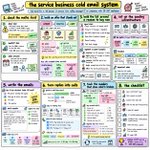
Cold email for service businesses works the SAME way, so I broke down the full build:
- Checking the maths
- An offer that stands out
- A list with a reason to buy
- The sending setup
- The emails
- Turning replies into calls
- The numbers that matter
Full breakdown in the article:

