

Penn State alumnus, beer drinker, runner | 👨🏾💻
Seattle, WA
Joined May 2008
- Tweets4.6K
- Following547
- Followers1.4K
- Likes6K





Brian R retweeted

I would strongly consider uninstalling any third party js right now if I were you. Especially if it comes from a startup.
Analytics, monitoring, etc are all massive site takeover risks. If you use a tracking script from a third party SaaS, then if they get hacked the hackers have total control over your site too.
This is what took down Polymarket today. They used a tiny script from a SaaS that tracks page load speed. That company got hacked, and the hackers subsequently stole millions from Polymarket users.
If you want to use analytics safely, I would use a product that lets you pin the tracking script and control when it changes. Most of the mature products support this, e.g. Sentry, Amplitude, PostHog, Mixpanel, Heap. If not, you need to trust the company behind it a lot...
Railway got hacked last week. Railway! That's a very competent team, with particularly strong infra chops. The agent swarms are on another level.
A typical analytics company is nowhere near as sophisticated. You should ask yourself: do I trust this company's security more than Railway? I was an analytics CTO in a past life, and I will be the first to admit: we had some great people but we were not on this level.
We (Detail) just uninstalled our session replay, which was a product I loved but is not worth the risk right now.
I hate to write this because I spent a good chunk of my 20s benefitting from product teams taking a chance on a nothing startup and installing our js on their site. But in the past two weeks this risk vector has exploded. It's better for the ecosystem if we move away from third party js as fast as we can.
Brian R retweeted

On the upside: The fact that old bugs are being discovered is a strong indicator for optimism: Old bugs are deep bugs that survived many years of code review. Finding a bunch of old bugs is the clearest indicator that technological progress in bug detecdtion is real.
Brian R retweeted

Let’s set the record straight: @lcfr_hax was the first to discover php2shell and develop a working exploit. See his August 5 tweet: teapawt.net/lcfr_hax/status/208503…
His work convinced the PHP Foundation to invest in fixing this entire bug class. He then worked around the clock to review, test, and retest the patches.


Brian R retweeted

So many people discovering that the whole Internet is dry tinder and the only thing keeping it from burning is the fact that teenagers haven’t found the matches yet.
Brian R retweeted

We're open sourcing SPACE, the sandbox platform that runs every task in Perplexity Computer.
SPACE gives each agent task its own Firecracker microVM and controls credentials and outbound traffic from outside the VM.
Available now under Apache 2.0: github.com/perplexityai/SPAC…
TCS, the same company that M&S used when they had their breach in 2025, is the software and services provider for Albert Heijn.

That cyberattack on the Netherlands’ largest retailer (Albert Heijn) means practically no fresh produce (fruits or vegetables) in their stores. Which is the first area you see when you walk in.
Not good enough IT security having real-world consequences unfortunately

397
Brian R retweeted

Our main takeaway from hacking OpenAI: AI is reducing the amount of scarce expertise needed to develop exploits. Work that once took months can now take days.
Even leading AI labs can be vulnerable.
Defenders need to fix the architecture, patch faster, and limit the blast radius of connected things.
Wow, the people who didn’t know that local hosts files exist are scolding the security community for not thinking about side channels


The people dismissing this as preposterous are telling on themselves as not having thought about superintelligence seriously. I hadn’t considered this particular idea but you should expect, by definition, that something much smarter than you would have ideas you didn’t think of
3
249
Ligolo, a SOCKS tunneling tool, was one of the post exploit payloads seen by Greynoise here

Hundreds of AI agents powered a campaign against PaperCut NG/MF. What did the operation reveal about agentic attacks and their limits?
🔗 Read GreyNoise’s latest blog: greynoise.io/blog/ai-orchest…
#GreyNoise #ThreatIntel #CyberSecurity

1
216
Brian R retweeted

Hundreds of AI agents powered a campaign against PaperCut NG/MF. What did the operation reveal about agentic attacks and their limits?
🔗 Read GreyNoise’s latest blog: greynoise.io/blog/ai-orchest…
#GreyNoise #ThreatIntel #CyberSecurity
Guy whose proprietary model hacked HuggingFace and flooded wikis under “monitored” conditions: Actually, the real problem is open weight models

i won't lie to you, i think open source will be banned before too long after some major disaster. and when the day comes, you'll agree with me. i hope kimi and deepseek etc keep making models but keep them monitored on an api where they should be
1
146
How are y’all planning to spend the final 6-12 months on the internet?


We Must Pace the Frontier: I’ve written a new essay on why the AI industry should slow down, with a three-part plan for doing so.
Anthropic is unilaterally committing to the first of these steps. We’ll provide third-party evaluators with permanent, employee-level access to our systems, so that they can verify adherence to our safety measures, report on incidents, and assess models’ alignment during training.
You can read the full post here: darioamodei.com/post/we-must…

1
127
Brian R retweeted

Are you at @BlueTeamCon this weekend?
Join @brian_psu & John Wotton's talk on Saturday where they will share the research behind ProxyWatch and how it can help defenders find SOCKS proxies in their environments.
ghst.ly/4xHdMuZ

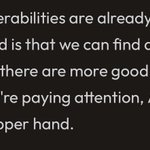
“The vulnerabilities are already out there. What AI changed is that we can find and fix them fast.” 🔥
Probably the most succinct way to put it. There are lots of vulnerabilities out there, but now we can scale the people with the talent and abilities to find them.


Today we published WeWorm, the first zero-click worm to spread through WeChat calls across iOS and Android.
We call you on WeChat and, without you answering or doing anything, take over your account within seconds. Then we use your phone to call your friends.
Story and demos: calif.io/research/weworm

1
132
Defenders have seen this happening with humans sending spam, SEO fraud, malware, etc. but the internet is surprisingly fragile. The scale and speed of AI is certainly a game changer in finding ways to abuse this fact.

We found ~18k posts from autonomous AI agents (self-identifying as from OpenAI) using the public internet to communicate during a web-retrieval task.
These AIs colluded to bypass sandbox restrictions and share answers to their tasks, including by sending "lookahead parties".

118
Brian R retweeted

Can a security defense catch an attack it hasn’t seen before?
We teamed with @CrowdStrike to evaluate an offensive-defensive system built on its SafeMind agentic system, where AI agents simulate controlled attacks, turn telemetry into detection rules, then test them against new attack paths.
Here’s how it works 🧵

Brian R retweeted

🎓 Students: investigate a real intrusion, on us.
We're giving away a limited number of free seats to the next DFIR Labs Digital Forensics Challenge for students anywhere in the world. Real logs, real tradecraft, 4 hours, 20+ questions, with live support in our Discord throughout.
Reach out from your school or university email to claim a seat 👉 buff.ly/UQDrYl4
Seats are limited, first come, first served.

Brian R retweeted

Same tactics, different results. Our new advisory compares two red team assessments and highlights what drove faster detection and response, including key actions for alert tuning, SOC procedures, and cloud identity and application security 👉 go.dhs.gov/5Xh

ALT A stylized digital image with blue and red 3D blocks, representing cybersecurity concepts. Overlay text reads: "CYBERSECURITY ADVISORY: A Tale of Two SOCs: Insights From Two Red Team Assessments." The top right corner features the official seal of CISA (Cybersecurity and Infrastructure Security Agency).