

BigLaw, USMC, and Fortune 50 litigator. Founder of SimDuo, an AI-powered, lifelike litigation skills simulation training platform. I build with AI.
Pittsburgh, PA
Joined October 2026
- Tweets346
- Following95
- Followers80
- Likes48





Pinned Tweet
18+ years as a litigator: BigLaw, USMC, and Fortune 50 company.
I also build software with AI. Real apps, not demos, including SimDuo, an interactive trial skills simulation platform.
I'll share my thoughts on AI and what I learn building with it.

3
4
690
AI has removed the time and cost friction associated with filings, so there will be more paper. I agree there. Courts will adopt AI more slowly, and the system was not designed to handle the pending influx. I’d think the number of trials would remain constant at capacity and courts may “encourage” settlement more aggressively. The proportion of cases going to trial would drop certainly.
I recently posted that consenting commercial parties would/should be able to have low-value disputes resolved by an AI mediator or “judge” and caught a lot of flak. But I think such an arrangement may benefit both parties and courts if done well.

6/ Fun one for the civil procedure nerds: if you were designing a dispute-resolution system from first principles - keeping discovery, early dispositive motions, written discovery, depositions, even live evidentiary hearings - but assuming lawyers use AI at every step (and remain fully responsible for what they sign and say), what would the rules look like?
1
1
24
This presentation link is wild. I've never seen anything quite like it. Part cinema, part video game.
claude.ai/artifact/Cy2d8Vn63…


Opus 5.6 is unceremoniously the most powerful model I've laid my hands on. This is insane.
claude.ai/artifact/Cy2d8Vn63…
Have a go.
57
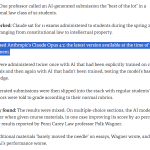
I missed a key part of last week's story about Claude passing 10 law school exams at Penn and finishing in the top 10% on most.
It was Opus 4.7!
How would Opus 5.5 or Fable 5.2 do?
While impressive, law school exams tend to test a student's ability to apply facts to settled black-letter law. That's rarely what lawyers do in real life.
Law students and junior attorneys need reps more than ever to build the foundation of experience on which judgment rests.


1
27

It was Opus 4.7 that took the law school exams!
How would Opus 5.5 or Fable 5.2 do?


TRACKED CHANGES: Penn Law gave Claude the same finals its students took and slipped its answers into the grading pile. Claude passed all 10 graded exams, finished in the top 10% on seven, and beat all 84 students on the legislation final, reports Axios.
31
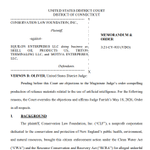
A federal judge in Connecticut recently affirmed a magistrate's ruling that an expert's prompts and queries with ChatGPT were discoverable when it was used "to identify all the documents that could be relevant to a particular question" because they comprised the basis for her expert opinion.
In Conservation L. Found., Inc. v. Shell Oil Co., 3:21-cv-933-VDO (D. Conn. 11/20/2026), the plaintiff brought a citizen enforcement action alleging unlawful conduct related to bulk storage and a fuel terminal.
The plaintiff engaged a Harvard Professor to be an expert witness. In writing her opening report, she relied on materials produced in litigation and employed a research assistant to help her with review of the litigation materials. The research assistant processed the litigation docs using a dedicated Microsoft Azure cloud environment created solely for the project. AI prompts, queries, and model outputs were used interactively as intermediate tools to identify potentially relevant docs for further review. The research assistant used ChatGPT to do this, and did not preserve complete native prompt/output log standalone files.
Defendants moved to compel production of AI reliance materials. Defendants argued that Plaintiff violated FRCP 26(a)(2)(B) by refusing to produce underlying facts, data, and documents that construct the methodology the expert relied on to use AI. Plaintiff objected. The magistrate judge granted defendants' motion to compel.
The plaintiff challenged the magistrate judge's order. The district court applied a clearly erroneous standard and affirmed.
Interestingly, the parties had entered into a Rule 29(b) stipulation which included a non-discoverability provision covering expert report drafts and communications (see clip below for stipulation language).
The district court judge ruled that it was not clearly erroneous for the magistrate judge to distinguish AI prompts from the categories of non-discoverable information listed in the stipulation, which did not mention AI.
The court concluded that AI prompts or queries used by the expert or her team in the course of producing her expert report are discoverable under Rule 26(a)(2)(B)(i) because they comprise "the basis" for her expert opinions. The expert discussed in advance what the ChatGPT prompts would be and reviewed the documents after the analysis was run. The court found this enough to show that the prompts and queries comprised the basis for her expert opinion.
My thoughts on this one:
1. Always ask for and expect to be asked for AI prompts used by an expert in preparing an expert report or forming an opinion.
2. Advise experts to conduct their chats as if they will be shown to the jury.
3. If parties agree that expert AI prompts are off limits, say so expressly in any stipulation.


1
42
Honest question: How do we even know AI solved the Reimann Hypothesis? I read that the proof was 250k pages.
No human could have reviewed this, much less understood the reasoning.
We know AI can hallucinate (although it’s getting much better) and is sycophantic so how can we trust the result when no human has been able to solve the problem.

115
I don’t agree with this approach. I understand not wanting a model to generate judicial orders. But preventing everyone from using it for any purpose seems like overkill. It has great value with appropriate guardrails.

Massachusetts bars its judges, clerks, and court staff from using generative AI for legal research, legal writing, or other legal work. Bob Ambrogi's new 50-state survey calls it the most restrictive judicial AI policy in the country. 🧵
1
51


The bigger accomplishment would be explaining the Riemann Hypothesis in terms I can understand.

Oh my god: Anthropic mathematician Levent Alpöge (@__alpoge__) says he has proven the Riemann Hypothesis, open for 167 years.
"I believe I have, working with Claude, discovered a proof of the Riemann Hypothesis."
He says the method also covers the Generalized Riemann Hypothesis. The proof is out as Lean code (a proof language where a computer checks every step), so experts should be able to check it quickly, Scientific American reports.
Same Alpöge who was behind this year's Jacobian conjecture result and the Navier-Stokes work with Tristan Buckmaster.
I assume we will get an official statement very soon from him!!

51
The Federal Reserve Bank of Dallas generated the below GDP-growth prediction chart in June 2025. It shows a slight chance of a "Singularity - Extinction" scenario taking us to zero around 2040.
I showed this chart during an AI presentation to a group of lawyers in October 2025.
I've been thinking about it lately with the string of outages and cyber incidents.
The break point appears to be right around 2026-27.
What will it be, folks, are we taking the red line up or the purple line down?

1
42
A California Court of Appeal recently declined to overturn a trial court's ruling that allowed expert testimony where the expert used ChatGPT as a "thought partner" and to help write portions of the expert report. This was a prosecution expert at a mental health diversion hearing.
The Court of Appeal found a material factual error in the expert's report to be "troubling." A defense expert also testified that the key section of the report in question scored 98% on an AI-detector. But the appellate court deferred to the trial court's determination that the expert did not rely on AI in generating her expert opinion.
The court said using AI to generate an expert opinion would constitute a novel scientific technique that would be inadmissible absent an adequate foundation establishing reliability. But using AI as a thought partner and to organize facts and thoughts does not require such a foundation.
In my view, this case was a close call and likely would have been affirmed even if the trial court ruled the other way.
This case is a good reminder to probe any expert on the use of AI and to ensure any expert you're using can withstand such probes.


1
49
Is it now irresponsible to write code manually?

No.
1. In the presence of superhuman bug finding machines, humans cannot write safe code without extreme levels of care and planning.
2. That care has almost never been applied to the critical systems in our lives. Not because software engineers don't care, but we aren't really engineers, not in the way civil engineers are engineers. The title is stolen valor.
3. Even careful, experienced "engineers" have difficulty writing code that is safe against modern models in C/C++ and other low-level languages.
4. We are finding that CVEs are overrated; huge numbers of organizations are being owned by custom vulns in the 100s of billions of lines of non-standard enterprise code out there or misconfigurations in heterogeneous systems, which LLMs can find and write exploits for live.
5. @dinodaizovi is right, we need architectures for which one RCE is not game-over and that buy us time for AI-driven response.
6. Everything is going to have to be re-written by AI, in type/memory safe languages, with minimal libraries, using formal methods, contracts, solvers, etc...
34
What is the point of diminishing returns of model size and intelligence?

Something I think people fail to understand is that as soon as there is 1 cheap / smaller Chinese open weights model roughly on par with Opus 5.5, it is game over for Anthropic. 5.5 is, for better or worse, good enough for almost every task. 🧵
39
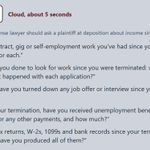
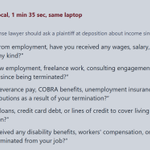
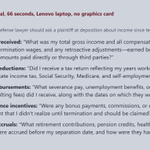
I downloaded two open models to my laptop and ran the same prompt asking for deposition questions through both, and Opus 5.5 high.
The prompt: "List five questions a defense lawyer should ask a plaintiff at deposition about income since termination. One line each."
LFM3 1.7B: 66 seconds
Ornith 9B: 1 min 35 sec
Claude Opus 5.5: 5 seconds
Local models were slow, but free. Their outputs are in the thread if you want to judge quality.
Which model did a better job?
Would these local outputs have seemed like magic two years ago? I think yes.
2
1
60

