


ALT DOI: 10.1093/med/9780197676158.001.0001 The thalamus has often been treated as a minor, rather insignificant player in cortical functioning. In the not too distant past, the thalamus was considered a rather boring, machine-like relay of subcortical information to the cortex. Over the past decade, there has been a groundswell of new and renewed interest in the thalamus and thalamocortical interactions, leading to discoveries demonstrating the thalamus's ongoing and essential role in cortical functioning and, likewise, the significance of the cortex for thalamic functioning. The Cerebral Cortex and Thalamus is a groundbreaking volume bringing together a cohesive account of cortical and thalamic mechanisms for control of behavior with an emphasis on the importance of interactions between the two structures. The book elucidates the research that makes it increasingly clear that the cortex and thalamus are necessary partners for sensory, motor, and cognitive functions. Interactions betwee


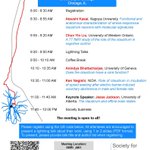
ALT Saturday, November 11, 2023 · 8am - 12pm EST hosted by the Center for Neuroscience and Behavior at American University Washington, D.C. 8:00 - 8:30 AM Registration and Poster Set Up 8:30 - 9:20 AM Ami Citri, Hebrew University Claustro-frontal circuits in behavioral control 9:20 - 9:45 AM Lorenz Fenk, Max Planck Institute Exploring sleep and claustral dynamics in the dragon brain 9:45 - 10:30 AM Poster Session 10:30 - 10:55 AM Maxime Chevée, Vanderbilt University Motor activity in the claustrum during a sensory selection task 10:55 - 11:20 AM Gilad Silberberg, Karolinska Institute Pre- and post-synaptic determinants of synaptic connectivity between claustrum and ACC 11:20 - 11:45 AM Anna Taylor, University of Alberta The claustrocortical circuit in pain Constitution Hall 3501 Nebraska Ave NW. Washington, DC 20006 Registration on Eventbrite Contact Rachel Crupi for questions: [email protected]


ALT Title text: Department of Neuroscience Summer Internship Program for Undergraduates Body: The Johns Hopkins Department of Neuroscience Summer Internship Program (NeuroSIP) is a 10-week funded summer program that provides research experiences for undergraduate students, including students from underrepresented backgrounds who are considering graduate studies in neuroscience. Students are provided with housing at no cost and a minimum $4000 stipend. Faculty list: https://neuroscience.jhu.edu/research/faculty Application deadline is February 1, 2023. Website: https://neuroscience.jhu.edu/diversity/24 Application: https://www.hopkinsmedicine.org/som/pathway/sip.html (Interested students should select “BSI” and “NeuroSIP” on the application) For more information regarding the program and application process, contact: Seth Blackshaw ([email protected], @SethBlackshaw on Twitter) Alan Gutman-Wei ([email protected], @weitforit) Yared Haile ([email protected]

ALT Title: Kavli Neuroscience Discovery Institute Summer Internship Program for Undergraduates Body: The Kavli Neuroscience Discovery Institute supports initiatives that bridge neuroscience, physics, data science and engineering to solve the mysteries of the brain. The Kavli NDI Summer Internship Program (KavliSIP) at Johns Hopkins University is a 10-week funded summer program that provides research experiences for undergraduate students, including students from underrepresented backgrounds who are considering graduate studies in neuroscience, engineering, and related fields. Students are provided with housing at no cost and a $4000 stipend. The application deadline is February 1, 2023. Website: https://kavlijhu.org/ Application: https://www.hopkinsmedicine.org/som/pathway/sip.html (Interested students should select “BSI” and “KavliSIP” on the application) For more information, contact: Seth Blackshaw ([email protected]) Alan Gutman-Wei ([email protected]) Yared Haile ([email protected])