

Proprietor of Studio Stretch — a design studio helping teams make better product decisions. Teaching design @MICA. Let's build something: https://teapawt.net/t.co/iESdsoKQqU
Baltimore
Joined January 2009
- Tweets5.6K
- Following950
- Followers920
- Likes1.9K



Planning on leaving feedback via the app but if anyone at Anthropic sees this and wants direct feedback DM me. Let's see what this can do!

ALT An app screenshot from my install of Anthropic's Duet app showing its initial onboarding state.

We’re opening a research preview of Claude Duet, a new app where Claude works as a proactive agent.
It comes to you with what needs your attention, completes tasks you ask of it, keeps working when you step away, and checks with you before it acts on your behalf.
1
69
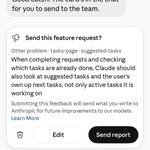
Sweat those details! I imagine the team is getting feedback from all angles but I like that you can just ask to send feedback and there's a native channel to do it ✨

ALT A screenshot of the Duet app where I've asked to send some feedback to the Duet team and it's generated an inline form to submit it.
1
42
Also possible that @inflight will be used to facilitate @designertom and @ridd_design tearing apart the Studio Stretch site on the live @joindiveclub show today teapawt.net/i/broadcasts/1RJZzBNDa…. Don't hold back!

1
46
Congrats @ridd_design @designertom @kbarber on the launch! Inflight brings us closer to a world where working with AI is less solitary and more collaborative and they're poised to play a huge role in that category.

introducing @inflight
the missing feedback layer for prototypes
⇢ works with any agent
⇢ supports pinned comments + video
⇢ turns feedback into next steps for Claude
1
5
211
Another insane day for people trying to keep up with AI progress (maybe especially insane for designers who are also seeing what's being released by Figma)

They did it. They made a Muse open weights model, which is a huge step forward for OSS in the US.
This is going to further accelerate AI diffusion because enterprises will be able to mix and match frontier performance for orchestration and high end tasks, while being able to have low cost and tailored post trained models for repeatable workflows.
Overall this dramatically increases token consumption and workloads across the stack. Great to see Meta doing this.
1
34

Clipping comes for product design

.@alexandr_wang says modern product marketing is now all driven by the screenshot:
“To have a modern consumer product, it has to work on the screenshot. The screenshot has to fly, either through group chats or word of mouth or online.”
“Having Jolly in the screenshot immediately communicates this is a Muse screenshot.”
31

The next creative job is entrepreneur. And honestly I don't know how well prepared the creative field is for this shift. Some creatives will shift to being creators. Some will shift to being curators and directors. Some will shift to teachers of IRL creative skills. But no matter what, you'll have to move like an entrepreneur and hold on to your ideas loosely while you hold onto your creativity tightly.

AI is making creativity more valuable than ever before and..
we have 3 years of data to prove it.
Introducing the Creative Intelligence 2026 report from @contralabs.
Full report: c87.to/creative-intelligence…
46
Bryan Connor retweeted

This analogy is the best I've ever heard when it comes to how LLM-generated code looks, works, and what the role of developers is morphing into.
Pre-AI codebases are sturdy, with scaffolding that allows for human comprehension and, at the same time, prevents hyper-optimization. We need to "get" the code, not just run it.
Post-AI codebases let go of all pretense to be both accessible by interpreters/compilers/runtimes AND humans, and contain JUST what is needed to provide the expected outcomes.
And that is what developers are realizing they must measure, review, and verify. Not the code, but the constraints and tests around it.

Codebases are going to start looking like optimized topology 3d prints
When AI is better at math than humans it also becomes better at algorithm & codebase design
At that point the system and delivering quality software doesn’t require human understanding to exist in the actual code layer.
Only needs to be understood by humans at the high level of passing testing, verification, vibe checks and being understandable when queried via AI in the rare case one need to dive deeper.


Nice! Amazing resource for brand designers out there

I built a way to unearth the images hidden in old books.
Check it out: insideoutlibrary.com
Searches 1.4 million images, all public-domain. Strange diagrams, forgotten inventions, and other visual curiosities.

2
41
It may be hard to hear, but that prototype your team made isn’t a product. It’s the most detailed product requirements doc you’ve ever written.
I used to start working with clients by turning ideas, references, and goals into something visual they could react to. Now clients come with a prototype already built, and they're much more attached to it. The new work is helping them see what they've made: an interactive spec. Turning it into a product is still work to be done.
35
