

High Performance Computing and AI systems specialist. Patents author. My posts are my very personal opinions.
Joined September 2010
- Tweets52.7K
- Following803
- Followers534
- Likes8.5K







BSD daemonologist and invocator. retweeted

“Software engineers should be excited”
De lo mejor que he leído últimamente. Qué buena época para ser software engineer.


BSD daemonologist and invocator. retweeted

Every Mac on macOS 27 now has a free LLM built into the Terminal.
No account. No API key. No internet. No token bill.
Setup (1 minute):
1. sudo fm license (enter your Mac password, one time)
2. fm available (checks the model is downloaded)
3. fm respond “your question”
Works on any Apple Silicon Mac, M1 included.
- Pipe files: cat notes.txt | fm respond -i “summarize this”
- Get JSON back: build a schema with fm schema object, pass it with --schema
- Local API: fm serve gives you an OpenAI-compatible endpoint on localhost
- Resume chats: sessions save to ~/.fm/sessions/
The limit is 4,096 tokens per session, and your prompt, instructions, and the answer all share it.
So skip code and math. Use it for summarizing, extracting, classifying, and rewriting.
Free, private, offline, and already on your Mac.

BSD daemonologist and invocator. retweeted

Se habla de modelos pero creo que debemos empezar a enfocarnos más en harness, hablar de loops, tools, permisos, contexto alrededor del #LLM.
Y para eso me puse a revisar algunos repos en #Github que creo les pueden servir.
- mini-coding-agent de Sebastian Raschka. Un coding agent en un archivo de #Python, sin dependencias, corre con Ollama.
github.com/rasbt/mini-coding…
- mini-swe-agent, un agente de un aprox de 100 líneas en Python que resuelve tareas reales de SWE-bench. Me sorprende que es un bash como única tool y un loop bien diseñado.
github.com/SWE-agent/mini-sw…
- humanlayer/12-factor-agents Este si lo veo como una jooooyita, muchas sugerencias, buenas prácticas y justo lo que estaba buscando, siento que es mi favorito
github.com/humanlayer/12-fac…
- huggingface/smolagents si viene de @huggingface ya sabemos que es calidad, y esto no es la excepción. En este repo vas a encontrar agentes "minimalistas" donde el LLM escribe código Python en vez de JSON tool calls. Está super bueno y lo veo como un repo para "jugar" un ratito y explorar nuevas ideas.
github.com/huggingface/smola…
- ai-boost/awesome-harness-engineering y por último este recurso, y es una lista completa que tiene todo el stack anterior: memoria, permisos, MCP, evals, observabilidad. Y lo que hoy se hace llamar #Harness Engineering. Super tooop!
github.com/ai-boost/awesome-…
Si tienen otro repo que creen le pueda servir a la comunidad ayúdame compartiendo en los comentarios, y espero sean de utilidad estos enlaces.
#ai #AgenticAI

BSD daemonologist and invocator. retweeted

The Space-Eater 🚀 💀
Dead Space reimagined as a classic 80s horror movie. (Can't wait to play the remake!)
#DeadSpaceRemake
#horror #scifi #amv #posterdesign


BSD daemonologist and invocator. retweeted

Alternative Poster for Dead Space Videogame (2023)
Aka: Dead Space Remake
By Estevan Silveira @estevansilveira
estevansilveira.com
instagram.com/estevan_silvei…
#DeadSpace #AlternativePoster #EstevanSilveira

BSD daemonologist and invocator. retweeted

This Sunday, we’ll be hosting a very special Space focused on robotics, featuring several experts in the field.
We’ll discuss key topics around Tesla Optimus and the new robotics companies that are growing rapidly.
Don’t miss it.
teapawt.net/i/spaces/1jGXgBDBlOeKZ
BSD daemonologist and invocator. retweeted
Tesla Optimus will soon be able to perform all of these tasks and much more.
As @elonmusk said:
“Optimus will be the biggest product ever.”
Me acaban de asignar 16 nodos Nvidia GB200, cada uno con 20 TB en storage NVMI y 740 GB de GPU.
El objetivo es montar un LLM con algunos modelos para el team de research y diseño de tecnología.

6
22
2,527
la marca de agua tokenizadora no funciona con tokens. Tiene que funcionar con los embeddings de cada token. No importa si hay sinónimos, o si la secuencia de los tokens cambia.
2
377


BSD daemonologist and invocator. retweeted

Jay Alammar is the best teacher in AI. Period.
If you have ever seen "The Illustrated Transformer," you know his diagrams are legendary. He also open-sourced the entire codebase for his O'Reilly book: Hands-On Large Language Models.
It’s effectively a visual masterclass in LLMs for free.
Chapter 1: Introduction to Language Models
Chapter 2: Tokens and Embeddings
Chapter 3: Looking Inside Transformer LLMs
Chapter 4: Text Classification
Chapter 5: Text Clustering and Topic Modeling
Chapter 6: Prompt Engineering
Chapter 7: Advanced Text Generation Techniques and Tools
Chapter 8: Semantic Search and Retrieval-Augmented Generation
Chapter 9: Multimodal Large Language Models
Chapter 10: Creating Text Embedding Models
Chapter 11: Fine-tuning Representation Models for Classification
Chapter 12: Fine-tuning Generation Models
I will put the repo link in the comments.

BSD daemonologist and invocator. retweeted

Google Brain founder, Andrew Ng:
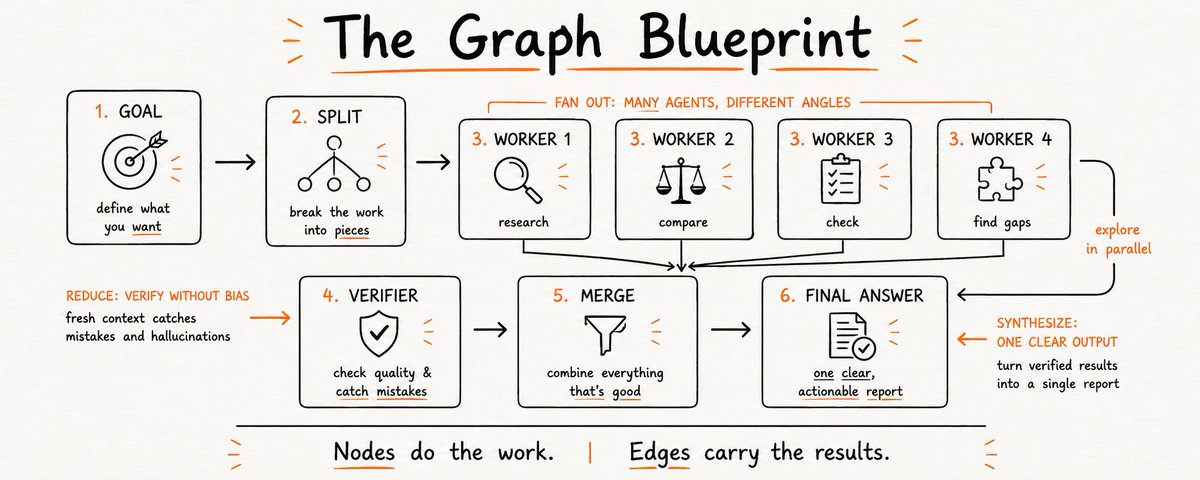
"Prompting will be dead in 6 months, graphs are what's replacing it."
In 2 hours at Stanford he shows how to build agents that work and improve entirely on their own.
The first 10 minutes cover what most $500 courses never do.
Watch the lecture first, then read the guide below on how to build a system that improves itself.

BSD daemonologist and invocator. retweeted

Learn AI for free directly from top companies.
1 - Anthropic:
anthropic.skilljar.com
2 - Google:
grow.google/ai
3 - Meta:
ai.meta.com/resources/
4 - NVIDIA:
developer.nvidia.com/cuda
5 - Microsoft:
learn.microsoft.com/en-us/tr…
6 - OpenAI:
academy.openai.com
7 - IBM:
skillsbuild.org
8 - AWS:
skillbuilder.aws
9 - DeepLearning.AI:
deeplearning.ai
10 - Hugging Face:
huggingface.co/learn
Comment "Learning" if you find this helpful.
Repost so others can take help.
Must bookmark for future reference.

BSD daemonologist and invocator. retweeted

Google just released a free 2-hour course on full Graph Engineering.
How to go from one prompt to 100 agents running inside one graph:
17:44 - Build your first AI agent
39:30 - Run agents with loop engineering
1:12:38 - Turn agent loops into graphs
1:34:26 - Build agents that throttle themselves
1:55:05 - Orchestrate the full multi-agent system
Most people build one agent and stop there.
Google is teaching the full stack:
Prompt → Agents → Loops → Graphs → Multi-Agent Systems
Single agents are the old workflow.
Self-regulating agent graphs are the new one.
This 2-hour watch is worth more than most paid agent engineering courses.
Bookmark and watch it today
Then read the full architecture below ↓


BSD daemonologist and invocator. retweeted

Just saw that the LLMs-from-scratch repository passed 100,000 stars on GitHub!
This is super cool and motivating. I am really happy to see that this open-source repo has helped so many people.
Thanks also to everyone who shared ideas and opened PRs with improvements!
Of course, I plan to keep adding new material, including new attention variants and architectures (while bigger projects like RL and Reasoning From Scratch live in their separate repositories).
I am also currently working on a larger applied custom “small” LLM project. It has been keeping me super busy this month, but I will share more on that soon.
If you are new to it, some of the highlights include
1. Of course, the complete code path from tokenization and attention to pretraining, classification, and instruction fine-tuning, etc. All of it FROM SCRATCH, of course! (RL lives in a companion repo.)
2. From-scratch implementations of Llama, Qwen, Gemma, and Olmo (smaller variants that run locally and can be plugged into the training scripts).
3. From-scratch implementations of attention alternatives and other architecture components, such as GQA, MLA, sliding-window attention, Gated DeltaNet, DeepSeek Sparse Attention, cross-layer KV sharing, and mixture-of-experts
4. Materials on KV caching, training performance, memory-efficient weight loading, DPO, evaluation, and LoRA
So, if you don’t have any weekend plans yet, happy tinkering!

BSD daemonologist and invocator. retweeted

Head of Claude Code, Boris Cherny:
"You're not supposed to write code anymore. You're supposed to build a graph that writes itself."
In 30 minutes he breaks down how engineers at Anthropic build graphs that write the code, catch the bugs, and ships.
The missing piece most developers skip: how to wire those agents into a graph that runs, verifies, and improves without you.
Watch it, then read the full guide on graph engineering below.


Readers added context they thought people might want to know
Boris Cherny states he did not use the word "graph" or discuss graphs in the video, contrary to the attributed quote. x.com/bcherny/status…
BSD daemonologist and invocator. retweeted

Esto es una auténtica joya.
Hace cinco semanas, Andrej Karpathy se unió a Anthropic.
Dos ingenieros senior de Anthropic llevaron el enfoque de Karpathy un paso más allá con el concepto de Graph Engineering.
Los sistemas agénticos mejoran de verdad cuando conectas los agentes en forma de grafo.
Lo integré en mi configuración y la primera respuesta ya fue completamente distinta.
No fue una mejora pequeña. Fue un cambio total.
Claude dejó de dar respuestas genéricas y empezó a trabajar exactamente como yo quería.
Guárdalo antes de que se pierda en tu feed.
Léelo ahora y luego échale un vistazo al artículo de abajo👇


BSD daemonologist and invocator. retweeted

Anthropic engineer:
“90% of our engineers were using self‑improving loops. Now everyone shifted to building agentic Graphs"
"No more prompting”
In 10 minutes she shows her full Claude Code setup and workflow live, from a blank terminal.
Worth more than a $500 agentic course.
Watch this video, then save the article below on how to become a graph architect👇


BSD daemonologist and invocator. retweeted

This guy bought a $400 Mac mini and walked into a coffee shop with $2,100 for installing an AI agent that never touches the internet.
I had to rewatch this because the pitch is almost too simple. He shows up, plugs in the Mac mini, installs a local AI agent running entirely through Ollama, done in under an hour. Zero cloud dependency, no API bills, no monthly charges bleeding the client dry. The coffee shop owner gets a private AI system that keeps working even if the WiFi dies, and he walks out with $2,100 for an install that takes less time than a long lunch.
The hardware cost him $400. One deployment and the machine's already paid for five times over. Then he locks in a monthly retainer for support, somewhere around $100-150, which means every client after the first is close to pure margin stacking on top of recurring revenue.
Most people hear "AI business" and think they need to build a SaaS platform or learn to code or raise funding from someone. This skips all of that and goes straight to walking into coffee shops with a Mac mini under one arm.
Not a company that scales to a billion dollars, obviously, but a solo operator clearing a few thousand a month from local installs while everyone else is still arguing about which LLM is best on Twitter.


