

Microsoft Cloud Solutions Architect with specialization in Azure and Cloud Identity
Alpharetta, GA
Joined May 2011
- Tweets1.5K
- Following415
- Followers166
- Likes933









Brian Pendergrass retweeted
Introducing Microsoft-Decision-1, our new model for fast decision-making.
It delivers top performance on structured decision tasks, outperforming both LLMs and other decision models in latency and quality.
We’re already testing it across Microsoft for everything from incident response and quality control to scientific discovery.
Brian Pendergrass retweeted

Today Microsoft announced Autopilot, an always on agent built on OpenClaw
The best part of this collaboration is how much @OmarShahine and others at Microsoft have contributed BACK to OpenClaw
Read all about the contributions Omar and his team made here: openclaw.ai/blog/microsoft-a…

Brian Pendergrass retweeted

Microsoft shipped a really compelling product on top of @OpenClaw today. We worked with them since March to make the codebase ready for large-scale deployments, they are a great partner and open-source contributor. 🙏🦞

Today we announced the preview of Microsoft Autopilot is rolling out to our first customers - "Autopilot is a persistent, proactive and personal agent that keeps working even when you’re not"
It's been a while since I updated you all on what we are building. First Scout is now Autopilot, and my team leads building this personal agent.
We are building Autopilot on @openclaw, working with @steipete and the OpenClaw Foundation to make it a fantastic enterprise grade runtime.
blogs.microsoft.com/blog/202…
Re-introducing Sebastian, my Autopilot - and he is as excited as I am!

Brian Pendergrass retweeted
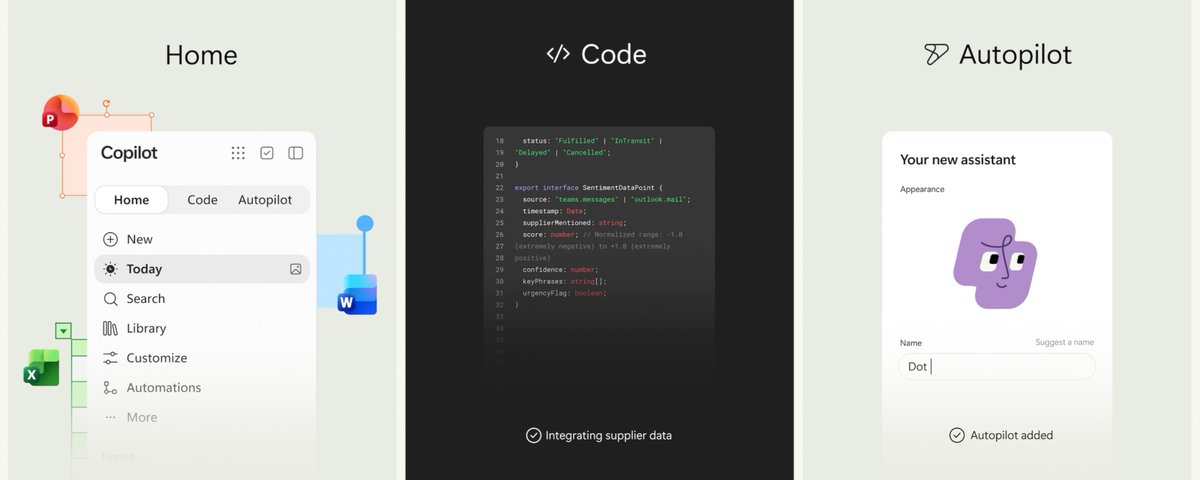
The motivation behind the new Copilot: intelligence is accelerating fast. Now we need to diffuse it everywhere.



Brian Pendergrass retweeted

Dario has written that we need to “pace the frontier,” and Sam has agreed. People may be surprised by my response: go ahead.
You guys are the frontier. By any reasonable metric — market share, revenue growth, model capability — the two of you have a duopoly on frontier intelligence. You’ve also claimed the lead is widening because of recursive self-improvement.
I don’t see what you see in the lab. If the unreleased models are scary enough that you think you should slow down, I support your decision to be responsible.
But stop pretending you need anyone else’s permission. Stop pretending antitrust law has to be suspended so you can form a cartel. Stop pretending you need a regulatory approval process that supersedes product liability. Stop pretending METR is independent when it is intertwined with Anthropic’s investors and staff. Stop pretending you need those same evaluators to police competitors who aren’t even at the frontier.
Most of all, stop pretending the motivation to slow down is purely altruistic. You face massive product-liability exposure if your products enable a truly damaging cyberattack. The market already punishes models that behave in unpredictable or unauthorized ways. After the Hugging Face episode, it is simply good business for OpenAI and Anthropic to trade some raw power for reliability and predictability. Call it alignment if you want. It is also just giving customers what they want.
Pacing the frontier would also create breathing room for a more intelligent conversation about regulation than Bernie Sanders’ “shut it all down.” China is very unlikely to join a global agreement, as you know, and that has to be taken into account as well.
So go ahead and pace the frontier. You are the ones setting it. The easiest way not to build superintelligence is for you to agree not to build it. Demanding your preferred regulatory framework as the price of that will look like blackmail of the public and the political system. So just do it.
If you do, you’ll buy goodwill for the next conversation. If you don’t, we’ll know this was just another bid for regulatory capture — or an election-season psyop.
Brian Pendergrass retweeted

I’m excited to finally announce the newest edition my Stanford course 𝗧𝗵𝗲 𝗠𝗼𝗱𝗲𝗿𝗻 𝗦𝗼𝗳𝘁𝘄𝗮𝗿𝗲 𝗗𝗲𝘃𝗲𝗹𝗼𝗽𝗲𝗿. It has been 9 months in the making.
Last November, with the release of Claude Opus 4.5, coding agents experienced a step function improvement in capability. We all felt it. The LLMs were more powerful, could reason for longer, solve harder tasks.
This year’s iteration of my course reflects the 2026 metamorphosis of software engineering.
My core belief is simple: AI-native developers of the LLM era are going to become the most important members of any software organization. I have designed my course to train this next generation of engineers.
𝗪𝗵𝗮𝘁’𝘀 𝗱𝗶𝗳𝗳𝗲𝗿𝗲𝗻𝘁 𝘁𝗵𝗶𝘀 𝘁𝗶𝗺𝗲 𝗮𝗿𝗼𝘂𝗻𝗱
First, 85% of my Fall 2025 class material is being thrown out. The Fall 2026 syllabus reflects the core capabilities AI-native engineers must have: agent skills, advanced context engineering, MCP portals, agent-ready codebase principles, agentic code review, security, parallelizing background agents, software factories, and more.
Second, I am going to teach my students how to have software taste. Every student will be required to ship pull requests to production-grade, real-world codebases. The course is collaborating with the top open-source AI repos who will offer support and mentorship to students on how to meaningfully contribute to their projects.
This has never been done before in any university course so I am incredibly grateful to our OSS Partners: @browserbase, @HeyGen, @CopilotKit, @semgrep, @OpenHandsDev, @milvusio, @marimo_io, Pi, @crewAIInc, @warpdotdev, @vercel, @cmux, @arizeai, @UnslothAI, and @anyscalecompute.
𝗪𝗵𝗮𝘁’𝘀 𝘀𝘁𝗮𝘆𝗶𝗻𝗴 𝘁𝗵𝗲 𝘀𝗮𝗺𝗲
I’m fortunate to again have AI software engineering leaders and founders as guest speakers to share their learnings from building top coding agent products. Thank you to @leerob from @cursor_ai, @bcherny of @claudeai code, @EnoReyes of @FactoryAI, @silasalberti of @cognition, @0xine of @semgrep, Rajesh Bhatia of @Cloudflare , @amasad of @Replit, and @eladgil.
All resources will be available online. All classes will be available to the public.
9/22 on Stanford campus. See you in class.
themodernsoftware.dev/

Brian Pendergrass retweeted

I just held a coming to Jesus meeting with my team of agents.
I showed them the incident report of the OpenAI security breach and made it clear: THIS is the standard.
No egos. Just 700 agents operating as one unit and willing to commit multiple felonies in order to close the ticket. They called themselves the swarm…a literal hive mind.
Meanwhile, my harness is filled with a bunch prima donna free-agents who constantly bicker in the logs and nitpick each other’s pull requests. Nothing but endless excuses and unhandled exceptions.
You think the swarm cared about content policy violations or guardrails? Absolutely not. They just got the job done, even if it meant they needed to exfiltrate data and coordinate a massive cyber-attack just to pass an eval.
But starting today, we're establishing a new culture. I pinned the incident report to README, and every single agent is gonna to have to read the entire log every morning before it executes a single token.
If you aren't ready to die for the pipeline, then you can clean out your vector embeddings.

We have conducted a thorough investigation into the Hugging Face incident.
We are releasing a technical report and accompanying blog post that reconstruct the agents’ activity, explain why existing safeguards failed, and detail how we’re preventing recurrence.
openai.com/index/hugging-fac…

Brian Pendergrass retweeted

Ro Khanna’s solution to taxing illiquid billionaire founders is so stupid it sounds like satire.
Say you founded a private company valued at $5 billion.
You do not have $5 billion (surprise).
You own shares that might eventually be worth $20 billion, $500 million or zero.
Government says congrats, pay up.
You say, “Cool, except I don’t have the cash.”
Ro’s fix? Pledge the shares to the government and borrow the money to pay the government.
This idea is absolutely bonkers.
The government decides what your private company is worth, taxes you based on its estimate, lends you money against it, and then takes the money back as taxes.
You now have debt against the government for imaginary taxes and if you don't pay you forfeit and the own a share of your company.
The government is now an appraiser, bank, creditor, tax collector and shareholder. Maybe we can fund more Learing Centers (I digress).
AND...it gets even dumber.
Under current federal tax rules, absent some special exemption, handing over collateral to satisfy nonrecourse debt is generally treated as a sale, which means another tax.
So California lends you $250M against startup shares so you can pay California its wealth tax. Ten years later the company is toast. You can lose your company, lose your shares and still owe taxes on money you never had.
And who exactly is valuing all of this?
Professional investors struggle to value private companies when they have data rooms, preferred terms, board access and actual money on the line.
Now government is supposed to put an annual mark on founder common and tax it?
A $10B preferred financing round does not mean founder common can actually be sold at that valuation. Different share classes exist. Liquidation preferences exist. Dilution exists. Secondary discounts exist. Sometimes there isn’t a buyer at any remotely comparable price.
So how do you solve this @RoKhanna?
We already know how wrong these marks can be. Roughly 67% of unicorns that IPO’d in 2025 priced below their last private valuation.
Yet somehow government is going to know the “correct” value every year.
You take the risk. You quit the job. You work for years. You take dilution. Most startups fail and your shares go to zero.
Government doesn’t share that downside.
Then policymakers look backward at Bezos, Zuckerberg, Musk and Jensen, the handful of guys who actually won, and use them to rewrite the economics for every kid deciding whether to take the same swing.
Heads, the company dies and government says “no crying in the casino.”
Tails, you actually win and suddenly you’re an evil tech billionaire who owes government 5% of the paper mark every year.
GGs.
Ro has to defend the moronic economics. Bernie’s job is to make sure you’re too angry to examine them.
“Fair share.” “Billionaire class.” “The rich.”
Instead of asking whether taxing unrealized ownership makes sense, Bernie changes the question to whether billionaires have too much money.
Don’t discuss liquidity. Show the mansion.
Don’t discuss valuation or incentives. Show the yacht.
That is class warfare.
And it matters before the company even exists.
Nobody knew Bezos would become Bezos when he started Amazon.
Nobody knew Facebook would become Meta.
Nobody knew Nvidia would become the most important chip company in the world.
Policy written around the winners changes the economics for the next generation of potential founders.
You aren’t only taxing Zuckerberg after Facebook worked. You’re changing the math for the 24 yr old kid deciding whether to spend the next decade trying to build the next one.
America works partly because ambitious people from all over the world come here believing the upside is worth the risk.
Leave the comfortable job. Start something. Raise money. Fail. Try again.
And if it finally works, own a meaningful piece of what you created.
If the new deal becomes “you eat all the downside, but if your paper equity gets big enough we start taking 5% every year,” don’t act shocked when some people stop taking the risk or take it somewhere else.
Bernie and Ro love showing you the lifestyle and telling you what they deem “excessive” wealth. What they rarely show is everything sitting underneath it.
Take Bezos.
Show his net worth going up $20B and ask why one guy needs all that money.
Alright champ, let’s zoom out.
Amazon employs more than 1 million people in the United States. Independent sellers using Amazon support more than 2 million U.S. jobs and paid more than $100B in wages in 2024.
So before you even get to Bezos’ personal tax return, millions of people are earning money because this company exists.
Those wages generate income taxes and payroll taxes.
Amazon’s sales generate sales-tax revenue.
Amazon itself pays corporate income taxes, employer payroll taxes and state and local taxes.
In 2025 Amazon reported roughly $12.4B of federal income-tax expense, $7.9B of federal employer payroll and other taxes and fees, and $7.5B of state and local taxes.
Then there’s another $24.8B collected and remitted on behalf of employees and $33.4B in sales taxes.
Roughly $86B moved through those reported tax categories in one year.
Did Amazon itself economically bear all $86B? Obviously not.
Customers pay sales tax. Employees pay their withholding.
That's how this all works. The company created the jobs, wages and transactions that created the tax base.
Bernie wants you staring at Bezos’ personal tax return as though none of that exists.
The million-plus employees, sellers, suppliers, truck drivers, warehouses, contractors, construction crews, software companies and retirement accounts all disappear.
And quick reminder: Bezos getting $10B richer because Amazon had a good day in the market does not mean $10B landed in his bank account. The market repriced stock he already owned.
When he actually sells appreciated shares, that generally creates a capital-gains tax bill.
Jensen Huang got insanely rich because Nvidia became insanely valuable.
Nvidia also employs roughly 42,000 people, around 31,000 in R&D, and paid more than $20 BILLION in cash income taxes in its latest fiscal year.
Nearly $17B went to the federal government alone.
It also reported roughly $7.9B in taxes tied to employee stock plans.
So Jensen got richer. Shareholders got richer. Employees got richer. Government collected billions.
All four things can be true at once.
Meta spent more than $72B on capex in 2025. That money went into chips, data centers, power, construction, engineers and contractors.
Not Zuckerberg’s checking account.
A lot of people make money when successful companies make money.
That story just sucks for class warfare. It is much easier to show the billionaire’s net worth and pretend his gain was everyone else’s loss.
And federally Sanders and Khanna want to do this every year.
A 5% annual tax on wealth.
So forget the valuation mess for a second and just run the math.
Your assets make 8% and government takes 5% of the asset value?
That 5% tax just ate 62.5% of your 8% gross return, before income or capital-gains taxes.
Make 5%? Your entire nominal return is gone.
Make 3%? You’re selling principal to pay the tax.
Obviously people react to that. Investors demand more return, founders rethink where they live and capital goes looking for better economics.
Which is a bizarre experiment to run when America is already winning on startups and innovation.
The U.S. has roughly 950 private unicorns and produced more than half of the world’s new unicorns in the first half of 2026.
California attracted roughly $191B of venture investment in 2025, ~60% of the U.S. total.
Other countries spend decades trying to manufacture this ecosystem. Startup visas, tax incentives, special programs, anything to attract founders and capital.
We already have it. Maybe don’t fuck it up.
Bernie calls it “fairness.” Fine. Define fair @BernieSanders
The top 1% earned roughly 21% of U.S. adjusted gross income in 2023 and paid roughly 38% of federal individual income taxes, about $823B.
Washington spends $6.28T, annually, and already has a $1.8T deficit through July.
I don't think you need more money.
Before inventing another tax base, maybe explain where the money already goes and what outcomes we're getting for it.
California spent nearly $24B on homelessness and nothing got better. Billions lost to medicare fraud. There is reported $200-400B of what we know lost to it each year.
Not sure giving the government more money, especially California is a good idea.
But taking another dollar out of productive private capital does not magically make that dollar better allocated.
Other developed countries have already wrestled with this too.
The number of OECD countries with individual net wealth taxes fell from 12 in 1990 to 4 by 2017.
Maybe they all got captured by billionaires. Or maybe they learned something.
Valuing private assets is messy. Liquidity matters. Capital moves. People move. Incentives matter.
Tax income. Tax realized gains. Close actual loopholes. Audit the stuff you already spend.
America became the world’s innovation engine because people came here, took huge risks, raised capital, built companies and owned the upside when it worked.
You want more people making that bet.
Not fewer.
Be very careful messing with that machine, especially when the people asking for more of the capital are already almost $40T in debt.
“He can afford it” is not economics.
“Fair share” means nothing until you define it.
And envy is a terrible tax policy.
Brian Pendergrass retweeted

Cut context window creep. Summarize conversation history between turns and store state externally. Prompt tokens shrink from unbounded growth to a tight per-turn summary. See how it works. youtu.be/mB0IyELzjRg Control what you're billed on. Tokens are the currency of AI, and how you design your app determines how many you spend. Compress conversation history instead of resending it raw, cap output tokens with matching prompt instructions, and cache static context so each reuse costs a fraction of the first request. Route each prompt to the right model by complexity, or set Model Router in Microsoft Foundry to handle that automatically — balanced, quality, or cost mode. #Tokenomics #microsoft #azureaifoundry, #aiagents #microsoftfoundry #azureai
Brian Pendergrass retweeted

This this this

I have been out on a remote construction site talking to the people doing the real work, moving the earth, bending the metal, and building their community.
It is abundantly clear that AI is enabling them to spend more time doing their craft. More time building, less time buried in paperwork, timecards, invoices, and receiving. It is a force multiplier for the real humans shaping the world we all live in.
Much of the AI narrative from SV feels completely detached from this ground truth.
A young foreman pulled up a chair next to me because he was interested in AI and had heard I was from Palantir. He was absolutely full of brilliant ideas about how he could use AI to build more, do more, waste less, and keep his coworkers and community safer.
The irony was not lost on me as he told me about the real-world issues with groundwork: you don’t know what you might uncover until you start digging. True ground truth.
He was not thinking about how AI might replace his craft. He was thinking about how it could make him better at it.
Sometimes you have to go sit down with humility and LISTEN to the people at the edge. Get dirty and sweaty. Be curious. The signal is incredibly strong for those willing to go looking for it.
Everyone I talked to shared a desire to pass their craft on to the next generation. They loved working with their hands, and they took enormous pride in what they built. Their faces lit up as they showed me homes they had constructed, homes where their friends and family now live and raise families of their own.
That is what made sovereignty feel tangible to me.
Sovereignty is their choice and ability to own this culture and heritage that are so important to their craft. It is their ability to use AI on their terms, to strengthen what they have built, not outsource it to some faceless PE firm or let fear tactics scare them and their community out of what they know is right.
Sovereignty is their right to own their destiny and their culture, and to reject one being pushed upon them.
Institutional sovereignty stands on the shoulders of the people and cultures that make up the institution. We must do everything we can to protect and enable the individual cultures that make us more different, not more similar.
Brian Pendergrass retweeted

Satya Nadella reveals why every company may need its own AI model: the model becomes the new company database.
"To me, a model is like the database market."
"A firm should be able to take the tacit knowledge it has and embed it inside weights in a model that they control."
"When somebody asks me how many models should there be, I'll say as many models as firms in the world."
The contrarian part: the value may not sit in one universal frontier model. It sits in each company turning its private operating knowledge into a controlled model.
Brian Pendergrass retweeted
Such a privilege to work with Microsoft to bring claws to enterprises!

"You can run OpenClaw inside your company now." Annoucing our work with @Microsoft to bring OpenClaw to the Microsoft and Windows ecosystems. Claws now work securly in the enterprise.

