

Building Quench, a modern TypeScript runtime in Rust. Types are first-class and make your code faster. Half the memory you are used to. AOT to one binary
Joined February 2009
- Tweets12.5K
- Following765
- Followers946
- Likes17.2K




Code Mode needs a JS engine you can run hundreds of times on one box.
QuickJS is the usual answer.
Quench is a better one, with at least 1.86x QuickJS on V8-v7 (geomean), up to 2.57x.
Both are pure interpreters, no JIT on either side. Pure Rust. 100% Test262.

1
89
And it stays small, with just 6-8 MB peak on most V8-v7 rows, where Node --jitless needs 43-50 MB and Bun JIT-off 16-26 MB.
Yes, on a hello-world, QuickJS starts lighter (3.6 MB vs 5.1 MB).
Both are well under the 10 MB where it stops mattering

1
61
Coming next → an embedding API with prewarmed VMs and forking, plus a capability sandbox with no stdlib by default, details: quench.run
22
We are in the era of custom made apps for friends and family.
I downloaded the app from App Store, and I know 4 people in its 10 users
1
57
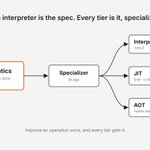
Most engines write a + b three times 1) interpreter 2) baseline JIT 3) optimizing JIT.
Quench writes it once, as a Rust row generic over a Stage.
Concrete stage is the only interpreter.
Stencils are copy-and-patch JIT.
Emiting Cranelift IR for the optimizing JIT and AOT

72
An interpreter can be fast and small.
Quench, our Rust JS engine, with JIT off shows raytrace 2.14x, crypto 2.06x, richards 1.80x the score of the best of Node --jitless and Bun JIT-off,
in 6-8 MB of RSS where Node needs 43-50.
Three JIT tiers and AOT build on the same semantics

1
124

In Quench trying to put only two levels of JIT, Basic (copy and patch stencils, modern approach) and Ultra (giving Cranelift a try). While classical engines (JSC, V8) are having 3 levels, hope it will help to win it over.
Some example where it nailed efficiency comparing to C twin, not proven yet, that it can deliver same for all critical paths

1
71
“Find gaps to the vision, spawn swarm of sub-agents and deliver it right now”
My favorite prompt lately, since agents can postpone big changes forever
42

I see certain lag in AI usage spreading, started to receive .html files recently from people instead of PDF or Google Sheets
44
I turned the JIT off in every engine and ran the classic V8 benchmarks.
Quench’s interpreter came out ahead of Node, Bun and QuickJS on all 8. Between 1.2x and 1.7x the best of them.
It’s written in Rust. Here’s how it holds up on harder tests 🧵

1
86
Test by test it’s uneven, and we publish both sides.
Up to 3.5x the best other interpreter on numeric and emulator code. Down to 0.23x on startup-heavy and proxy-heavy code.
That’s what I'm fixing now.

1
47
Why care about an interpreter? Serverless cold starts, short-lived CLIs, locked-down platforms, small containers.
Every number here has a write-up with method and caveats: quench.run/blog
Code: github.com/butaji/quench

37
Ask your agent
Analyze all work threads, identify improvements, break them into principles, and build a foundational system to solve them, with a complete implementation plan and tasks distributed across work threads
58
When orchestrator is just resending my "wtf" to the agents I don't feel like its doing its job properly
59
