










Satish retweeted

Here's the protected swing model: how to find it, which asset to trade, where your stop goes, and when you get out ↓
1. What a crack is
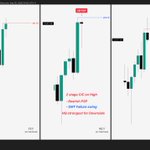
An SMT or a PSP between correlated assets.
• 1 crack = a signal
• 2 cracks on the 30m, 1h or 4h = a protected swing
2. Example: gold vs silver, 30m
• Gold makes a lower high, silver makes a higher high → SMT
• Same candle: gold closes bearish, silver closes bullish → PSP
Two cracks, one swing.
SMT first? The PSP is confirming the SMT.
PSP first? The SMT is confirming the PSP.
3. What it tells you
Price shouldn't trade back through that swing in ANY asset. It's your true invalidation. Your bias points away from it, toward the draw.
4. It's a map, not an entry
Enter:
• right after it
• on a 15m SMT fill
• on a gap fill sequence
• on a CISD
• deep in discount on a single PSP
Keep your stop near the protected swing.
5. Which asset?
The one whose cracks support the direction. Price characteristics first, the draw second.
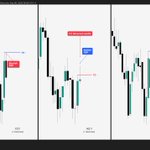
NQ vs YM on the 1h: NQ printed the bearish SMT + PSP at 04:00 London. YM had the previous day low closer, but NQ had both cracks, so NQ was the trade.
• Stop on the hourly high ≈ 1:3 into the PDL
• Stop at the swing ≈ 1:1
Both are valid.
6. When it isn't clean: the tally
1 point each:
• SMT in your direction
• PSP in your direction
• previous trend
• proximity to the draw (closest asset only)
• premium / discount
NQ scores 4 → leader. ES scores 2 → backup. No factor outranks another. You just count.
7. Management
Alert the swing in every asset. The weakest usually breaks it first. The moment ANY asset breaks it, the narrative is broken → breakeven or out.
8. One more rule
Swing pointing against a big daily candle? You're swimming against the current. Take a mechanical 1:2 and get out.
The 5 steps:
1. Find 2 cracks (30m, 1h or 4h)
2. Mark the protected swing
3. Pick the asset with the tally
4. Enter toward the draw, stop near the swing
5. Alert every asset, abort if any breaks it
Full breakdown in the video ↓ Bookmark it for your next session.
Educational content, not financial advice.
Satish retweeted
Stop buying the laggard early. You need 1 or 2 cracks first.
Most traders buy YM the second NQ takes the high, and get chopped. Here's the exact catch-up model, and how many cracks you wait for ↓
1. Start with the draw
The previous day high (PDH). Mark yesterday's high and low on NQ, ES and YM. Each asset gets its own range: PDL → PDH.
2. Find the leader
The leader reaches the draw first. In the example, NQ takes its PDH while YM is still trading below its own.
3. Watch the leader at the high
In a catch-up, NQ holds there and you'll see weakness:
• a bearish PSP or a bearish SMT
• no displacement
Quick displacement or a V-shape away from the high? That's a reversal. Don't call it a catch-up.
4. Now the laggard cracks
• SMT: NQ makes a lower low, YM holds a higher low
• PSP: one candle, NQ closes bearish, YM closes bullish
Each one is a crack in correlation. An SMT and a PSP on consecutive candles, in either order, is a two-stage.
5. The part most traders skip
Where's the laggard sitting in its own range?
• Discount (below 50%): far from its high → wait for 2 cracks
• Premium (above 50%): high is close → 1 crack is enough
• Exactly 50%: rare → take the two-stage
6. Timeframe
You only count cracks on the 30m or higher: 30m, 1h, 90m, 4h, 6h. A 5m crack doesn't count.
7. Target
Your target is the laggard's own PDH.
The bearish version is the exact mirror: the leader takes the PDL, the laggard prints bearish cracks (2 in premium, 1 in discount) and targets its own PDL.
3 mistakes that cost the most:
✗ Buying a discount laggard on 1 crack
✗ Counting a 5m crack
✗ Calling it a catch-up after the leader displaced
Full breakdown in the video ↓
Bookmark this for your next session. Case 2, the protected swing, is next.
Educational content, not financial advice.


Satish retweeted
5-step framework for finding high-probability entries:
Key Level → FVG, IRL, ERL or swing liquidity
Swing Confirmation → C2 / C3 structure
Invalidation → Know exactly when the idea is wrong
Gap Refinement → Refine the FVG for the entry
SMT Confirmation → Validate the higher-timeframe intention
The goal isn’t to predict every move.
It’s to build a repeatable process where every trade has a location, confirmation and invalidation.
Comment “FRAMEWORK” + repost if you want the full breakdown. ♻️

Satish retweeted

Struggled to understand:
• What a crack in correlation really is
• How to use PSP and SMT properly
• Why do they work the way they do?
It's a research-grade guide that explains all of it. Publishing soon on X.
Liquidity Dispersal Theory: 22 pages
For early access:
➡️ Repost this 📬
➡️ Follow me 🤝
➡️ Comment - "LDT" ✍️💬
and I'll DM you the article 📮


Satish retweeted
Ritrade is now officially partnered with @BlueGuardiancom, the firm powering the First Ladder Program.
If you want to trade the similar or same evaluation alongside me while the program runs, use code RITRADE at checkout for the maximum discount on your account.
Same firm, same rules, same conditions; I will be trading live on stream. Every constraint I work around is a constraint you are working around too, which makes the walkthrough a lot more useful than watching someone trade an account you do not have.
Code: RITRADE
LINK: blueguardian.com/?afmc=Ritra…


Invalidations
- Opposing setup forms, price manipulated the PWH & formed a reversal off the high
- Invalidations of EQ
@TTrades_edu


