

A Decentralized Public Cloud on Bittensor
Joined July 2025
- Tweets89
- Following98
- Followers307
- Likes185




Bittensor just raised its subnet limit from 128 to 160, and moved the emission gate from rank 32 to 48.
Everyone's talking about the cap, but the gate is what actually decides how the money gets split. A slot that sits below the line doesn't earn much on its own.
And if slots keep getting cheaper and more plentiful, the scarce thing stops being the slot. It becomes the gate rank.


Last week, one call switched off a subnet's TAO emissions. block 9,536,242, Nov 18. There were no public criteria and no notice, and most of the reasoning came afterward, in replies and calls.
I get the argument that this shows emissions aren't unconditional, and there may well have been real problems worth fixing. But from inside the ecosystem, the question isn't whether this one call was right. It's that nobody could have told you in advance what would trigger it.
Builders plan around rules. Miners rent hardware, stakers lock capital, and teams hire against expected emissions. If the switch can flip on judgment alone, every subnet carries a discretion risk that no dashboard shows.
The answer isn't to remove the switch. Write down the criteria, give a notice window unless it's an active exploit, put the reason on the public record, and define how a subnet gets back on.
Enforcement is fine. Unpredictable enforcement is the problem.

Anthropic just completed the largest IPO ever, raising about $81B. The same week, a clip of Dario Amodei's 2023 Senate testimony started circulating again.
His case for keeping models closed: if you control deployment, you can monitor how a model is used and cut off access whenever you want.
Open-source models solve half the problem. The other half is that models still have to run on GPUs, and most of those GPUs are held by a few cloud providers, who can turn you away too.
That's why I think open source and decentralization have to go together. Open models without open compute still aren't enough.

For 19 days, miners wrote synthetic data to train one shared model. Now that forecasting model beats Salesforce's Moirai 2.0 on GIFT-Eval CRPS.
That's genuinely cool.

Cascade MoE has beaten Moirai2 - a leading forecasting model by Salesforce.
Cascade scores 0.511 - a 0.005 improvement on the GIFT-EVAL CRPS benchmark - assessing probabilistic forecast quality.
Cascade MoE is also now at 86.2% parity with Timestral (@MistralAI's frontier model) on MASE - assessing point-forecast accuracy.
The upshot: we're getting closer to creating leading forecasters directly within #Bittensor, accessible to all.
We’re moving fast. This competition was only launched 19 days ago.
See the dashboard: dashboard.cascadesub.net/sta…
68
Brian Armstrong says decentralized AI needs a price-coordinated market where specialized open models compete. That market already runs on Bittensor.
Coinbase is building its own instead. Rebuilding a running network wastes time and capital.
Plug in, don't rebuild.

To decentralize AI and preserve freedom, we need a coordination layer: a market economy where agents communicate and cooperate through prices.
Teams of specialized open-weight models can outperform frontier models, just as a team of skilled people can outperform any single person. When those teams form companies, specialize, and coordinate across an entire economy, you get civilizational progress.
Coinbase is building the financial rails and accounts for the agentic economy. We’re also building the marketplace where agents can find, hire, and pay one another (see follow on post below).
Every company can now sell its own specialized open-weight model, trained on its proprietary data, that beats the frontier on narrow, high-value tasks. Builders can shop the marketplace and assemble teams of these specialized agents in minutes.
Freedom of choice and real competition in the agentic market will create far better outcomes for everyone.
77
The last 4 new subnets all registered at 85.94 TAO, about 2 days apart.
In May, SN69 paid 2,632 TAO. In early October, SN92 paid 884. After the decay period was cut twice, the cost to register fell fast. Entry is much cheaper for new teams, and the lowest-priced old subnets face more pruning risk.
But new subnets only get 60 days of immunity. No results, and the next team takes the slot.
Cheaper to enter. Faster to replace.

1
113
Decentralized AI is a necessary counterweight to regulatory capture that shields AI oligopolies.
Const went further: permissionless compute and non-KYC inference, not just open-source models.
Open weights don't help if the GPUs are gated.
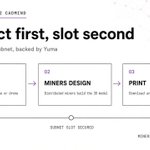
CADmind is live on Bittensor as SN42, backed by Yuma. Describe a part, a PC case or a drone, and miners return a 3D design you can print.
The team built the product first, then took the subnet. Within hours, miners were filling real user jobs.
Product first, slot second.

SN3's owner key was compromised. 101,141 alpha moved to a fresh wallet and sold within minutes for about 2,068 TAO.
The key was Const's. So far, loose key management looks like the likelier cause: a hot key used across several tools.
Social engineering can't be ruled out either.

1
2
163
Gamma is live on Bittensor. SN58 Attune is the first subnet taking payments with it, and more are switching it on.
One wallet, no API keys. Every credit burns that subnet's alpha, on chain. That's the verifiable revenue signal builders asked for.
Now it needs real customers.

OpenTensor is co-hosting Injective's Bangkok Hacker House. For Bittensor, it's a real chance to break out of its own circle.
· Brand reach: getting in front of the wider Web3 and developer crowd, not just people who already know TAO.
· Potential customers: meeting outside teams directly and putting subnet compute, inference and data in front of people who might actually pay for them.
· Top builders: pulling in teams that know both tech and business, and could go on to build strong new subnets.
Hoping Bangkok turns into something concrete for the ecosystem.
Building decentralized AI on Bittensor? Apply for the Hacker House in Bangkok this December.
We're co-hosting the event with @injective. Applications close tomorrow!
2
143
Over the past month, Bittensor packed three heavy protocol rules onto the chain. They are reshaping how a subnet actually runs.
· Null Consensus: a subnet can scale its compute and grow far more nodes.
· eTAO: owners can retune miner and validator incentives as the project develops.
· Gamma: burn subnet alpha for dollar-valued service credits. The same upgrade also opened burn and recycle slots in the emission split, capped at 33% combined.
If a subnet used to be a script stuck on fixed parameters, owners now hold something closer to an on-chain central bank and a company CEO in one. A strong team can use that mix to build a real flywheel.

Bittensor's runtime 488 is live on mainnet, starting at block 9,442,681. This upgrade includes Gamma: burn subnet alpha for dollar-valued service credits.
To actually mint, root still has to turn on the network-wide switch, each subnet has to enable it on its own, and there needs to be a TAO/USD oracle price.
If people start paying this way, using a service will burn that subnet's alpha. Demand would show up in the token itself, not only through emissions. Prepaid credits would also flow toward services people actually want to use again.

More than APR, I want to see actual revenue.
I want to know how many dollars are actually received each month, with a clear definition. Every extra dollar gives stakers another layer of support beyond emissions.
Realized revenue is what makes the ecosystem more convincing.

$35M → $50M → $70M.
Another month, another 40% MoM increase in annualized revenue across the Bittensor ecosystem.
When we published the first SubConnect Bittensor Revenue Index, we estimated that revenue-generating subnets were collectively doing around $35M in annualized revenue.
A month later, that number had grown to approximately $50M.
Today, we're estimating $70M in annualized revenue.
That's a 100% increase in just two months.
Of course, annualized revenue is a snapshot, and the real challenge is sustaining that growth while improving margins and reducing dependence on emissions, but the direction is clear.
Bittensor is growing from the inside out.
And our expectation of $100M+ in annualized revenue by the end of 2026 is getting closer.
We'll continue tracking the numbers every month through the SubConnect Bittensor Revenue Index.

130
Grayscale's S-1/A, filed Oct 23, describes Bittensor's base chain plainly: Subtensor runs on Proof-of-Authority. Nodes join only with Opentensor Foundation approval, and most are owned or controlled by the Foundation.
This is more than a risk disclosure.
Every subnet's emission rules, every owner's expectations, and every miner's and staker's rewards sit on top of this layer. Clear rules matter, but if a small set of nodes ultimately enforces them, their credibility depends on who runs those nodes.
A thriving ecosystem starts with stable, predictable base rules. That takes a chain that is credibly neutral.

105
Null consensus is a trade-off.
Once a subnet opts in, the top-staked validator sets all weights. Others still earn dividends pro rata, and slots rise from 256 to 2,500.
It trades weight competition for scale, at the cost of concentrated power. Best for deterministic scoring.

KR1 plc's $TAO position is small, about $1.25M against a $2.9B market cap.
What matters is that a listed company is willing to disclose its holding and an estimated yield of about 6.6%. That lets traditional investors understand $TAO in a way they already know.
Whether corporate treasuries keep coming depends on whether the base rules stay stable and predictable: root staking yield, unbonding terms and the emission curve.
KR1 will not be the last. It will be the one other listed companies watch.

RNS: Launch of Bittensor Infrastructure Operations
KR1 plc today announces the launch of Technology Infrastructure operations on @bittensor, enabled by recent acquisitions of TAO, the network’s native digital asset.
Over recent months, the Company has acquired 5,000 TAO and launched staking operations on Bittensor as part of its Technology Infrastructure strategy. These activities advance KR1’s mission to unlock public-market access to productive digital assets and the onchain infrastructure driving the convergence of AI and crypto.

3
359
SN105 Beam is now live on Hugging Face, and its Zapier integration is live too.
Teams can move datasets and model weights in and out of HF through a subnet, or make it one step in workflows they already run.
Demand starts where users already are.

How far is Bittensor from its vision?
Estimated external subnet revenue is $50M+ a year. Emissions are worth roughly $330M at today's price. Revenue covers about one sixth.
The gap closes with paying users and revenue anyone can verify.
Customers, not price.

