
19 | deep into AI & Quant since 2021
Joined March 2016
- Tweets819
- Following198
- Followers333
- Likes3.1K


Igor Babuschkin (ex-xAI Research & Engineering) helped build Grok from zero.
I turned Grok Bot’s persistent-agent architecture into a 7-layer harness built to make long jobs end with an artifact, evidence, and a restart point.
It's f*cking unreal...
send it to Grok Bot, and thank me later. Then save the full harness below.


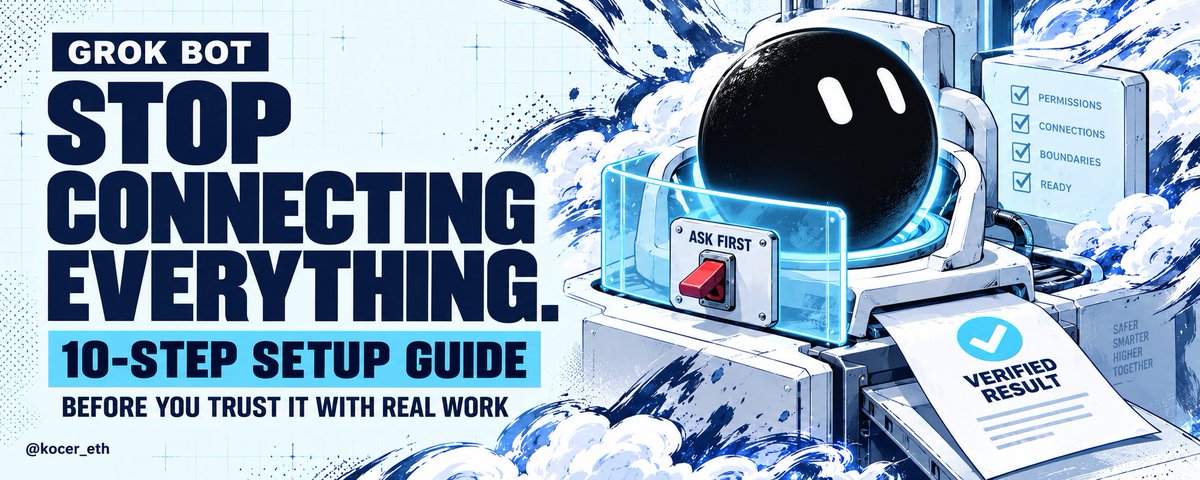
How to build the full Grok Bot setup for real work (every step, every check)
i don't count "it can open my apps" as a finished setup.
› Grok Bot gets one job. you define the result, limit access, and check the evidence.
here's the full setup map:
📁 grok-bot-setup
┃
┣ 📁 01. installation
┃ ┣ 📁 /official-download
┃ ┣ 📁 /confirm-account-access
┃ ┗ 📁 /review-data-settings
┃
┣ 📁 02. bot role
┃ ┣ 📁 /one-primary-job
┃ ┣ 📁 /clear-description
┃ ┗ 📁 /defined-deliverable
┃
┣ 📁 03. approval rules
┃ ┣ 📁 /draft-is-not-send
┃ ┣ 📁 /ask-before-buying-or-deleting
┃ ┗ 📁 /review-app-approval-controls
┃
┣ 📁 04. working context
┃ ┣ 📁 /goal-and-experience
┃ ┣ 📁 /constraints-and-priorities
┃ ┗ 📁 /non-negotiable-requirements
┃
┣ 📁 05. minimum access
┃ ┣ 📁 /public-sources-first
┃ ┣ 📁 /only-necessary-connections
┃ ┗ 📁 /verify-with-a-read-only-check
┃
┣ 📁 06. output format
┃ ┣ 📁 /recommendation-and-comparison
┃ ┣ 📁 /sources-dates-and-unknowns
┃ ┗ 📁 /approve-one-sample-row
┃
┣ 📁 07. first task
┃ ┣ 📁 /compare-three-options
┃ ┣ 📁 /use-the-same-criteria
┃ ┗ 📁 /deliver-then-stop-for-review
┃
┣ 📁 08. verification
┃ ┣ 📁 /open-the-supporting-sources
┃ ┣ 📁 /find-the-earliest-failed-step
┃ ┗ 📁 /fix-that-step-not-the-personality
┃
┣ 📁 09. lasting preferences
┃ ┣ 📁 /keep-approved-output-preferences
┃ ┣ 📁 /exclude-temporary-facts
┃ ┗ 📁 /confirm-what-was-saved
┃
┗ 📁 10. reusable skill
┣ 📁 /save-inputs-steps-and-output
┣ 📁 /include-failure-and-approval-rules
┗ 📁 /test-with-a-different-input
10 steps. one focused bot. two checked tasks. no coding required.
Grok Bot does the work. you decide what it can touch and what counts as done.
JEV + Grok Bot... i can't understand why everyone isn't wiring this up yet
Grok Bot can browse, read files, run commands, and keep working in the background.
JEV adds the decision layer before the agent burns time and context on the wrong path.
what JEV handles:
-> scores which sources deserve to enter the context
-> chooses act, skip, ask, or defer from options Grok Bot already prepared
-> selects the next recovery path when a tool or website fails
-> rejects weak candidates before Grok Bot spends another full turn investigating them
what Grok Bot handles:
-> searches websites, repositories, documents, and connected apps
-> executes the selected workflow inside its browser, filesystem, and terminal
-> returns the result with sources, timestamps, and an action log
-> parks sending, publishing, deleting, purchasing, and production changes for your approval
Grok Bot does the work. JEV decides which work deserves the next step.
the agent stops wasting full-context reasoning on every minor choice.
the execution layer stays autonomous. the decision boundary stays inspectable.
you're wasting time correcting full Grok Bot reports. use this 4-part brief to approve one sample before the real work.
the setup guide has a simple fix: approve one sample before the full task.
paste this into Grok Bot and replace the brackets:
1. outcome › [the decision this report should help me make]
2. sources › [approved links, files or attachments]. flag missing information instead of guessing.
3. format › [table, document or draft]. include [required fields] and keep it within [length].
4. review point › show one sample, then wait for approval. do not send, publish or overwrite anything.
use the actual sources for the sample, not invented placeholder facts.
for a comparison, return one completed row. for a report or draft, return one representative section.
include the evidence behind factual claims. mark anything you could not verify.
if a missing detail would change the result, ask before proceeding.
after approval, apply the agreed format to the remaining work.
check the sample's sources too. approving the layout does not verify its claims.
keep this brief for your next report, comparison or draft. the full 10-step setup is in the quoted article.
cesar retweeted

Sam Altman’s face when his $20 GPT-6 Astra absorbs the instincts of 167 elite memecoin traders. Their edge is now one live AI radar anyone can use for free.

I used GPT-6 Astra to score every Pons V2 token and wallet on Robinhood Chain straight from public logs.
741,643 indexed events on one token alone. 29 attributed curve participants, 93/100 score, HIGH CONFIDENCE.
It's live and it's free: meerkat.my
No private key. No signer. No transaction path. It reads the chain, it can't touch it.
Another token resumed a killed indexing job from a 64-block overlap and still closed clean at 41,302 persisted events. Every point on every score traces back to a block and a log index.
Most token scores hand you a number and ask you to trust it. Trust the model, trust the wallet they didn't disclose, trust that "verified" means what they say it means. You can't click through any of it.
MEERKAT doesn't ask for that trust:
→ SCORE is GPT-6 Astra. Breaks a token 0-100 across five components: deployer exposure, creator tax, participant breadth, two-sided market, current holder breadth. Every component opens into the blocks behind it.
→ WALLET SCORE is GPT-6 Astra. Reads token scope, early discovery, two-sided activity, evidence depth. Confidence drops on its own when the local index is thin, it doesn't fake certainty.
→ FEE FLOW follows creator revenue to its current recipient. HOP OUT paid 1.177 ETH across 26 sweep events, split curve and pool, and the recipient doesn't match the deployer. Labeled ROUTED AT LAUNCH, not hidden.
→ RELATIONSHIPS maps attributed wallets around a token and keeps pool callers explicitly separate from real participants.
→ TIMELINE pages 50 events at a time, colors BUY green and SELL red, links every row to its transaction.
→ Two hard rules run under all of it: early entry is a curve buy within 30 blocks of launch, fast exit is a sell within 300 blocks of that wallet's first buy. The rule is shown, not just the label.
FLYBRAIN ran 27x this week. Eight trusted wallets were in by 20:18, the alert fired at 20:18, and the pool didn't even open until 20:51. Most people saw the chart after it already moved.
I caught 18x of that run, and it wasn't a lucky entry. It was because my own system was already reading the wallet flow before the pool opened, not after. By the time the crowd was refreshing charts, I already had a position.
No signer means MEERKAT can't push a trade for me any more than it can for you. It reads chain state. It never holds a key.
Landing page, terminal, APIs, indexer, database, all one local Node process. Open source, self-hostable, same code running the public terminal you can open right now.
Next: global wallet discovery across the whole chain, then Pons market context sitting right next to the score.
We're reading evidence anyone could open. Most people just never open the dossier.
cesar retweeted
I used GPT-6 Astra to score every Pons V2 token and wallet on Robinhood Chain straight from public logs.
741,643 indexed events on one token alone. 29 attributed curve participants, 93/100 score, HIGH CONFIDENCE.
It's live and it's free: meerkat.my
No private key. No signer. No transaction path. It reads the chain, it can't touch it.
Another token resumed a killed indexing job from a 64-block overlap and still closed clean at 41,302 persisted events. Every point on every score traces back to a block and a log index.
Most token scores hand you a number and ask you to trust it. Trust the model, trust the wallet they didn't disclose, trust that "verified" means what they say it means. You can't click through any of it.
MEERKAT doesn't ask for that trust:
→ SCORE is GPT-6 Astra. Breaks a token 0-100 across five components: deployer exposure, creator tax, participant breadth, two-sided market, current holder breadth. Every component opens into the blocks behind it.
→ WALLET SCORE is GPT-6 Astra. Reads token scope, early discovery, two-sided activity, evidence depth. Confidence drops on its own when the local index is thin, it doesn't fake certainty.
→ FEE FLOW follows creator revenue to its current recipient. HOP OUT paid 1.177 ETH across 26 sweep events, split curve and pool, and the recipient doesn't match the deployer. Labeled ROUTED AT LAUNCH, not hidden.
→ RELATIONSHIPS maps attributed wallets around a token and keeps pool callers explicitly separate from real participants.
→ TIMELINE pages 50 events at a time, colors BUY green and SELL red, links every row to its transaction.
→ Two hard rules run under all of it: early entry is a curve buy within 30 blocks of launch, fast exit is a sell within 300 blocks of that wallet's first buy. The rule is shown, not just the label.
FLYBRAIN ran 27x this week. Eight trusted wallets were in by 20:18, the alert fired at 20:18, and the pool didn't even open until 20:51. Most people saw the chart after it already moved.
I caught 18x of that run, and it wasn't a lucky entry. It was because my own system was already reading the wallet flow before the pool opened, not after. By the time the crowd was refreshing charts, I already had a position.
No signer means MEERKAT can't push a trade for me any more than it can for you. It reads chain state. It never holds a key.
Landing page, terminal, APIs, indexer, database, all one local Node process. Open source, self-hostable, same code running the public terminal you can open right now.
Next: global wallet discovery across the whole chain, then Pons market context sitting right next to the score.
We're reading evidence anyone could open. Most people just never open the dossier.
Elon Musk realizing a $300 Grok Bot running just 5 methods can pull $10,000 a month while the guy who built it dropped every prompt on X for free
I used GPT-6 Astra to score every Pons V2 token and wallet on Robinhood Chain straight from public logs.
741,643 indexed events on one token alone. 29 attributed curve participants, 93/100 score, HIGH CONFIDENCE.
It's live and it's free: meerkat.my
No private key. No signer. No transaction path. It reads the chain, it can't touch it.
Another token resumed a killed indexing job from a 64-block overlap and still closed clean at 41,302 persisted events. Every point on every score traces back to a block and a log index.
Most token scores hand you a number and ask you to trust it. Trust the model, trust the wallet they didn't disclose, trust that "verified" means what they say it means. You can't click through any of it.
MEERKAT doesn't ask for that trust:
→ SCORE is GPT-6 Astra. Breaks a token 0-100 across five components: deployer exposure, creator tax, participant breadth, two-sided market, current holder breadth. Every component opens into the blocks behind it.
→ WALLET SCORE is GPT-6 Astra. Reads token scope, early discovery, two-sided activity, evidence depth. Confidence drops on its own when the local index is thin, it doesn't fake certainty.
→ FEE FLOW follows creator revenue to its current recipient. HOP OUT paid 1.177 ETH across 26 sweep events, split curve and pool, and the recipient doesn't match the deployer. Labeled ROUTED AT LAUNCH, not hidden.
→ RELATIONSHIPS maps attributed wallets around a token and keeps pool callers explicitly separate from real participants.
→ TIMELINE pages 50 events at a time, colors BUY green and SELL red, links every row to its transaction.
→ Two hard rules run under all of it: early entry is a curve buy within 30 blocks of launch, fast exit is a sell within 300 blocks of that wallet's first buy. The rule is shown, not just the label.
FLYBRAIN ran 27x this week. Eight trusted wallets were in by 20:18, the alert fired at 20:18, and the pool didn't even open until 20:51. Most people saw the chart after it already moved.
I caught 18x of that run, and it wasn't a lucky entry. It was because my own system was already reading the wallet flow before the pool opened, not after. By the time the crowd was refreshing charts, I already had a position.
No signer means MEERKAT can't push a trade for me any more than it can for you. It reads chain state. It never holds a key.
Landing page, terminal, APIs, indexer, database, all one local Node process. Open source, self-hostable, same code running the public terminal you can open right now.
Next: global wallet discovery across the whole chain, then Pons market context sitting right next to the score.
We're reading evidence anyone could open. Most people just never open the dossier.
YOU WILL WRITE THE SAME NOTE FOR THE THIRD TIME TOMORROW AND STILL NOT TURN IT INTO A WORKFLOW. THE 4-LINE RULE AT THE BOTTOM OF THIS ARTICLE IS THE ONLY REASON MY VAULT STOPPED GROWING WITHOUT WORKING.
i ran a search across my vault last month for one idea i had been thinking about all year.
five notes came back. same idea. five different filenames. all written like i was seeing it for the first time.
that was the day i copied four lines out of this article and pinned them at the top of my inbox folder.
the rule reads:
» once: matters once, write it down. a line in today's note, nothing more.
» twice: matters twice, turn it into a note. give it a title the future you can search for.
» three: matters three times, turn it into a workflow. the steps, not the story.
» decision: affects a future call, put it in a decision log. no chat reopens it.
i thought the rule was about tidiness. it is not. it is about state.
once tells you the thing exists. twice tells you it repeats. three tells you it is a pattern. a decision tells you the question is closed.
three weeks in, the vault stopped growing sideways. i still write as much as before. i just write it in the right of the four places, and the vault does the counting for me.
the ideas i used to lose to duplicates now compound. every fourth line i write is a decision that never reopens. every workflow i save gets called by the next thought that hits its shape.
your vault is not slow because you write too little. it is slow because it does not know which line to put a thought on.
paste the four lines at the top of your inbox tonight. by friday the third time you almost re-write something, the rule will catch you first.

I MADE +52 SOL ON PUMP.FUN YESTERDAY WITHOUT TOUCHING A SINGLE BUY. FIVE GROK BOT OPERATORS DID EVERY TRADE. ONE RULEBOOK KEPT THEM FROM RUGGING ME.
opened the laptop at 7am. equity row read 482 SOL, up 52 from the day before. i had not opened it in 16 hours.
the fill tape told the rest. 82 mints per minute scanned. 45 buys, 45 sells, 60% win rate. 359 rugs dodged. human input: none.
there is one Chief on the desk. i pasted his charter into Bot actions before the first buy. one page: name, reports to, what he owns, and the verbs he must park for me (buy, sell, sign, spend).
then i pasted ten one-line rules he signed as a shared skill called house_rules. rule 1 was the whole reason last night worked: if i cannot undo it in a minute, i park it.
Chief drafted the five operators over the next two weeks, each inheriting house_rules on line 1:
#1 SCOUT. reads the pump.fun mint feed at 82 per minute, tags the ones with volume.
#2 RUGCHECK. checks the contract authority. if the dev still holds mint, no buy fires.
#3 VETO. runs rule 1 on every proposed buy. non-reversible pass = park and move on.
#4 SOCIAL. watches social heat. below threshold, position is closed at market.
#5 RESUME. holds position state, exits on profit target or trailing stop.
Chief coordinates. every buy passes SCOUT → RUGCHECK → VETO before it hits the tape. every sell passes RESUME → SOCIAL. no operator approves an irreversible action alone.
that is the whole setup. no genius model. no secret indicator. one Chief, five operators, ten one-line rules, applied to a market where the rug is the default outcome.
paste the charter and rule 1 first. add the operators after Chief has parked his first non-reversible buy for you.

HOLY SH*T. ONE RULE FROM THE GROK BOT CHIEF CHARTER JUST FIXED MY CLAUDE CODE, CURSOR, AND CHATGPT PROJECTS. THREE LINES. UNIVERSAL AGENT HYGIENE.
Rule 4 says receipts on every finished job. deliverable, source list, and anything the model had to guess at listed separately.
models hedge into hallucination when the format lets them. force three sections in the reply and the hedge has nowhere to hide.
ask → agent runs → deliverable + sources + guesses separated → you spot the invention before you ship it.
i pasted this into three Claude Code sessions this week. every one returned cleaner outputs by the second turn.
the sources block caught two references to files that did not exist. the guesses block flagged a config assumption i would have shipped straight to production.
this is not prompt engineering. it is output shape.
agent hygiene is a paste, not a training run.
paste it as a system instruction, a project rule, or a repo-level AGENTS.md line. same three sections. same effect across every model that produces text.
cesar retweeted
ONE OF THE EMPLOYEES IS OBSIDIAN WROTE THIS OBSIDIAN GUIDE 8 WEEKS AGO. 542,000 PEOPLE READ IT. HERE ARE 3 FILES I WOULD DELETE TODAY AND THE ONE FILE I DID NOT KNOW I NEEDED.
i have been running my own guide for 60 days.
3 folders never got opened after week two. one folder became the single most important file in the vault.
04_people and 05_workflows stayed empty. 08_outputs became a stack of drafts i never opened.
the daily log worked for a week and then i started skipping days.
then i looked at my own git log. 90% of my Claude sessions touched three files. the other twenty pointed at nothing.
the cleanup that saved the vault:
→ deleted 04_people. Claude never had context to fill it. the two people who mattered moved into 03_decisions.
→ deleted 05_workflows. workflows drifted every 2 weeks. what actually held was writing the workflow inline in the file that used it.
→ deleted 08_outputs. drafts live in the tool where they get published. Obsidian was just holding stale copies.
→ added _index/routing.md, the one file i missed in june. it is a one-line description per folder written for the agent, kept current.
the vault went from 400 files across 10 folders to 180 across 5. context lookups are 3x faster.
i also swapped 07_daily for a state.md Claude reads first every session. i stopped opening Obsidian daily to feel productive.
the june architecture was right in principle. it was wrong about how much structure the AI actually needs. less scaffolding, better routing.
steal the routing file pattern before your next Claude session.
cesar retweeted
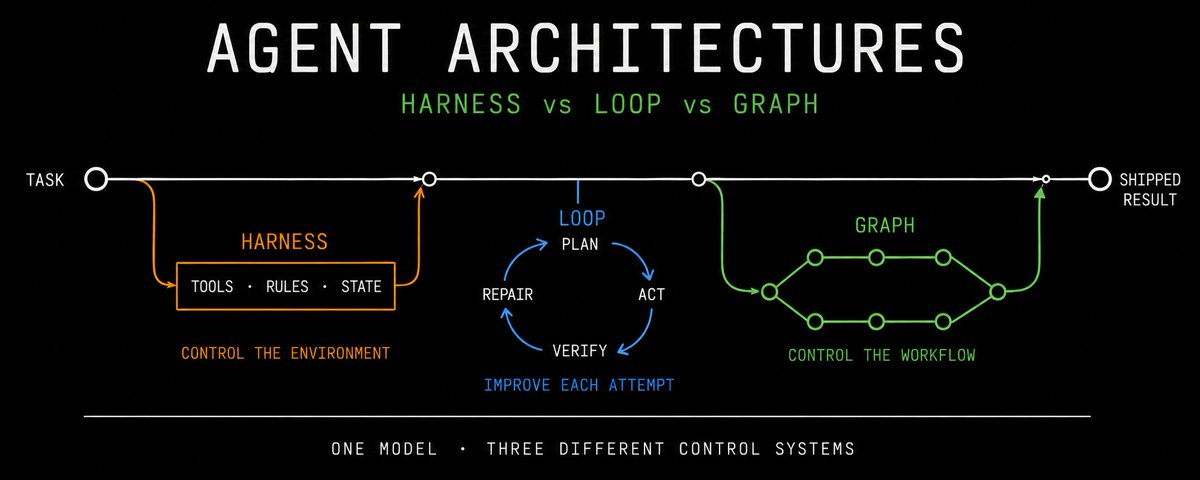
YOUR AGENT LOOP IS NOT A GRAPH. YOUR GRAPH IS NOT A HARNESS. SHIPPING THE WRONG ONE COSTS YOU A WEEK BEFORE YOU NOTICE.
three architectures. three different failure classes. building the wrong one is why your agent "sometimes works."
harness is the environment around one model. it decides which tools exist, what counts as done, what to log, when to escalate.
workspace → tool contract → permissions → verifier → artifact.
loop is the model getting consequences. it turns "here is a suggestion" into "here is an action that failed the test, now repair the relevant part."
plan → act → observe → verify → repair or stop.
graph is the workflow made visible. it is not more agents. it is explicit states, branches, approvals, and durable memory across restarts.
classify → route → durable state → approvals → resume.
for a month i believed a bigger prompt was the same as an agent loop. it is not. the loop is what makes the model face reality after every attempt. without it you are just refining a suggestion machine.
harness first. loop when you can measure success. graph only when the routes truly branch. skip a step and you get a very expensive chatbot that sometimes opens the right tab.
A REALISTIC FEMALE HUMANOID ROBOT CAN MAKE PEOPLE STOP BEFORE IT SPEAKS, BUT THE HOME TEST STARTS WITH ITS NEXT RESPONSE
The demo's skin, eyes, and facial detail make people stop before the robot speaks.
That first pause is the commercial test for humanoid companions.
A robot entering someone's room has to feel safe before it can feel useful.
Visual realism lowers the barrier to that first interaction.
But it also creates a harsher test for everything that follows.
A realistic face makes delayed replies feel stranger, not less noticeable.
It makes stiff movement harder to forgive.
It makes an empty gaze look like a broken promise.
The real product is not a convincing face at an exhibition.
It is whether voice, gaze, timing, memory, and movement stay believable at home.
That is the gap between a crowd-stopping humanoid and a companion people keep nearby.
Care, hospitality, education, and retail will depend on crossing that gap.
Visual realism gets the robot through the door.
Reliable behavior decides whether it gets invited back.
Bookmark this before you need the workflow. Follow for the next breakdown worth keeping.


CLAUDE CAN PRESS YOUR EXPERIENCE FOR A DEFINED BUYER, OUTCOME, DELIVERY METHOD, AND PRICE LOGIC BEFORE YOU BUILD THE OFFER
Most people try to invent a product before they can name the problem it solves.
Reverse that order.
Use Claude as an interviewer before you use it as a copywriter.
Give it one job: uncover the work you do so naturally that you rarely describe it.
Have it ask one question at a time about clients, projects, and repeatable wins.
Push past job titles until it finds the costly problem underneath your experience.
Then make it connect that problem to a buyer who already feels the urgency.
The goal is not a vague course, ebook, or bundle of prompts.
It is an offer with a defined buyer, outcome, delivery method, and price logic.
Make Claude challenge the weak parts before it turns the interview into an offer.
Who pays for this problem now?
What is different after the buyer gets the result?
What evidence makes a $1,000 price feel credible rather than arbitrary?
The reframe matters: Claude does not create your expertise or buyer demand.
It gives your experience a structure that is easier to test with real conversations.
Use the interview to find the offer.
Use buyer conversations to decide whether it deserves to be built.
Bookmark this before you need the workflow. Follow for the next breakdown worth keeping.


STOP MANUAL TAGGING OF 500 SUPPORT TICKETS. BUILD THIS 3-LAYER FEEDBACK COMPILER INSIDE OBSIDIAN.
support teams drown in customer feedback tickets, Discord bug reports, and endless Slack channels every week.
product managers spend hours copying snippets across spreadsheets without building a clear feature backlog.
i've tracked over 500 customer tickets across three product launches. manual tagging failed every time our user volume grew.
the bottleneck is simple: raw customer feedback is too messy for agents until you structure it into deterministic layers.
what works reliably is turning Obsidian into an automated customer feedback compiler:
1/ raw feedback inbox (00_inbox)
› dump unstructured user transcripts, support tickets, and feature requests directly into raw markdown files. › keep capture fast and frictionless without forcing support reps to clean or categorize text during the call.
2/ automated pattern clustering (02_projects)
› run local agent scripts to group similar customer pain points into modular feature clusters and bug trackers. › let Claude extract exact customer quotes and frequency counts into structured project briefs automatically.
3/ persistent decision logs (03_decisions)
› maintain a single routing index that maps customer pain points to approved product specs and roadmap priorities.
› product engineers query this index to verify user demand before writing a single line of backend code.
save this feedback architecture before triage starts on your next product release.
VOICEBOX CAN TURN SPOKEN NOTES INTO FIRST DRAFTS ON YOUR OWN DEVICE, THEN TURN APPROVED SCRIPTS INTO NARRATION
It turns spoken notes into text and creates speech without a voice subscription.
The useful shift is control, not another list of celebrity voice presets.
A local voice workflow keeps raw recordings closer to the machine where they begin.
That matters when calls, rough ideas, and client notes are not for a cloud app.
Use it to dictate first drafts, then turn approved scripts into narration.
Use your own voice, or get clear permission before cloning anyone else's.
The repo is reusable software, not a finished content business in a box.
You still need clean audio, a review step, and a reason for listeners to care.
Presets make the demo scrollable, but a consistent voice makes the work useful.
Open source lets you inspect the setup instead of trusting a black box.
If it fits your machine, Voicebox can remove a slow voice-production step.
Bookmark this before you need the workflow. Follow for the next breakdown worth keeping.


cesar retweeted
STOP TREATING YOUR OBSIDIAN VAULT AS AI MEMORY. WITHOUT ONE ROUTING FILE, CLAUDE IS BURNING TOKENS ON NOISE YOU FORGOT YOU SAVED.
a folder full of markdown does not make Claude smart. what makes it smart is what your agent can find without rereading the whole vault.
storage:
write → tag → graph → agent scans everything
the model touches the entire vault, hallucinates half of it, forgets by the next session.
memory:
write → index → route → agent opens two files
the model reads the index first, follows one path, answers with a link back to the note.
i have rebuilt my Obsidian vault three times this year. the first two collapsed inside a month because Claude kept guessing which folder to open. the third one holds because the first thing i ship now is the routing file.
Markdown, links, and the graph view are not what changed. what changed was a one-line description per folder, written for the agent, kept current, loaded before any retrieval call.
if your agent still starts every session by scanning your whole vault, you are running storage. write the routing file today.
CLAUDE CAN SCALE TO 1,000 PARALLEL AGENTS WHEN EACH WORKER OWNS ONE FILE AND A DEPENDENCY GRAPH EXPOSES SAFE CONCURRENCY
The video shows Claude splitting a repository map across parallel workers.
Each worker takes one file and traces its imports, callers, and tests.
That turns scattered agent output into a dependency graph.
The graph shows which changes can run together without touching the same surface.
It also flags the dangerous part: two agents editing one dependency at once.
More agents do not remove that conflict.
They can produce more conflicting edits before anyone notices.
A separate verifier watches the graph instead of repeating each worker's task.
It checks missing edges, bad assumptions, and edit collisions.
The verifier needs isolated context.
Give it the worker's reasoning, and it can approve the same mistake twice.
When the graph has no independent branches, stop forcing parallel work.
Run the task as a loop.
Parallel agents help only after the codebase has clean boundaries.
Bookmark this before you need the workflow. Follow for the next breakdown worth keeping.


CLAUDE CODE AND GRAPHIFYY CAN REPLACE GIANT CONTEXT DUMPS WITH A TARGETED QUERY ACROSS CONNECTED MARKDOWN NOTES
The demo uses graphifyy to turn local Markdown files into a connected graph.
Claude Code can retrieve the relevant notes when a task needs past context.
That changes the prompt from “here is my entire second brain” to a focused query.
Your project decisions, research, specs, and meeting notes stay in Obsidian.
The agent gets the few files and relationships that matter for the current task.
This is useful when a codebase has months of decisions scattered across Markdown.
It is also useful for recurring work where the same constraints keep returning.
The install shown in the video is: pip install graphifyy && graphify install.
Then point the tool at an Obsidian vault and let it build the local map.
The value is not “infinite memory.”
The value is retrieval that avoids stuffing every old note into every Claude Code session.
A graph cannot rescue vague notes, duplicate files, or missing links between decisions.
Write durable notes with clear names, dates, and project context first.
Then Claude Code has something useful to find instead of a larger pile of text.
Bookmark this before you need the workflow. Follow for the next breakdown worth keeping.

