
Where Independent minds collide
Prestonpans
Joined February 2009
- Tweets22.6K
- Following756
- Followers788
- Likes11K



Calum Miller retweeted
A gentle we ditty of mine:
“The birds may fall silent; the locals may moan. I’m saving the planet by wrecking our home!”
yesthink.scot/p/song-these-a…

A gentle we ditty of mine:
“The birds may fall silent; the locals may moan. I’m saving the planet by wrecking our home!”
yesthink.scot/p/song-these-a…
Calum Miller retweeted

Song: These Are My Mountains (And This Is My Dozer)
#YesThink
open.substack.com/pub/yesthi…

Calum Miller retweeted

If, by the way, the same situation that just happened in Brazil had happened but with the parties switched -- if Bolsonaro had won last night's election and then a pro-Bolsonaro judge sent the Federal Police to seize Lula's passport and bar him from leaving the country -- every major western media outlet and liberal NGOs would be screaming about the authoritarian attack on Brazil's elections and the destruction of basic freedoms.

Calum Miller retweeted

This is what worries me. About France and about the UK...
"No one can tell when, exactly, a crisis might arrive: it depends on the country and its politics. Yet once investors conclude that a country cannot conceivably afford to pay the debt, interest rates will surely start to jump, the mechanism through which practically every financial crisis plays out. We are in the phase where everybody still pretends that the situation is under control, and that all that needs to happen is for governments to save a bit of money here and there. In practice, though, ministers of all stripes find this hard"
And
"Looking at the presidential candidates in France today ahead of the election next April, I struggle to see how the country will end up with a government that succeeds in doing all of the following: bringing the budget deficit under control; avoiding social unrest; complying with European rules; and staying in the eurozone. Something has to give here."
And
"Yet what many Europeans, including politicians, don’t understand is the relationship between debt and membership of the eurozone. Put simply: you can’t default on your debt and expect to keep the euro. Debt serves as collateral for the money the banking system gets from the ECB. If a country defaults on its debt, the banking system inevitably freezes up....
... France defaulting on its debt would likely lead to a French exit from the euro. Should we ever get to this point, the ensuing financial crisis would dwarf everything we have ever experienced. Financial institutions would fail all over the world. For its part, the eurozone might not survive, as other countries default on their debts and crash out in turn. Ironically, one of the European countries most affected in this scenario would be the UK. Despite not being a member of the EU, let alone the eurozone, Britain’s capital market would be deeply vulnerable to chaos across the Channel."
Does anyone believe @UKLabour has the economic nous to navigate this when our own finances are so shaky?
unherd.com/2026/10/how-the-n…

Calum Miller retweeted

Net zero added £140.3bn to Britain's electricity bills in 2002–24: £2,286 for the average household. Modelled, in 2024 prices. Nobody official counts it. Parliament should require a yearly statement, with data anyone can check.
richardlyon.substack.com/p/n…
Calum Miller retweeted

New Yessay from @calummiller "Travel north through the beautiful Lake District and you soon arrive at a vast industrial estate that used to be known as the Scottish Borders."

Calum Miller retweeted

We now see the full extent of preplanning and empire-building that went into the United Nations' global warming campaign.
It was all behind the scenes. Today, the UN has a workforce of roughly 190,000 and an annual budget of $3.45 billion. It has become a vast self-managing, self perpetuating bureaucracy - arguably the largest non-governmental network in the world. The UN had been laying the groundwork for an environmental crisis for decades before it was finally announced in 1988.
The UN took control of the World Meteorological Organization in 1951, transforming it into a specialised UN agency. The WMO operates with an annual budget of approximately $138.7 million and has a staff of 350 to 400.
The WMO bridges the gap between raw meteorological data, international political agendas and global news media - linking thousands of land stations, ocean buoys, aircraft and satellites. While its stated role is to share critical weather and water data, this massive infrastructure has been effectively co-opted into a public relations framework.
Consequently, the world has been bombarded with weather hysteria for almost 40 years. Mainstream news outlets routinely prioritise speculative, worst-case climate models over empirical observations - like 'rain bombs' - maintaining a permanent state of crisis designed to shape public compliance.
The information gathering agency, the Intergovernmental Panel on Climate Change, runs the scientific arm. It operates with a core secretariat of just 15 staff members and an annual budget of roughly $12.5 million. The IPCC was established 38 years ago, ostensibly as a neutral body to gather objective scientific information on climate.
In reality, the IPCC became the driving force behind the greatest environmental and social upheaval in modern history. Highly politicised from its inception, it was founded entirely by UN agencies - the WMO and the UN Environment Programme. This gave the UN absolute control over the global climate agenda and funded what has become the largest propaganda campaign in history.
The UN has also run annual fund raising COP summits around the world for 30 years. They have become junkets for the rich and privileged.
The IPCC did not recruit independent scientific staff; instead, its administrative apparatus actively sponsors and selects studies that supported the carbon dioxide hypothesis. Research raising questions or doubts are minimised or discarded. Critics find their studies starved of funding and publishers, while some even faced threats to their academic tenures.
Local weather outlets and national agencies now operate inside an ecosystem heavily influenced by these overarching, high-alarm targets, broadcasting continuous warnings of 'global boiling', catastrophic sea-level rise, and 'Code Red for Humanity' - with UN leadership acting as the chief amplifier. This environment birthed foundational, highly charged studies designed to lock in future warming projections.
For decades, the UN promoted only extreme scenarios. A prime example is the IPCC's reliance on high-end warming trajectories - such as projections warning of up to a 5.5-degree temperature rise - predictions so extreme that even mainstream scientists have increasingly conceded they are implausible.
Armed with a crisis of its own making, the UN called for the rapid dismantling of hydrocarbon fuels - coal, oil, and natural gas - the very energy sources that lifted humanity out of stagnation and powered the Industrial Revolution. Almost every aspect of modern civilisation, from transport networks to industrial manufacturing, relies entirely on these dense, inexpensive and reliable energy sources.
Climate management bears no relation to the UN’s foundational charter of resolving international conflict; it's a textbook case of bureaucratic mission creep.
The sheer complexity of this UN machinery, combined with an aura of technical authority, is precisely what insulates it from public scrutiny.

Calum Miller retweeted
@neso_energy has issued an emergency instruction to the Camster windfarm in Scotland
All day NESO has been issuing warnings that it didn't have enough turndown capacity in Scotland so I guess they had to instruct capacity off regardless of the Bids and Offers in the BM


Calum Miller retweeted

The cheap green lie
You are told that solar and wind are cheap
But you need near-100% backup when no sun or wind, paying for two systems
Data for 2025 shows that
cramming in more solar and wind makes electricity overall more and more costly
Sources:
Electricity prices, households and industry, 2025
iea.org/data-and-statistics/…
Solar and wind generation, electricity use and consumption weights
iea.org/data-and-statistics/…
Solar and wind for countries without IEA 2025 data
ember-energy.org/data
Electricity trade partners, plus industry prices for Norway, Albania, Iceland and Kosovo
ec.europa.eu/eurostat/web/en…
US industry price
eia.gov/electricity/annual
Australia, IEA 2021 prices updated with official price indices
abs.gov.au/statistics/econom…
South Africa industry price
eskom.co.za/wp-content/uploa…
Taiwan industry tariff
taipower.com.tw
Egypt industry tariff
egyptera.org/en/TarrifAug202…
Tunisia tariffs (archived copy, the STEG site is unreachable)
web.archive.org/web/20250614…
Azerbaijan industry tariff
regulator.gov.az/en/istehlak…
2025 tariff changes applied to IEA 2024 prices
Pakistan: nepra.org.pk
Thailand: erc.or.th
Ghana: purc.com.gh
Paraguay: ande.gov.py
Kazakhstan: stat.gov.kz/en/industries/ec…
GlobalPetrolPrices 2025 averages for 18 countries, read from archived 2025 pages
globalpetrolprices.com/elect…
web.archive.org
Sri Lanka 2025 tariff changes
pucsl.gov.lk/end-user-tariff…
Indonesia solar and wind estimated from official 2025 capacity
esdm.go.id/id/media-center/a…
Statista 2025 averages for China, Mexico, Brazil, Russia, Singapore, Peru, Argentina and South Africa (data from GlobalPetrolPrices)
statista.com/statistics/1369… (business prices worldwide)
statista.com/statistics/1461… (household prices worldwide)
statista.com/statistics/1173… (Latin America business)
statista.com/statistics/1123… (Latin America households)
statista.com/statistics/1373… (China business)
statista.com/statistics/1372… (Mexico business)
statista.com/statistics/1372… (Mexico households)
statista.com/statistics/1617… (South Africa households)

£27m/year will exclude pension liabilities

Astounding Sunday Times investigation reveals new scandal in SNP’s Socialist Scotland:
800 NHS, central government, council and quango workers whose jobs no longer exist but remain on the public payroll because of the SNP’s ‘no public-sector redundancy’ policy.
Estimated cost of paying people to do nothing: £27m a year.
One NHS Highland worker has been receiving a full salary and benefits for 17 years despite not having a specific job.
The health board refused to say what the worker had been doing for almost two decades and how much they had been paid.
Likely cost to the taxpayer is expected to be far higher with several public bodies refusing to disclose salaries for hundreds of the workers awaiting redeployment.
Scotland 🏴 has no duplicated reliable energy system. We’ve bet the house on both the unreliable kind and the kindness of our neighbours. This bet gets riskier over time as both Peterhead and Torness age: blind faith is no Scottish energy policy.

One of the most persistent works of financial fiction in modern energy policy.
When you replace a single reliable energy system with duplicated reliable and unreliable energy systems, the reliable system still sets the power price when the wind drops. That would be gas.
That will remain the case until people are prepared to go into hospital and have the life support machine switch off when the wind drops.
Why is the UK government at war with farmers, WHY?

The UK government has spent years heaping costs, regulation and tax uncertainty onto British food producers, Farmers, and Small businesses - then turns around and tells the public to stockpile three days of tinned food and bottled water because "unexpected events seem to be becoming more common."
Official figures show a net loss of more than 3,000 agriculture, forestry and fishing businesses in 2025 alone, the highest on record, with thousands more closures in the years before that. Inheritance tax changes on family farms (even after partial U-turns), soaring energy and inspection costs, labour shortages, post-Brexit trade deals that opened the door to cheaper imports, and chaotic subsidy schemes that left most applicants empty-handed have all piled on the pressure.
Local abattoirs have collapsed from roughly 2,500 in the 1970s to around 200 today; surveys of farmers show large numbers warning they may have to stop producing meat locally or exit entirely if the next one closes.
This week the government launched its "Be Ready" campaign, advising households to keep non-perishable food, litres of bottled water per person, cash, torches and radios in case of cyber attacks, extreme weather or other disruptions. That is sensible basic preparedness.
What is absurd is watching the same state systematically weaken the domestic producers who actually grow and process the food that would make the country more resilient in the first place, while imports fill the gap and rural businesses fold.
You cannot talk seriously about national resilience and food security while watching the infrastructure that produces British food shrink year after year. The contradiction is obvious.
Calum Miller retweeted
[1] “Tesla vs milk float.” Britain ran tens of thousands of electric milk floats for decades. Being early didn’t give us an EV industry then, and a slogan won’t give us a heat pump industry now.
[2] “Heat pumps can heat as hot as a gas boiler.” So can a kettle. The question is cost: efficiency falls as flow temperature rises, so the hotter you run it, the less of the promised saving is left.
[3] “Cheaper to fit than a gas boiler in 59% of cases.” That’s after a £7,500 taxpayer grant. That isn’t cheaper, it’s someone else paying. And in the other 41% it costs more even with the grant.
[4] “Save 25-40% on bills.” Electricity costs roughly four times as much as gas per unit. UK field trials report typical efficiencies of around 3, which is below break-even on a standard tariff. The savings depend on a special heat pump tariff, which the CEO’s company sells.
[5] The China comparison. China built its EV lead on cheap coal power and state money, and it is already the world’s biggest heat pump manufacturer. Planning to outbuild China while paying some of the highest industrial electricity prices in the developed world is not a strategy.
[6] Consider who is speaking: a company that makes the heat pumps, sells the tariffs that make the numbers work, and benefits from the grant. That isn’t myth-busting. It’s a sales pitch on Times Radio.
Calum Miller retweeted
Electricity in Britain is expensive because of gas, we're told. That is a claim that can be tested. Next week I publish the first report in Affordable Energy, a series testing official claims against the evidence.
Here is how the test works: richardlyon.substack.com/p/e…

Calum Miller retweeted
Travelled by train today through the windmill free Lake District into the industrial estate the Scottish Borders has become: what an eyesore. I wish we Scots 🏴 would care half as much as the English 🏴 for our natural environment.
Travelled by train today through the windmill free Lake District into the industrial estate the Scottish Borders has become: what an eyesore. I wish we Scots 🏴 would care half as much as the English 🏴 for our natural environment.
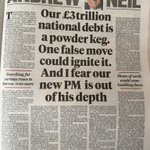
“£61 billion is a massive amount of money.
It's equivalent to the UK's entire annual defence budget – the money we're paying, increasingly to foreign creditors, simply to service our national debt for SIX MONTHS” 😳

Official figures out this morning report that last month, the UK government borrowed £24.5 billion.
But the fineprint shows that almost £11 billion of that extra borrowing went on debt interest payments.
That's more than £400 per household on debt service costs, in September alone.
So far during this financial year, from April to September, the government's debt interest payments amount to £61 billion.
Now, this number will barely feature in UK newspapers and across our airwaves. It may be mentioned in passing in out-of-the-way business sections, or on the odd business bulletin.
But this huge debt interest bill won't register with the vast majority of our political and media class, or impact the national debate.
Let me explain why that's so wrong and so dangerous ...
£61 billion is a massive amount of money.
It's equivalent to the UK's entire annual defence budget – the money we're paying, increasingly to foreign creditors, simply to service our national debt for six months, not to pay any of it back.
£61 billion is equivalent to the money you'd raise over a year from adding a whopping 7 pence to the basic rate of income tax.
For £61 billion, you could build around 40 large, state-of-the-art hospitals, or employ more than 100 thousand extra nurses for ten years.
£61 billion would pay for free-at-the-point of use social care for everyone who needs it in the UK, for an entire year – three times over.
Again, this is the debt interest bill on Britain's spiralling national debt – now more than 3 trillion pounds – over the last six months alone.
The UK's public finances are close to meltdown – yet so many MPs and journalists continue blithely to view ever more public spending and borrowing as the answer to every problem.
Those who highlight the dangers post by our hugely precarious national accounts are dismissed as cranks, ideologues or worse.
But basic arithmetic has no ideology.
And there is nothing "progressive" or "kind" or "right-on" about driving the UK ever closer to the fiscal cliff edge, provoking a crisis that will make the "austerity" years of the 2010s feel like a picnic, a crisis in which poorer households will suffer the most.
Yes, Britain's national debt is lower than that of France. But because our borrowing has been rising so sharply, and because we're so prone to inflation, our debt service costs are much higher.
The UK is spending a disgraceful 3.6pc of GDP on public debt interest, while France spends less than 2.5pc.
Endless airtime and column inches are devoted to spurious conversations about a billion or two of additional "fiscal headroom" we may or may not have in three years' time.
And, of course, any "extra headroom" is immediately pledged in new spending – which means yet more borrowing.
These conversations are a waste of time – and, in fact, are deeply counterproductive. Three-year fiscal forecasts, even one- and two-year forecasts, routinely turn out to be askew by tens of billions of pounds.
I'm not saying we don't need fiscal rules - we do, but we need more immediate rules, which actually bite, acting as a meaningful constraint on out-of-control borrowing and spending.
Instead, political and media sages present the nation with spuriously precise discussions about fictional fiscal outcomes way into the future – using rules which are deliberately designed to kick arithmetic realities into the long grass ....
An increasingly expensive, over-bearing, out of control state is not the answer to Britain problems.
But unless we change course, it will certainly be our downfall.
Please like/share if you think what I'm saying is important – and if fiscal realities should feature more prominently in our national debate.
And for more sharp, plain-speaking economic analysis subscribe to:
"When The Facts Change - economic and politics in a fast-moving world, with Liam Halligan"

“Shirky Principle: Institutions will try to preserve the problem to which they are the solution.”

I recently spent some time with former colleagues from academia. All of them brilliant, peak human capital. Almost all of them fundamentally unable to plug into the economy, inoculated against productivity by a youth spent experimenting in laboratories instead of building wealth for society. Dealing with real people in the real world.
90% of them have left academia in the last 10-15 years, and 90% of those are functionally unemployed. Grad school does a lousy job of training scientists to be professors (since most of them don't get the good postdoc or tenure track position) and an even worse job of preparing people for real life.
We complain that our societal infrastructure is collapsing, our state capacity is low, our incumbent industries are faltering. Where are the next generation of leaders that can push us forward?
A huge fraction of them were conveyor-belted into academia by schooling systems that have no mechanism to channel ambition and 99+%ile competence, and our universities are mostly hedge funds with glorified psych wards/academic departments on the side, running an insane pyramid scheme that exists only to prove, over and over again, the Shirky Principle: Institutions will try to preserve the problem to which they are the solution.
We literally poured trillions of dollars into state-funded research and effectively neutered our elite civilian technical leadership development programs.
I recently asked a few academic friends if they were finding AI useful in accelerating their programs of research. You know, to solve the Big Problem their entire field exists to solve?
Some were. But most were complaining about how it created pedagogical issues, explaining how their department decided to ban the use of AI, or how it took 18 months to approve an enterprise account, or how they tried Gemini 2 on a puzzle a year ago and it wasn't very helpful, or repeating nonsense about datacenters and water consumption, or supposed IP theft by model companies, as though that has any bearing on their ability to, eg, accelerate a cure for cancer.
Elon sometimes calls AI a supersonic tsunami - a huge wave you don't see coming. I see it coming. But even the people who you'd think have been waiting for this their entire careers are steadfastly looking in the other direction.