

Product Lead @ LandTech 🚀 - Building data-driven products (Agentic AI & B2B SAAS) to help solve the housing crisis
United Kingdom
Joined September 2009
- Tweets10.9K
- Following793
- Followers1.1K
- Likes4.8K







Pinned Tweet
You can also find me on @bluesky. bsky.app/profile/calumshephe…. Would love to connect with people over there also!
Each day I log in and become more amazed at what is possible - so cool.

Spent a bunch of tokens over the last few weeks building a fully procedural New York simulation.
mrdoob.github.io/slop-newyor…
It's only 784KB gzipped and the code is on github, so you can do whatever you want with it ✌️
Calum Shepherd (calumshepherd.bsky.social) retweeted

Introducing tiny.london
A massive isometric pixel map of London, based on amazing NYC demo by @_coenen from 9 months ago
My agent created the dataset, finetuned qwen image LoRA adapter, did a multiday inference run and built an efficient tile viewer!


I wanted to share something I built over the last few weeks: isometric.nyc is a massive isometric pixel art map of NYC, built with nano banana and coding agents.
I didn't write a single line of code.

How many lots will this site deliver? It’s the first question every land buyer asks, and until now the answer meant a spreadsheet or phone call. Last week we launched a new Lot Yield insight: an instant estimate of how many lots a US parcel can deliver!
loom.com/share/fb2d4797e4b84…


Calum Shepherd (calumshepherd.bsky.social) retweeted

Frantically fixing a confusing product caused by frantic shipping is just more of the same.
Pause and step back. Get the team clear on what you’re building and why. Have clarity to guide the shape, what ships and what doesn’t.
Quality is a way of working, not a cleanup sprint.
Calum Shepherd (calumshepherd.bsky.social) retweeted

One of the most compelling parts about working at an ElonCo was the agility to pivot to whatever the most important problem was.
One day I said: I wasn’t hired to go after spam, but a tsunami is coming and I’m going to drop everything to focus on that.
The org is so flat and agile that your title is basically meaningless. Anyone can sound the alarm about a problem and solve it themselves—or rally the team to join them.
This is how startups work but it’s very hard to make it work in a larger company.


Calum Shepherd (calumshepherd.bsky.social) retweeted

in case you want to build a domain specific harness:
langchain.com/blog/how-to-bu…
great blog by @sydneyrunkle


Nan has become a bit of a product influencer for me - take that how you will. Really appreciate what he's been building, his outlook etc. Looking forward to seeing what comes next for him now!

Calum Shepherd (calumshepherd.bsky.social) retweeted

Harvey is a great example of how American companies are building world-class specialized models: they took an open-source base (Kimi K3), post-trained it on legal data, and delivered state-of-the-art performance on legal benchmarks at a fraction of the cost of frontier models. Restrictions that kneecap open models would do nothing to stop Chinese labs from shipping the next Kimi. They would, however, cripple the ability of startups like Harvey to create high-performance, low-cost vertical models. Of course some of the closed labs would love this — it eliminates their competition.

Introducing Tenet, our first model post-trained for legal.
Tenet is a Kimi K3 base that we post-trained with @FireworksAI_HQ on a corpus of publicly available legal data, synthetic data, and human expert data simulating long-horizon legal work.
Training increases Tenet's all-pass rate by 82% on LAB and 22% on LAB Contracts relative to the Kimi K3 base model. It achieves state-of-the-art performance on LAB Contracts and places second on LAB.
These gains generalize to other leading agentic benchmarks including @mercor's Apex Agents - Corporate Law, @crosbylegal's Redline Bench, and @scale_AI's Professional Reasoning Bench.
Tenet is also optimized for token efficiency, operating at less than a fourth the cost of leading foundation models.
We additionally post-trained three specialist models for Tenet to use as subagents:
1) M&A Diligence: post-trained with @baseten on our LAB Diligence environment in an RLM harness, this model is optimized for high-scale, long-horizon tasks.
2) Review Tables: trained with @appliedcompute on our Review Table environment, this model is state-of-the-art and cost-effective at high-volume document review and structured data extraction.
3) Firm Knowledge: trained with @EngramLab on our synthetic law firm environment, this model is optimized to learn and search over a firm's knowledge via memory and structured notes.
More details on model training, environment design, benchmarking, results, and more in the article by @gabepereyra below.
What's next for Harvey’s research?
- Scaling LAB to more jurisdictions, practice areas and workflows
- Scaling compute to bring new generalist models and capabilities to Harvey
More to come soon.
Calum Shepherd (calumshepherd.bsky.social) retweeted

Great post on what post training looks like for applied AI use-cases to bring down costs and improve accuracy on certain tasks. This will increasingly be an approach that companies that can get closer to the underlying workflow in an enterprise will take.
The key is that once you understand a domain well enough and have enough volume on a set of similar tasks, it can start to make sense to purpose design models just for that work.
“In post-training, we incentivized efficient tool use and reasoning through reward shaping, preferring trajectories that would reduce tokens consumed at inference-time given equivalent performance. This allowed us to co-optimize for both cost and quality, gaining significant performance while keeping cost stable.”
Now, this won’t make sense in every domain, as general purpose frontier closed or open models will be good enough out of the box -or necessary- for the work at hand. But once you have deep enough vertical expertise, and either the costs are too high to do at scale *or* you have a unique enough task type not being trained on otherwise, this will make a ton of sense.
Very compelling value proposition for being an applied AI company, and awesome to see multiple paths to winning in the market right now.


Calum Shepherd (calumshepherd.bsky.social) retweeted

Wow, seems like Google is buying Spirit Airlines' enterprise data for $10m (outbidding Mercor at $7.5m).
Basically includes every internal document, email, workflow, and codebase for a once $6B company.
Honestly, $10m for 34 years of operational data really seems like a steal.

Calum Shepherd (calumshepherd.bsky.social) retweeted

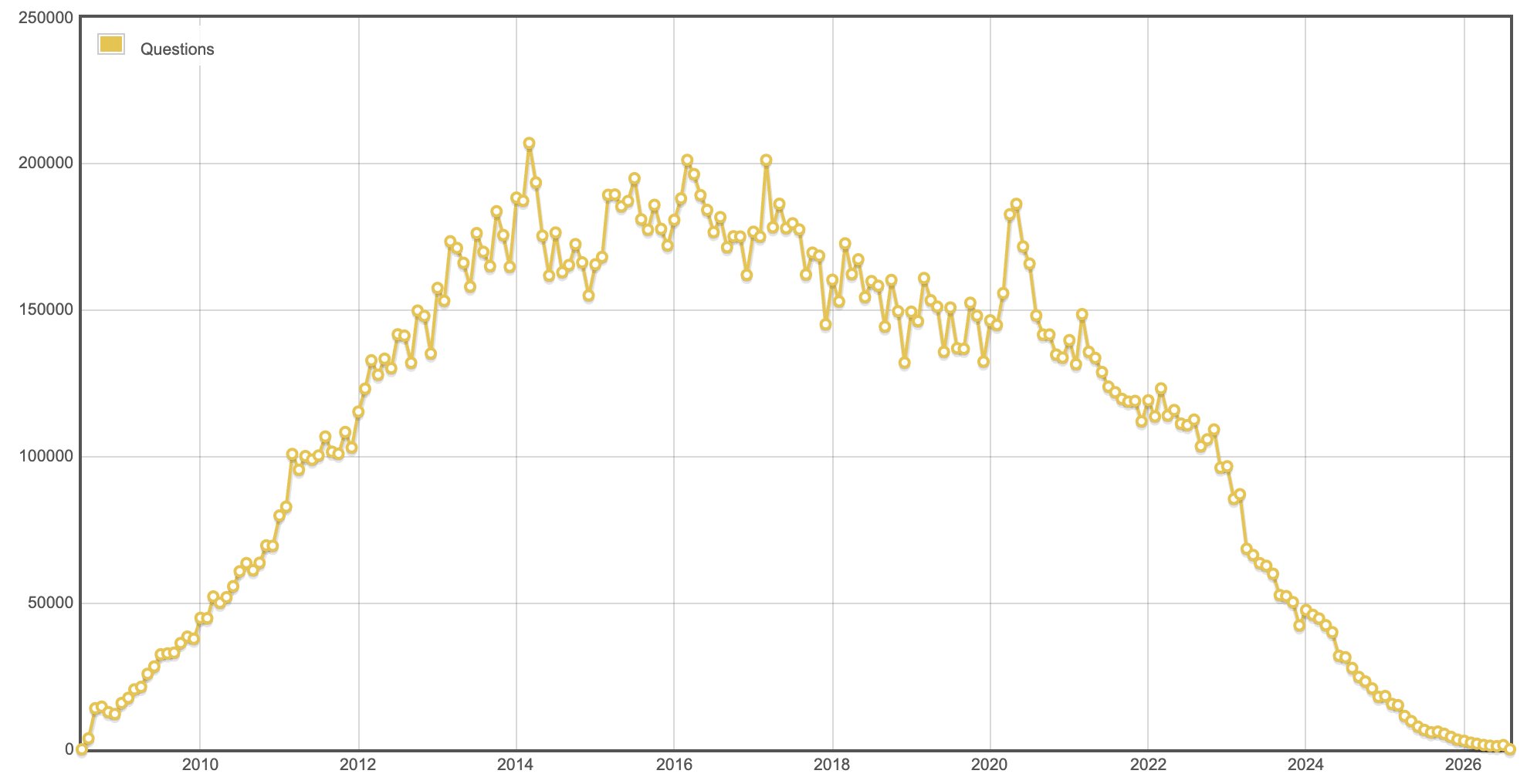
Stack Overflow has gone from a peak of 207k questions in march 2014, down to 1.4k in july 2026
end of an era



Calum Shepherd (calumshepherd.bsky.social) retweeted

There are a few things that I look back on as my mistakes in the early days.
Quake was overly ambitious technically. We could have done all the great multiplayer and modding work inside a Doom++ engine, allowing the designers to work with a more stable base instead of rug-pulling everything out from underneath them a couple times. The follow up game could have then brought in full 6DOF environments and characters.
I pushed everyone too hard. I didn’t appreciate how maturing companies need more slack, and that running people at startup intensity constantly will wear them out. Quake was also where I really had to accept my personal limits. I was working pretty much as hard as humanly possible, and I was still slipping past my goal points.
On all of the founders’ shoulders, our original corporate stock arrangement and buy/sell agreement was a mistake, and resulted in bad incentives. We wanted to ensure that all ownership rested in the hands of people working hard on current projects, but the Silicon Valley standard approach of vesting stock would have worked out better.
One real problem that I don’t accept the blame for is that we were insisting that level designers be not just game designers, but also have strong visual design esthetics. They needed to make things that not only played well, but looked awesome, and it got more challenging as the technology provided a richer palette. Romero covered that well, which set our company expectations early on.
We should have figured out how to pair up artists and designers earlier, but there was infighting among the designers, and the ones that could manage the visuals were happy to disparage the ones that couldn’t.
Sorry, Sandy.

How Quake ruined id Software.
There has been a lot of praise of Quake of late, with its 30th anniversary, and it's deserved. Quake is an amazing feat of art, programming, and design. I worked on it, and everything came together almost perfectly from all of us. We ended up with a free-wheeling, frenetic action game with enough of a visible world to grip the imagination.
All the team did a brilliant job, fulfilling tasks just right. But at a grim cost. We worked long and hard, and I think it broke us spiritually.
1/3
These guys really do have a wonderful business model, and the numbers show it.

Bending Spoons has just filed for a US IPO.
In the first 3 months of this year it recorded $600m of revenue and $27.5m of profit.
The Italian company is known for buying smaller, struggling tech companies and turning them into cash generating businesses.
It's acquired AOL, Vimeo, Hopin, WeTransfer and Evernote as well as others.
Last year it announced raising $270m at an $11bn valuation, a day after announcing $2.8bn in debt financing.
Today it filed to IPO in the US under the symbol BSP!
This is HUGE as it's one of the first European companies taking advantage of the open IPO window.
Who is next?

This feels so relatable when you are truly doing something new in product.

you cannot project manage your way to product-market fit
there is no gantt chart that can get you there
you can start with some structured process for discovery, you can do a lot of good stuff operationally, but at the end of the day you need to be in the mud with the pigs for a while, until it either becomes a real farm, or maybe you decide that farming is not for you
Calum Shepherd (calumshepherd.bsky.social) retweeted

Everyone is obsessed with AI making a 10x engineer a 1000x engineer.
The recent reductions at CloudFlare and Click have me me realize the plot is equally about the inverse: AI amplifies the *negative* impacts of poor performers.
If a person with poor taste, who makes mediocore judgement calls, and doesn't properly build things customers love is able to produce 10x more work - does a company want that?
Hell no! Productivity isn't just about as many people as possible tokenmaxxing. AI is a double edged sword, especially when it's used to produce net new work.
If you give a bad artist a pen that can draw 100x as fast, you're going to pile up with a lot of junky artwork very quickly.
And since it happens so quickly leaders are now able to see quickly who is Picasso and who is not and adjust accordingly.

Today we reduced headcount by 22%. The business is the strongest it's ever been. So I think it's important to be direct about what I'm seeing and why.
First, I made this decision and I own it. I did it because the way to operate at the highest level of productivity is changing, and to win the future, ClickUp needs to change with it.
Second, this wasn't about cutting costs. Most savings from this change will flow directly back into the people who stay. We'll be introducing million-dollar salary bands. If you create outsized impact using AI, you'll be paid outside of traditional bands.
Most importantly, I have the deepest gratitude for those affected. We're doing this from a position of strength specifically so we can take care of people properly. Everyone affected receives a package aimed at honoring their contributions and easing the transition.
I only see two options: wait for this to play out gradually in the market or be honest about what I'm seeing and act proactively.
THE 100X ORGANIZATION
The primary change is that we're restructuring around what I call 100x org. The goal is 100x output. The roles required to build at the highest level are fundamentally different than they were a year ago.
Incremental improvements to existing systems won't get us there. We need new ones. That means creating enough disruption to rebuild rather than iterate on what's already broken.
The common narrative is that AI makes everyone more productive. It doesn't. Many of the workflows of today, if left unchanged, create bottlenecks in AI systems.
These roles will evolve. But waiting for that to happen naturally means falling behind now.
The 100x org is actually heavily dependent on people - infinitely more than today. This is only possible with 10x people that have embraced and adopted new ways of working.
THE BUILDERS, AGENT MANAGERS, AND FRONT-LINERS
— THE BUILDERS: 10X ENGINEERS
I don't think most companies have internalized what's actually happening with AI in engineering. The common narrative is that AI makes all engineers more productive. That may be true in isolation, but at an organization level - that is the farthest thing from reality.
Here's what we've validated recently at ClickUp: the great engineers, the ones who can orchestrate, architect, and review, are becoming 100x engineers. They're not writing code. They're directing agents that write code. The skill is judgment.
AI makes the best engineers wildly more productive, and everyone else using AI slows these engineers down.
Think about it - the bottlenecks are (1) orchestration - telling AI what to do, and (2) reviewing - what AI did. Everything is leapfrogged and no longer needed.
So who do you want orchestrating and reviewing code?
And how do you want your best engineers to spend their time?
If your best engineers are spending time reviewing other people's code, then this is inherently an inefficient bottleneck. These engineers can review their agent's code much faster than reviewing human code.
The new world is about enabling your 10x engineers to become 100x.
The wrong strategy is to push every engineer to use infinite tokens. Companies doing this are celebrating 500% more pull requests. But customer outcomes don't match the volume of code being generated.
I call this the great reckoning of AI coding, and every company will face this soon if not already.
More code is just another bottleneck to the best engineers, and ultimately to your company's impact as well.
— THE BUILDERS: 10X PRODUCT MANAGERS
Product management and design roles are merging.
Designers that have customer focus, become more like product managers.
And product managers that have intuition for UX become more like designers.
The bottleneck of user research is gone. It takes us just one mention of an agent to kickoff research and analyze results.
The bottleneck of product <> design iteration is also gone. The product builder iterates on their own, along with agents and skills that ensure alignment with quality and strategy.
Also controversial today - I believe that the wrong strategy is to have your PMs shipping code - that just introduces another bottleneck that the best engineers will waste their time on.
To be clear, PMs should be coding but they should do this in a playground to iterate, validate, and scope. That code should not go to production.
Everything outside of managing systems, orchestrating AI, and reviewing output becomes a bottleneck.
That's why the other roles that are critical along with these are the systems managers (to reduce bottlenecks) along with a bottleneck you can't replace - customer meeting time.
— THE SYSTEM MANAGERS
Ironically, the people that automate their jobs with AI will always have a job. They become owners of the AI systems - agent managers. We have many examples of these people at ClickUp.
The underlying systems in which we operate are absolutely critical to get right. I think most companies are delusional to think they can iterate on existing systems and compete in this new world.
You must create enough disruption so that old systems are deprecated entirely. If there's any definition for 'AI native' that's what it is.
— THE FRONT-LINERS
In a world that will become saturated with AI communication, the human touch will matter more than anything to customers.
This is a bottleneck that you shouldn't replace - even when agents are high enough quality to do video meetings.
One-on-one meeting time with customers is something that shouldn't be automated. The systems around the meetings should be - so that front-liners spend nearly 100% of their time with customers.
REWARDING 100X IMPACT
In a world where companies are able to do so much more with less, where does that excess money go?
In our case, much of the savings in this new operating model will flow directly back to those that enabled it.
We must reward people that create productivity accordingly. This aligns incentives on both sides. Plus, in a world where your best people create 100x impact, you can't afford to lose them.
You should aim to retain these employees for decades. The context they have and their ability to efficiently orchestrate and review will be nearly impossible to replace.
Compensation bands of today should be thrown out the door. We're introducing $1 million cash/year salary bands with a path available to nearly everyone in the company if they produce 100x impact by creating or managing AI systems.
THE FUTURE
Nearly every company will make changes like these. The ones that do it proactively will define what comes next.
The future is not fewer people. It's different work, new roles, and better rewards for those who embrace it. We're already seeing entirely new roles emerge, like Agent Managers, that didn't exist a year ago.
ClickUp is positioning to lead this shift, not just internally, but for our customers too. I've never been more certain about where we're headed.
Calum Shepherd (calumshepherd.bsky.social) retweeted

👀 New "AI Is Eating The World" 79-slide deck from @benedictevans
ben-evans.com/presentations


