

Defending Canadian rights and freedoms since 1964. [email protected]
Toronto, Ontario
Joined July 2010
- Tweets11.8K
- Following1.6K
- Followers42.6K
- Likes1.5K







Today, CCLA's Director of our Privacy, Surveillance and Technology Program, Tamir Israel, will be speaking on a Panel on Bill C-34. This bill will impose a social media ban for youth under the age of 16 and other age verification mechanisms. It’s part of broader conferences on the Safe Social Media Act hosted by @nccm and OpenMedia at the National Arts Centre in Ottawa. We are looking forward to a lively conversation on how to get Canada’s online safety law right. More details here:
nccm.ca/event/onlineharmscon…

The Supreme Court of Canada has agreed to hear the federal government’s appeal in the Emergencies Act case. We are now gearing up to defend our historic victory for the rule of law.
This challenge was never an endorsement of the “Freedom Convoy” protests. Because of the protracted timeline and the extent of the disruption, we agreed that the police should have used ordinary laws to dismantle the blockades in February 2022.
This case is about a fundamental democratic principle: even in times of crisis, no government is above the law.
Last January, the Federal Court of Appeal agreed with the CCLA that the federal government had failed to meet the stringent legal thresholds required to invoke the Emergencies Act. When unlocked, the Act’s extraordinary powers enable Cabinet to enact wide-reaching orders without going through the ordinary democratic process.
At a time when democratic institutions and fundamental rights face growing pressure, challenging government abuse is more important than ever.
We are immensely grateful for the exceptional pro bono legal services of Ewa Krajewska, Brandon Anand Chung and Erik Arsenault of Henein Hutchison Robitaille LLP in this landmark case.
Read our press release here:
ccla.org/press-release/emerg…

CCLA has written to the Ministers of Industry and Health urging the federal government to reject the House of Commons Science and Research Committee’s recommendations to remove equity, diversity and inclusion (EDI) from the criteria used by CIHR, NSERC and SSHRC. EDI and research excellence are not competing goals. Measures that identify and address systemic barriers help make sure talent is fairly assessed, and they are fully compatible with academic freedom.


The Canadian Civil Liberties Association (CCLA) is sounding the alarm on the proposed government surveillance law – Bill C-22. If passed, Bill C-22 would put everyone's privacy and digital security at risk.
Read our full alert detailing our concerns, and sign our petition below. The more of us who speak up, the harder we are to ignore.
Our alert:
ccla.org/take-action/civil-l…
Our petition:
action.ccla.org/page/199880/…

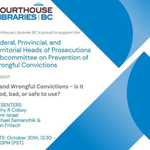
Join us Tuesday, Oct 20, 3:30 PM ET with the Federal, Provincial, and Territorial Heads of Prosecutions Subcommittee on the Prevention of Wrongful Convictions in presenting: AI and Wrongful Convictions – is it good, bad, or safe to use?
Register now!
courthouselibrary.ca/trainin…

Meet the speakers for Show Up, Ontario: A Rally for Our Democracy.
On November 5th civic leaders and advocates from across the province are joining us at Queen’s Park to speak about the threats facing democracy in Ontario.
Brent Jolly, President of the Canadian Association of Journalists, on threats to government transparency
Julia Croome, Director of Litigation Practice at Ecojustice, on threats to the rule of law
Bill Sinclair, CEO of The Neighbourhood Group Community Services, on threats to human dignity
Martha Hradowy, President of the Ontario Secondary School Teachers’ Federation, on government overreach
The rally is organized by the Canadian Civil Liberties Association, with remarks from Harini Sivalingam, Director of Equality, and Shakir Rahim, Director of Criminal Justice.
Protecting our democracy requires showing up when it matters.
Join us Thursday, November 5, from 12 to 1 PM at Queen’s Park. This event is free and open to everyone. Registration is optional and can be found here:
lnkd.in/ghMHdbd5


On November 5, we're gathering at Queen's Park to challenge democratic erosion in Ontario.
Over the past two years, the Ontario government has waged an unprecedented battle against accountability, transparency, the rule of law and human dignity. Freedom of information access has been severely restricted. Cabinet has been empowered to exempt companies it selects from laws it chooses. Homelessness has been met with enforcement instead of housing. And government-appointed supervisors have replaced elected school boards.
Four different issues, all pointing in the same direction. Together they describe a democracy being eroded in stages, law by law.
Join us, alongside speakers from the Canadian Association of Journalists, Ontario Secondary School Teachers' Federation, Ecojustice and The Neighborhood Group Community Services, to say these safeguards matter. Democracy requires vigilance, and vigilance means showing up.
Join us Thursday, November 5th, from 12 to 1 PM, at Queen's Park. This event is free and open to everyone. Our optional registration link can be found here:
action.ccla.org/page/201632/…

The CCLA will appear before the Supreme Court of Canada today as an intervener in Diggs v. AG (Nova Scotia).
This appeal is about whether a court can consider a habeas corpus application from a prisoner who experiences solitary confinement because of operational or policy decisions that also affect other prisoners. Habeas is a legal mechanism for a person deprived of their liberty by the state to challenge whether that deprivation is legal. An example of a situation this case concerns is where a prisoner endures solitary confinement because there are not enough staff to properly run a prison. A prisoner can already use habeas to challenge a decision specific to them that puts them in more restrictive confinement.
The CCLA will make three main arguments:
1. Removing habeas corpus for operational or policy decisions is inconsistent with the right of access to habeas corpus guaranteed in s. 10(c) of the Charter.
2. The availability of habeas corpus to review deprivations of liberty resulting from operational or policy decisions of general application is compatible with the purpose of habeas corpus review and applicable law.
3. A declaration by the court about the illegality of detention is appropriate where release from the challenged conditions is not possible or they have already ended. This can still be a meaningful remedy for the Charter violation.
You can read the CCLA’s factum here:
scc-csc.ca/pdf/case-document…
The CCLA is grateful to Jessica Orkin and Amanda Bruce of Goldblatt Partners LLP for their excellent pro bono representation in this case.

The Canadian Civil Liberties Association (CCLA) welcomes the Ontario Court of Appeal’s decision allowing the appeal of unhoused residents of a Hamilton encampment who are challenging the City of Hamilton’s enforcement of bylaws that led to their eviction. The CCLA intervened to support the rights of unhoused encampment residents.
The Court of Appeal identified several errors in the trial judge’s decision to dismiss the residents’ Charter challenge. These included insufficient reasons for the decision, the dismissal of key documentary evidence, cursory factual findings, an inadequate analysis of the residents’ section 7 and section 15 Charter rights, and an improper assessment of the availability of damages against municipalities for Charter breaches.
This decision underscores the importance of a thorough and rigorous assessment of Charter claims involving the rights of unhoused people, including the consequences of government actions that deprive people of access to shelter.
You can read our full press release here:
ccla.org/press-release/ccla-…

The Canadian Civil Liberties Association is concerned by the federal government's announcement to introduce legislation to indefinitely exclude people whose sole underlying medical condition is a mental illness from accessing Medical Assistance in Dying (MAiD).
CCLA welcomes provisions that would permit advanced requests. However, the blanket exclusion of people whose sole underlying condition is psychiatric is discriminatory and raises serious equality concerns.
"Rights protections and safeguards must work together through individualized assessments," said Howard Sapers, Executive Director of the Canadian Civil Liberties Association.
“Denying MAiD eligibility to people whose sole medical condition is psychiatric is discriminatory,” said Harini Sivalingam, Director of the Equality Program at the Canadian Civil Liberties Association.
CCLA urges the federal government to reconsider a blanket and indefinite exclusion of a class of legally competent adults from accessing end of life care.
Read the full press release below:
ccla.org/press-release/ccla-…

On October 19, Albertans will head to the polls to vote on 10 referendum questions.
Much of the attention has focused on Question 10: whether Alberta should remain a province of Canada or whether the Alberta government should begin the legal process required to hold a future binding referendum on separation. But the other nine questions also raise important questions about equality, democratic participation, judicial independence, and the distribution of constitutional powers.
Questions 1 through 4 propose limiting eligibility for provincially funded programs based on immigration status and charging fees for healthcare and education. Question 5 would add a citizenship-document requirement to vote, on top of the more than 50 forms of identification Elections Alberta already accepts. Questions 6 through 9 would change how superior court judges are appointed, abolish the Senate, and give provincial laws priority over federal laws in certain areas. Additionally, an essential consideration of Question 10 and any discussion of Alberta's constitutional future must also include the constitutionally protected rights of First Nations, Métis and Inuit peoples and the Treaties that govern relationships between Indigenous peoples and the Crown.
Referendums are an important part of democratic life, but democracy is not simply about counting votes. It is also about ensuring that people understand the choices before them.
Read each question carefully before you vote. You can read our full breakdown here:
ccla.org/fundamental-freedom…

Each year, the CCLET presents a nationwide high school essay/video contest on rights and freedoms in Canada to commemorate Bernard Chernos, a dedicated civil libertarian, lawyer and lover of lively debate. The Bernard Chernos Contest makes a great ready-made assignment for a wide range of high school courses. This year's topic asks students to explore how the rule of law has been challenged, protected, limited, or debated in Canada in the past two years. We welcome essay or video entries at any time of the school year until the deadline, including during the first semester. We also encourage entries in French. Visit cclet.org/contests for more information!

The CCLA will appear as an intervenor before the Supreme Court of Canada today in R. v. Chemlal. This appeal concerns the legal threshold police must satisfy to conduct a safety search when someone is not under arrest or detained. A safety search is a limited pat-down search of a person intended to address a risk to officer or public safety.
A central issue is whether an officer must have reasonable grounds to suspect, or reasonable grounds to believe, that a safety risk justifies the search. Reasonable grounds to believe is a higher standard.
The CCLA will make three submissions:
1. People who are not under arrest have a strong expectation of privacy in their bodies and personal belongings. Safety searches in these circumstances must remain exceptional.
2. The standard for a safety search is reasonable grounds to believe that the person poses an imminent risk to the safety of police or the public.
3. An imminent risk exists where there are reasonable grounds to believe that the person has a weapon and presents a realistic risk of harming, or attempting to harm, another person.
The CCLA’s factum can be read here: scc-csc.ca/pdf/case-document…
The CCLA is grateful to Carter Martell of Martell Defence for their excellent pro bono representation in this case, and to Catherine Ouellet of Gowling WLG for their pro bono agent services.

On September 11, 2026, the Supreme Court released its decision in R. v. R.B.-C., 2026 SCC 30. The CCLA was an intervenor in the case, which concerned how the right to be tried within a reasonable time under s. 11(b) of the Charter applies to sentencing proceedings.
The case addressed two central questions. First, if a person is convicted of an offence, how long may sentencing proceedings reasonably take? Second, what remedy should be granted if those proceedings are unreasonably delayed? The CCLA argued that the sentencing process should not continue in this situation. This is called a stay of the sentencing proceedings. A finding of guilt for the offence would remain.
The Court’s ruling was twofold. The Court found that there is no presumptive ceiling on the amount of time that sentencing proceedings can take. The test is a case-specific evaluation of whether the time taken to impose the sentence was markedly longer than it reasonably should have been in all the circumstances. The Court also held that there is no minimum remedy for a delay in sentencing proceedings. Rather, a court must craft the remedy it considers appropriate and just in the circumstances. That will ordinarily be a sentence reduction, although a stay may be ordered in exceptional circumstances.
The Court also made an important observation about why a stay of proceedings is the minimum remedy for a violation of s. 11(b) before sentencing, during the trial stage, holding at paragraph 63:
“In R. v. Rahey, [1987] 1 S.C.R. 588, this Court held that a stay of proceedings is the appropriate remedy for unreasonable delay occurring before conviction, because any lesser remedy would permit the trial to continue and thereby compound the breach of s. 11(b). That conclusion, however, was directed to pre-conviction delay, where the accused remains presumptively innocent and the proceedings leading to a determination of guilt are themselves tainted by unconstitutional delay.”
Find the link to the Court decision and CCLA's Factum here: ccla.org/criminal-justice/su…
The CCLA is grateful to Chris Rudnicki and Theresa Donkor of Rudnicki & Company for their excellent pro bono representation in this case. We also thank Catherine Ouellet of Gowling WLG for their pro bono agent services

Today, on the National Day of Action for Missing and Murdered Indigenous Women, Girls and 2SLGBTQQIA+ people, we honour the lives, memories and spirits of those who have been taken from their families and communities.
We stand with the families, Survivors and communities who continue to seek justice, accountability, healing and safety.
The National Inquiry into Missing and Murdered Indigenous Women and Girls made clear that the violence faced by Indigenous women, girls, Two-Spirit and gender-diverse people is rooted in the intersecting systems of colonialism, racism, sexism, gender-based discrimination and systemic inequality.
At the CCLA, we remain committed to defending the rights and freedoms of Indigenous peoples and advocating for laws and policies that advance equality, dignity, accountability and justice.
Remembering is not enough. Justice requires action.
