

Make informed decisions on EVs with Australia’s most comprehensive real-time EV charging, uptake & market data.
Melbourne
Joined February 2019
- Tweets155
- Following112
- Followers99
- Likes281






carloop retweeted

Have you ever wondered how far the public EV charging network in Melbourne has improved in the last 7 years? At @carloop_au we don't just wonder, we know!
carloop retweeted
From humble beginnings, Australia's EV charging network has exploded over the last few years.
At @carloop_au we have all the data you need to understand every aspect of EVs in Australia, from charging data through sales data to EV model forecasts.
An excellent question Richard. What can we do to accelerate the electrification of our highways and accelerate the decarbonisation of our essential transport systems?

This is the map of my recent EV lap of Australia, although it is missing 3000km of side trips.
By the end of 2024, this route should be covered by DC fast charging everywhere except for the red lines. Note that there needs to be DC chargers at both ends of a section to avoid the red brush.
At the moment, the only mob that I know of building DC charging on highways in the NT is the NRMA, although Evie has some very welcome chargers in Darwin.
Queensland is building a lot of chargers to augment and enhance their already extensive skeleton, but has no plans that I know of to add DC charging to their red section.
The section of the Ayre highway in SA from Penong to Border Village is on the NRMA map for future development with ARENA funds.
Considering their strategy in the USA, Tesla have been strangely slow to push out Superchargers on this prestigious route. They also have no off-grid chargers in Australia at all, despite building all the components in-house.
While most will never use these, the electrification of key routes in Australia provides a psychological boost that will speed the transition to passenger BEVs and is a key first step to the electrification of long-distance trucks as well. Megawatt-class charging is just a matter of scaling up what we do for light vehicles after all.
There are many obstacles in the way, including large remote areas away from large-scale energy grids, low population and traffic levels, kafkaesque planning processes and a shortage of experienced engineers. There is also a distinct lack of urgency around this from all levels of government.
There are a great many ways that we could achieve this goal, including broad distribution of remote power systems and pushing the electricity grid across the major highway routes.
Integrated with existing demands, remote power systems consisting of solar, wind and batteries, possibly with diesel generator backup, can vastly reduce the huge consumption of diesel in remote roadhouses and communities across the country.
Extending the grid would allow us to build interchanges between the eastern and western states, allowing eastern solar to support western morning peak, and western solar to do the same for the eastern evening peaks. Our wide brown land is almost 3 hours wide after all!
What can we all do to make this happen?

While regional DC charging infrastructure has a long way to go, it is already good enough to have enabled a solo traveller to drive right around Australia in 10 days.

#AUSYtour #AUSYHotLap
@Tesla @TeslaAUNZ #ModelY
Day 10
Arrived #Perth #WesternAustralia after traveling 270km from #Merredin. Efficiency 149Wh/km. Charging at home on a Type 2 AC charger.
Day 10 total 1,649km
Tour total 13,554km
Tour complete.


Congratulations @RAAofSA on getting this charger up and running. Travellers will be eternally grateful. Any comment on how you are managing to get slightly faster charge rates than equivalent WA EV network Kempower units?


Finally some movement on the RAA network!
Not a single completed DC charger on the main road from the SA border to Adelaide. What is going on here @RAAofSA? Wasn't the contract to build these chargers awarded in February of 2022, 20 months ago?


Fascinating discussion of going beyond just transitioning to EVs to improve transport outcomes, not just dumping ICEs at @AEVA_National Conference.

Even a couple.of years ago, new cars showing up in the VFacts data might happen once or twice a year. This month we have at least 4 new models, including one rocketing into the chart!
thedriven.io/2023/11/03/mode…

So much of Australia is off-grid like this site. @HorizonPower_WA and @NRMA leading the way in solving the thorny question of how to normalise remote EV travel in Australia.
Dropped in at the Overlander Roadhouse near Shark Bay on the way past to check progress on their off-grid solar DC fast charger setup.
The DC charger is installed and appears to be a Tritium RTM 75. The AC backup is also present and the usual JetCharge BYO type 2. Payment terminal is also visible.
What looks like the battery container is also visible and branded CDI energy.
There is an extensive solar array present which has a very interesting, possibly east-west layout.


Electrifying heavy vehicles typically has a far greater carbon reduction and cost saving per km than light vehicles. Great to see Victoria, traditionally very poor for EV incentives making changes required to allow heavy electric trucks.
thedriven.io/2023/10/29/vict…
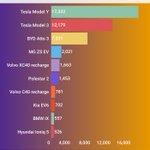
The transition is accelerating. A year ago, these numbers were significantly lower. Most states and territories have programs to build out chargers.

Where do you think we will be this time next year? Can BYD topple the reigning champion? Will the MG4 be high up in the charts?


An excellent solution for remote off-grid EV charging.

Erldunda. 2x 75kW DCRC with 25 kW PV & 180kWh storage. @AEVA_National @outbacktesla @NRMA @sydney_ev @EVCouncil @robrobdean


In September there were around 1068 DC charging sites in Australia of these, nearly 50% or 533 sites were within 100km of the coastline.
Given the population distribution of Australia this is actually a good thing for anyone who cares to go and explore!

This is a perfect example of why using Tesla Superchargers is so much simpler than other charging networks. Stall count is over 5 for Tesla, under 2 for everyone else. 1/2
linkedin.com/posts/carloop_t…

...and the detail of the other DC chargers.
More stalls often means more things that have to fail before the site becomes unusable, which is critical for travelers relying on fast charging.
linkedin.com/posts/carloop_t…


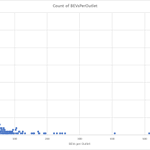
The hotspot has a PublicChargingMetric of 300-400, meaning finding some sort of charger is very easy.
By comparison we have Melbourne where the hotspots are in the range 30-40 using the same method. The second image uses the same scale as Oslo and our numbers barely register.

